

Recently I’ve been tinkering with my home soft router—the Epson ST190e I’ve mentioned before—swapping iKuai for OpenRouter, hoping to add some new applications to make the network a bit smarter. Then I stumbled upon a project on GitHub called RuView, with 66k stars. The README sounded too good to be true: in short, this project claims that ordinary WiFi can recognize human posture through walls, track breathing and heart rate, and even reconstruct what someone is doing in a room.
However, the project is still in its active development phase, with dozens of commits every day. Currently it only supports a few network cards, such as the ESP32-S3 development board (about 20 yuan on domestic e-commerce sites) or the Intel 5300 card (about 40 yuan). My soft router only has a basic RTL card, which at most detects “whether someone is moving in the room”. So I didn’t install it for now; I’ll wait until the 5300 arrives. But in the meantime, let me share my thoughts on today’s WiFi routers.
How Does a Router “See” the Human Body?
The principle isn’t complicated. WiFi signals bounce and refract between your living room, bedroom, and hallway. When you move, raise your hand, or even just breathe, your body perturbs these electromagnetic waves. By capturing subtle changes before and after the perturbation, the router can inversely calculate your position, posture, and even heart rate and breathing frequency.
What’s even more unsettling is that WiFi can accurately identify who you are.
Late last year, researchers at the Karlsruhe Institute of Technology (KIT) in Germany published a study introducing a new type of identity inference attack called BFId. This attack exploits data known as Beamforming Feedback Information (BFI), which helps routers focus signals directionally toward your phone or computer to improve transmission efficiency. Crucially, this technology was introduced as early as 2013 with the Wi‑Fi 5 (802.11ac) standard, and these BFI data are transmitted by default as unencrypted broadcasts, meaning any device within signal range can passively eavesdrop.
The German research team collected WiFi signal data from 197 participants under different walking styles and observation angles. The results showed that in normal walking scenarios, the identification accuracy based on BFI reached as high as 99.5%. Whether you are carrying a backpack, walking fast, or even when the signal is obstructed by walls, the BFI model maintains high recognition rates. Even worse, this requires no authorization from you, and you cannot avoid it the way you would dodge a camera. As long as you stand within WiFi signal range, your body shape, gait, and breathing pattern leave a unique “radio fingerprint” in the electromagnetic field.
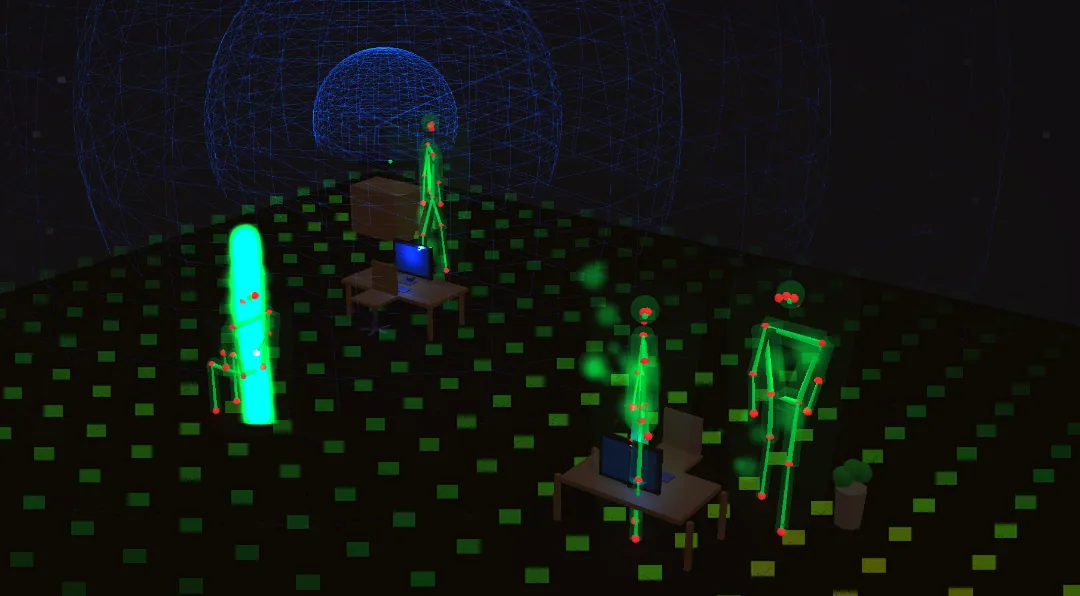
Projects like RuView are relatively benign, using cheap ESP32‑S3 chips that can only capture basic data like human posture, breathing, and heartbeat through walls. But big manufacturers are a different story. Their flagship routers, costing easily over a thousand yuan, equipped with 4×4 or even 8×8 antenna arrays and high‑performance processors, backed by commercial algorithms, can see details ten or a hundred times more precisely than open‑source projects. And these routers are increasingly entering millions of homes.
WiFi Routers Might Actually Save Lives
We must admit that today, this kind of WiFi sensing technology does have value. Take the six application scenarios listed on RuView’s project homepage—each one is full of “tech‑enabled humanistic care.” For example, elderly care: in bathrooms and bedrooms where cameras cannot be installed, WiFi sensing can monitor falls and abnormal breathing 24/7 without invading privacy, and can save lives in critical moments.
Another example is search and rescue after earthquakes or fires. Smoke and rubble render cameras and infrared sensors useless, but WiFi signals can penetrate concrete and detect faint breathing and heartbeats of survivors, helping rescuers pinpoint locations. In industrial safety, inside dusty mines or chemical plants where traditional sensors are easily disturbed, WiFi sensing can contactlessly monitor whether a worker has fallen or shows signs of life, triggering alarms instantly.
In smart buildings and retail energy saving, this technology also shines—without capturing faces, just by detecting whether a space is occupied, it can automatically adjust lighting, air conditioning, and ventilation, typically saving 15% to 30% in energy. Moreover, since personal identity information is never involved at the data source, by design it respects privacy more than cameras.

In these scenarios, WiFi’s “through‑wall” and “unobtrusive” nature is not an intrusion but a genuine lifesaver. That’s why IEEE officially approved the 802.11bf standard in 2025, writing sensing capabilities into WiFi’s official blueprint.
But the problem is that this technology remains far beyond ordinary people’s control.
The Unignorable Risks of WiFi Sensing
WiFi is invisible and intangible, and it has long remained outside the “control” of ordinary people. Not to mention many elderly and pregnant women resist “WiFi radiation”—in reality, most households, whenever there’s the slightest problem with their WiFi, directly call the ISP or a tech‑savvy friend or relative to fix it. Simple IP settings, band steering, SSID and password changes are like “gobbledygook” to them. WiFi sensing technology is even further out of their grasp; they are completely helpless.
First, walls are no longer a privacy barrier. In China’s dense residential environment, most families see dozens of WiFi signals when they open their phone’s WiFi list, not to mention hidden SSIDs. You have no idea whether someone around you is using WiFi to detect whether a neighbor is home, or to monitor a neighbor’s every move. It feels a bit like the Dark Forest in The Three‑Body Problem—every individual is completely transparent to such WiFi devices.
Second, it is even more insidious than cameras. With a camera, you can at least see the lens, choose to look down or detour. Even if hidden deeply, a camera has a physical shape you can search for via scanning or reflections. But WiFi antennas have no fixed shape—they can be a thin wire, a piece of copper foil, a ceramic patch, hidden inside routers, smart speakers, light bulbs, or even chargers. You have no way to judge with your naked eye which nearby device is “scanning” your body. Moreover, WiFi sensing is completely invisible; it could be hidden anywhere behind several walls. You have no chance to opt out; your gait and activity patterns are quietly recorded. Worst of all, you don’t even know whether someone is “spying” on you, and you cannot determine whether a device is “illegal” simply by its installation or usage.
Third, ordinary people simply lack the ability to “refuse”. Many people today don’t even know how to use a browser’s address bar—they are accustomed to apps and push notifications, completely unfamiliar with “active control”. They won’t even bother to log into their own router’s admin page, let alone identify who around them is spying or turn off some default‑on sensing feature. Technology is running faster and faster, and ordinary people cannot even catch its shadow. The end result: you’ve been watched nakedly, but you don’t know; even if you do know, you don’t know how to stop it.
What If the Technology Goes Down the Wrong Path?
I am not against technological progress. WiFi sensing can indeed save lives in healthcare and rescue, but the problem is that it is now turning from a “professional tool” into a “common feature,” and the whole process has seen almost no public discussion, nor has it left any defensive means for ordinary people.
Of course, development and security always go hand in hand. We cannot ban something just because of potential risks, nor can we sacrifice privacy for the sake of intelligence.
On the technical side, there are actually ready‑made levers. The transmission power and antenna configuration of ordinary WiFi devices are already subject to type approval by the national radio regulatory authority, which limits “radar‑grade” accuracy at the source. We can establish certification marks for compliant devices and add signal detection features to phones—when the phone detects abnormal WiFi signals nearby (e.g., unusually high power or accuracy reaching human‑recognition levels), it proactively alerts the user.
On the regulatory side, the law should clarify legal responsibility for malicious use of WiFi sensing for spying or tracking, and give ordinary users channels to detect and report violations. Not everyone needs to become a networking expert, but everyone should have appropriate tools and channels to regain the right to know.