Why Is There Almost No Discussion About 'Slowing Down Traffic' in China?
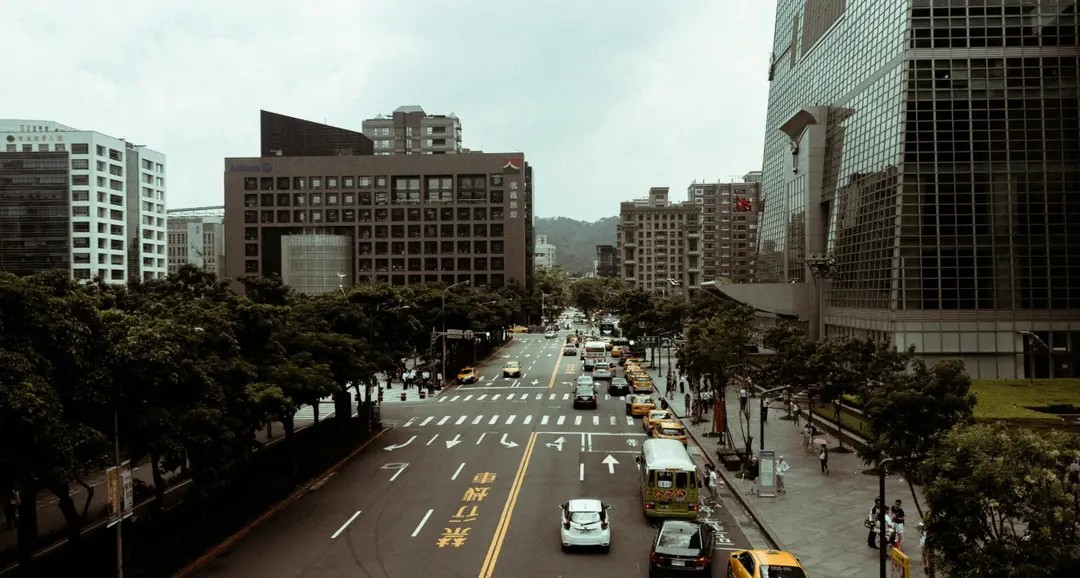
A few days ago, I wrote an article about my experience with high-speed tidal flow lanes. My intention was simply to document a personal commuting experience, not to make grand statements. Unexpectedly, the article sparked considerable discussion and some misunderstandings. Later, the Qingyuan traffic police officially responded, explaining the background and considerations behind implementing high-speed tidal flow lanes. At that moment, I felt a sense of warmth. After all, such a "trial" of high-speed tidal flow lanes is a first in China and represents an exploration in governance. Compared to institutional-level attempts, the smoothness of one individual's commuting experience is actually insignificant.

What is truly thought-provoking is the direction the comments took. A large number of comments focused on the issue of "slow-moving vehicles," almost forming a consensus: Low speed is the root cause of congestion and accidents; excessively low speed limits create risks; the key to easing congestion lies in increasing speed. Highways are called highways precisely because they shouldn't be slow.
This isn't just about highways; similar situations occur on national and provincial roads in China, especially on urban roads and expressways in urban-rural fringe areas, where the situation is even more complex. Large freight trucks often travel in clusters. These vehicles are heavy, carry substantial loads, and have long braking distances. If slow-moving vehicles appear ahead, it can easily lead to rear-end collisions and wave-like congestion. On these roads, slow-moving vehicles are perceived as "hazards"—not without reason but as an intuitive response to the actual driving environment. On highways, national roads, urban expressways, and urban-rural fringe areas, a tense relationship exists between low speeds and high-density transportation, leading people to instinctively react by calling for "speeding up."
However, this sentiment starkly contrasts with recent policy trends in some developed cities. For example, a few years ago, South Korea launched an "action to reduce traffic accident fatalities to zero," with one of the core measures being to lower vehicle speed limits. Last year, Helsinki, the capital of Finland, claimed to have achieved zero traffic deaths for a full year, also through systematic speed reductions and spatial redesign. Recently, Singapore proposed following Helsinki's example by comprehensively strengthening traffic governance, including measures such as lowering the legal blood alcohol limit and reducing speed limits.
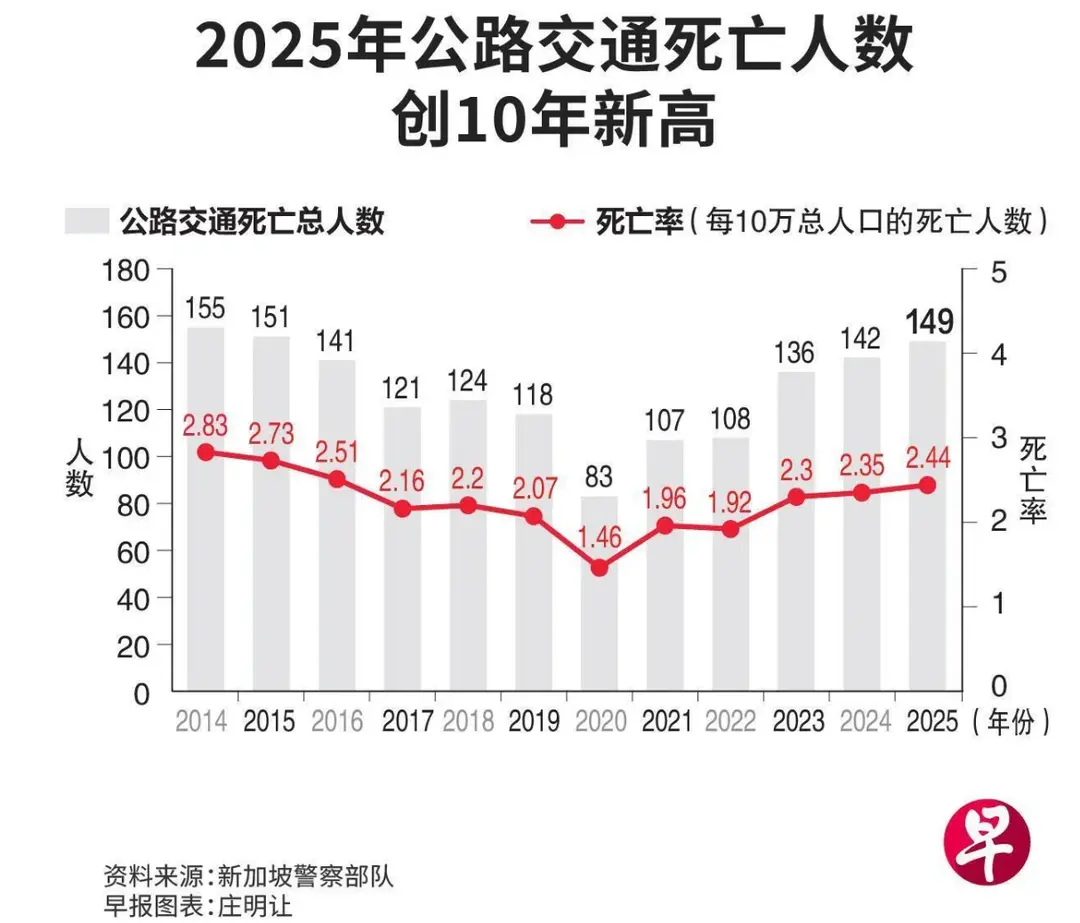
On one side, developed countries are actively slowing down; on the other, there are calls in China to go faster. The difference is not merely a matter of differing perspectives but a practical conflict rooted in developmental stages and governance capacity.
I. Why Are Slow Vehicles Perceived as Hazards in China?
Physically, higher speeds mean greater collision kinetic energy—this is common sense. However, in the actual operating environment of Chinese roads, people have derived a different set of experiences.
In high-density traffic flows, any localized slow driving can trigger chain-reaction braking. Wave-like congestion can further evolve into high-risk areas for rear-end collisions, leading to slow vehicles being labeled as "creating danger."
A deeper reason lies in China's high dependence on traffic flow efficiency. As is well known, China has one of the world's largest holiday population migrations, and its logistics system supports nearly half of the global industrial capacity. Transportation authorities have consistently emphasized improving transportation efficiency and reducing transportation costs per unit of GDP.
Within this structure, "slowing down" vehicles means extending time in the industrial chain and amplifying pressure on the entire social system. Therefore, low speed is not merely seen as an individual behavioral issue but as a potential systemic risk source. Those "slow-moving vehicles" on highways, national roads, provincial roads, and expressways in urban-rural fringe areas are naturally regarded as genuine hazards in transportation.
Yet, paradoxically, in the everyday language of ordinary Chinese people—whether from elders' reminders, friends' advice, or company management—the parting words when seeing someone off are almost always: "Drive slowly!" or "Take it easy on the road!" This opposition between logic and system, the intertwining of perception and experience, is indeed highly complex.
II. Why Are Western Cities Choosing to "Slow Down" Instead?
In the West, reducing speed is not an emotional choice but a governance strategy based on economic development and the carrying capacity of social structures.
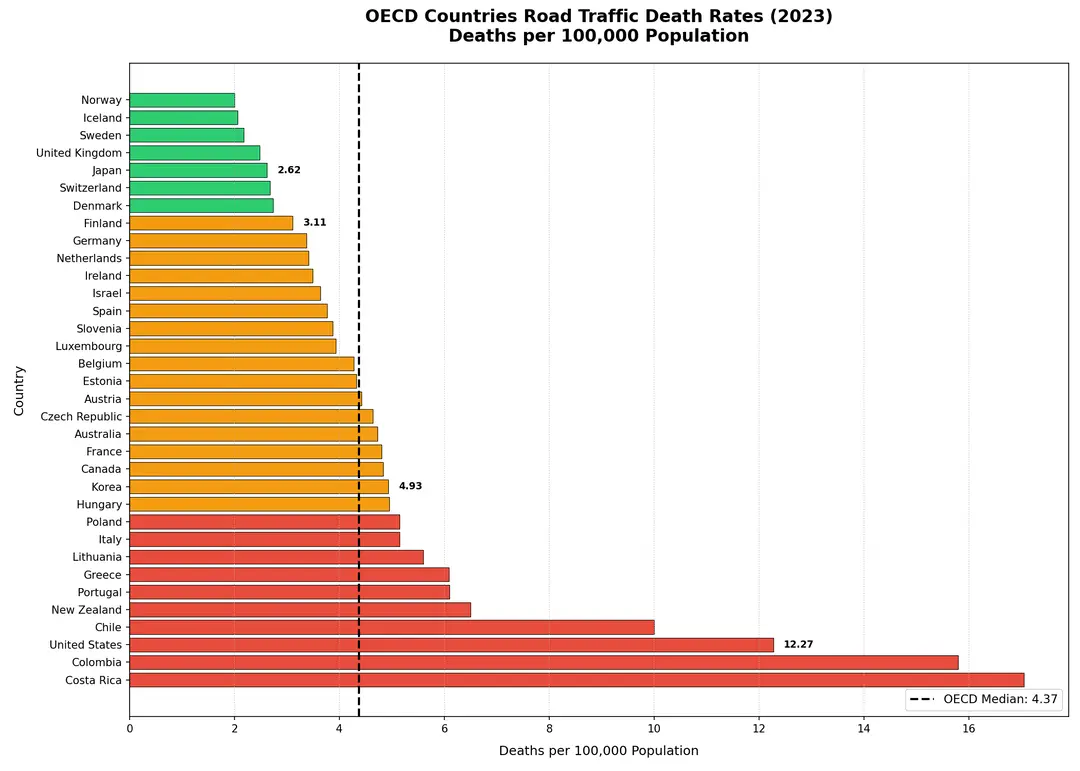
South Korea is the most typical case. I previously wrote an article briefly introducing South Korea's experience in traffic accident governance . Over a decade ago, South Korea still had the highest traffic fatality rate among OECD countries. However, over the past ten years, South Korea completed its economic transformation, entering the ranks of high-income countries. Society now has sufficient resources to invest in road governance, education, and infrastructure construction. This has made reducing urban speeds a feasible and systematic policy without causing economic efficiency to collapse. In April 2021, South Korea's revised Road Traffic Act implemented the "Safe Speed 5030 Policy," lowering speed limits on urban arterial roads to 50 km/h and on roads near residential areas and schools to 30 km/h.
Helsinki, the capital of Finland, widely praised in recent years, follows a similar path. Helsinki's Vision Zero strategy originates from a concept proposed by Sweden in the 1990s: "No one should die or be seriously injured in the traffic system due to foreseeable errors." The core logic of this concept is not simply to punish drivers or demand "zero mistakes" but to shift responsibility from "requiring perfect driving behavior from everyone" to urban planning, road engineering, and traffic management. It acknowledges that humans make mistakes (such as distraction, fatigue, or drunk driving) and thus must "forgive" these errors through multiple layers of protection (Safe System) to prevent fatal consequences. Under this philosophy, Helsinki has repeatedly lowered urban speed limits since the 1990s. After 2019, almost all urban and residential streets have speed limits of 30 km/h, with only a few arterial roads retaining limits of 40–50 km/h. Of course, besides speed limits, Finland also updated a series of supporting measures, including road design, vehicle technical standards, and citizen training, ultimately achieving the goal of "zero traffic deaths."
From this, we can see that the "slowness" pursued by developed countries through speed limits starkly contrasts with the reality on Chinese streets. In high-income countries like Western Europe, Northern Europe, Japan, and South Korea, slowing down means risks are systematically compressed; in China, slowing down may trigger new chain reactions of risk. Overall, economic foundations, population density, and logistics pressure determine the feasibility of slow-traffic policies.
The Outliers in the West
However, a closer look at OECD traffic accident data quickly reveals two puzzling countries: Germany and the United States.
Germany has long had one of the lowest traffic fatality rates in the OECD, at about 3.3 per 100,000 people. Yet, when people think of Germany, many immediately recall that it is a country with no speed limits on highways—cars can go as fast as they want on German autobahns, which has become an important symbol of German industrial culture. Besides highways, German urban roads, national roads, and rural roads have not adopted the "slow down for safety" approach seen in Northern Europe.
The United States presents another contrast. The U.S. has long ranked among the top in GDP per capita globally, with technological innovation and economic growth rates standing out among developed countries. It has a large population, strong consumption power, and medical resources far exceeding most nations. Yet, its traffic fatality rate is much higher than countries like Germany, Canada, and Australia—arguably the worst among developed countries.
One country is safe without speed limits; the other is highly developed yet dangerous.
If we simplistically equate "slowing down" with "safety," this difference cannot be explained.
Germany's low fatality rate is built upon a highly mature traffic system: strict driver's license exams, high-standard vehicle inspection systems, finely designed separation of freight and passenger traffic, well-maintained road surfaces and signage, and a stable culture of law-abiding behavior. Speed is enveloped within a highly standardized system.
The United States' problems, however, lie precisely at the structural level.
First, American cities are highly car-dependent. Many cities adopt low-density, sprawling development patterns with weak public transportation, long travel distances for residents, and driving as a rigid necessity. More driving naturally leads to higher exposure to risk.
Second, road structures vary greatly. While highway standards are high, many roads in urban-rural fringe areas, interstate highways, and rural roads have inconsistent design standards, complex intersections, and insufficient pedestrian protection facilities.
Third, large-displacement pickup trucks and SUVs dominate the American market. These vehicles are larger and heavier, posing higher fatality risks to pedestrians and smaller vehicles in collisions.
Fourth, complex social structures. Issues like wealth inequality, disparities in healthcare access, drunk driving, and substance abuse in the U.S. collectively impact traffic safety.
In other words, in the United States, whether speed limits exist may not matter much. What truly determines traffic safety levels is never speed limits themselves but the overall maturity of the traffic system. When a society's traffic system is sufficiently stable, speed is merely a variable; when the system has structural shortcomings, speed amplifies all risks.
III. Learning from Successes and Failures
From the experiences and lessons of developed countries, traffic safety is never the result of a single policy but the product of a combination of institutions.
The practices of South Korea and Helsinki show us that when a country completes industrial upgrading, has sufficient fiscal capacity, and stable social consensus, speed limits can become part of systemic optimization. It is not simply about "reducing numbers" but is implemented alongside road engineering improvements, driver education systems, and enhanced enforcement capabilities. Slowing down is an active choice within a mature system.
However, the contrast between Germany and the United States reminds us that speed limits are not a universal solution. Germany's low fatality rate stems from long-accumulated institutional capacity, while the United States' high fatality rate shows that even with GDP per capita ranking among the world's highest, if urban structures are highly car-dependent, road standards vary greatly between urban and rural areas, and enforcement and cultural consensus are difficult to unify, fatality rates can remain high.
This means we cannot simply replicate the "comprehensive 30 km/h" model of Northern Europe nor fantasize that "greater economic development naturally leads to more safety." What we can truly learn from are those universal institutional details.
For example: strengthening 30 km/h controls around schools and aging communities; reducing vehicle-pedestrian conflicts through physical separation measures; implementing high-intensity, sustained crackdowns on drunk and dangerous driving; mandating seatbelt use for all seats, not just the front; establishing巡回 education mechanisms for elderly drivers, even setting up specialized training centers; optimizing pedestrian crossing facilities and signal timing in areas with dense elderly populations; implementing centralized, unified management of school buses for children to reduce risks from decentralized, socialized transportation.
These measures are not grand "speed reduction revolutions" but refined repairs targeting risk structures. Their common feature is that they do not rely on slowing down the overall societal pace nor sacrifice efficiency as a prerequisite, yet they can significantly reduce traffic safety risks.
Simultaneously, China has unique advantages in the adoption rate of new energy vehicles, penetration of assisted driving technologies, and the construction of intelligent transportation infrastructure. If institutional development and technological application can synergize, certain risks might even be preemptively resolved through technological pathways.
IV. E-bikes: A Chinese-Style Dilemma
If car speed limits are a topic the world can discuss together, then e-bikes might be a uniquely Chinese problem.
For instance, my family once bought a certain brand of e-bike. Whether set to gear one, two, or three, the speedometer always showed a maximum speed of 25 km/h. However, in reality, the actual speed at full throttle in first gear versus third gear was completely different. On e-commerce platforms, the same model of e-bike is blatantly advertised with a maximum speed of 55 km/h and a weight of 104 kg, clearly not aligning with the national standard for "electric bicycles." Of course, when selling, they "technically" label the product as an "electric motorcycle." Yet, walking into any offline store reveals that these vehicles are sold as "electric bicycles" and registered with white license plates.
This is not merely a matter of marketing rhetoric but a microcosm of practical compromise.
Ordinary families need vehicles that can carry children, climb slopes, and commute; e-bike manufacturers need sales; and regulators need to maintain order.
Here, speed is not just a safety parameter but also a basic livelihood issue, a guarantee of fundamental life efficiency.
I have been following traffic governance in recent years and have written several related articles. Last year, during training at a police academy, I had in-depth discussions with professors from public security and traffic management colleges about e-bike governance. During the process, I proposed an improvement idea: for example, in e-bike management, we could refer to Taiwan Province's experience with light motorcycles and design a "two-stage turning" rule for e-bikes to reduce turning accidents, which have the highest accident rates in reality.
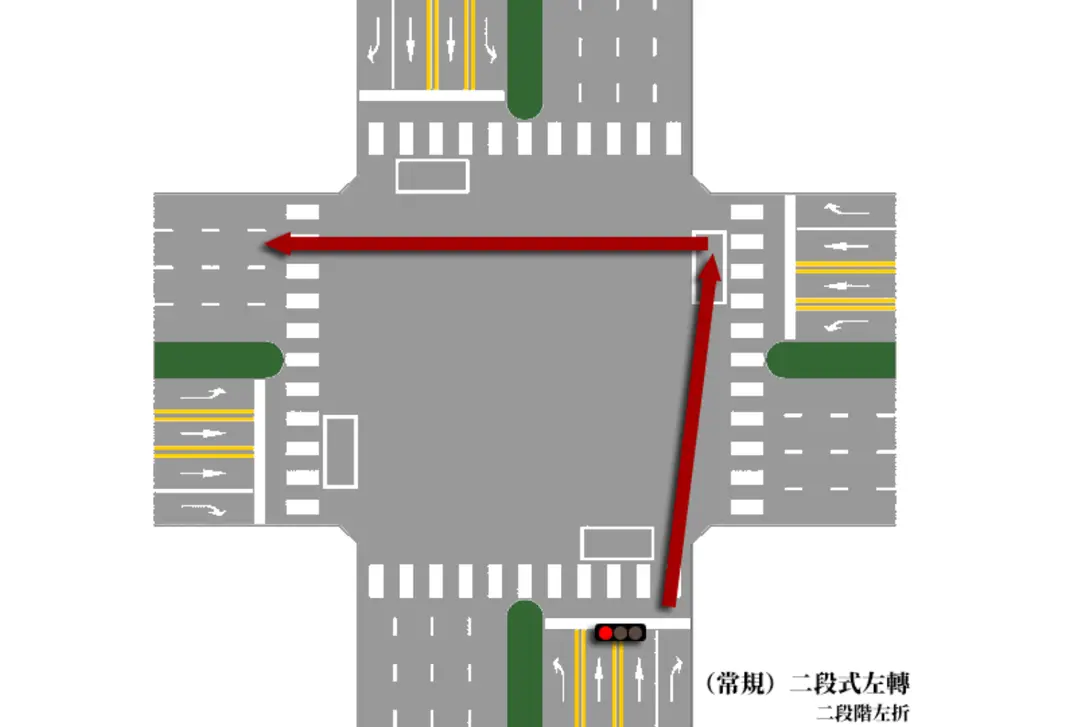
The logic of "two-stage turning" is quite simple: avoid interweaving conflicts with motor vehicles during the same turning moment. Instead, first go straight to the opposite side of the intersection, wait for the next signal to proceed, and then complete the turn. It sacrifices a few seconds but significantly reduces risk. In areas with high motorcycle density, this is a long-verified method of risk diversion.
However, the professor offered a more realistic assessment: the biggest obstacle currently is not the technical solution itself but the lack of regulatory consensus.
The primary contradiction lies in legal classification. According to current laws, e-bikes are not allowed on motor vehicle lanes; they should travel on non-motorized lanes or pedestrian systems. Legally, this definition is very clear. But reality is far more complex than the条文. A large number of e-bikes routinely travel on motor vehicle lanes, parallel with cars, weaving through traffic, and even rushing at intersections. In other words, the actual operating state itself exists in a gray area of "widespread violation."
And this gray area is not entirely due to riders' subjective choices.
I once commuted by e-bike for a period. On a so-called "non-motorized lane" of just one kilometer, more than half was marked as roadside parking spaces; either occupied by motor vehicles or with illegal parking at intersections. The remaining parts were narrow and discontinuous, even interwoven with bus stops and temporary unloading zones. If I strictly followed the rule of "not entering motor vehicle lanes," I often couldn't move at all.
Thus, a dilemma arises: the law requires e-bikes to use non-motorized lanes, but non-motorized lanes themselves are compressed, encroached upon, and marginalized. When e-bikes enter motor vehicle lanes, they are deemed违规.
The core of this issue still lies in: are e-bikes considered "motor vehicles"?
If they are motor vehicles, that would mean requiring driver's license exams, mandatory insurance, stricter production standards, and legal responsibilities matching those of motor vehicles.
But if they are not motor vehicles, then they must operate within the non-motorized system.
However, the reality is that the weight, acceleration, and maximum speed of many current e-bikes are already close to those of light motorcycles; their daily use scenarios for families also more closely resemble "low-cost car substitutes." Functionally, they are close to motor vehicles; legally, they are classified as non-motorized; and in terms of infrastructure, they lack complete保障.
Thus, there is a misalignment between institutional classification, road design, and actual需求.
This also explains why technical optimization solutions like "two-stage turning" are difficult to implement. Because their premise is acknowledging e-bikes as a stable category of traffic participants and designing clear, enforceable rules for them. The current institutional state is more like a temporary compromise: tacitly acknowledging their existence without fully creating institutional space for them.
The professor's point was straightforward: before legal classification is clarified, non-motorized lane保障 is insufficient, and enforcement capacity and social consensus are unified,单纯 discussing technical optimization easily remains on paper.
This is not a lack of solutions but a lack of a social environment capable of承载 those solutions.
#traffic governance #e-bikes #south korea #finland #singapore