
During the National Day holiday, I went back to my hometown. Sitting down with relatives and friends, the conversation inevitably circled around young people’s employment, marriage, and childbearing, as well as older people’s decisions about whether to pay social security, how to retire early, and how to choose social security for flexible employment. As we chatted, everyone unconsciously started opening the Personal Income Tax APP to check their accounts, and then the conversation drifted to personal income tax deductions, ultimately raising a question: why is the distinction between one child and two children so small in personal income tax deductions? Whether it’s children’s education or infant and toddler care, the difference between one child and two children seems to be just an extra 2,000 yuan deducted per month, amounting to an additional 24,000 yuan in deductions over a year. Simply put, the “price” of each child is exactly the same in the eyes of the tax system.
Several reasons came to mind during this.
The first reason is that the history of large-scale personal income tax collection is actually not very long.
The time since China truly established a broadly covering, highly socially relevant personal income tax system is not that long. I remember that it was only in the last five or six years that people began to generally pay attention to the annual personal income tax settlement. It was only in 2019 that six special additional deductions, including children’s education, were introduced. It was only in 2022 that the deduction for the care of infants and toddlers under 3 was added. And it was only in 2023 that the standard was raised from 1,000 yuan per child per month to 2,000 yuan. The system itself is still in the process of being improved, so it is quite normal that policies introduced have not been considered comprehensively enough.
The second reason is the historical inertia in everyone’s understanding of population size.
Our long-standing understanding of population issues has been built on the framework of “controlling population growth.” At least for those of us born in the 1980s, what we learned from elementary school onward was the “fewer births, better upbringing” doctrine, and questions related to family planning were mandatory topics in the political exams for middle school and high school entrance examinations. The decline in the fertility rate in recent years has come very suddenly, and policy adjustments often cannot keep up with changes in the situation. Many times, the inertia of policy remains, but reality has already changed. This kind of cognitive shift takes time.
The third reason is that some people have theoretical misunderstandings about tax deduction policies.
There is a view that since everyone is equal, one child gets a deduction of 10,000, two children get 20,000, three children get 30,000, and every child is the same—that is what fairness means. But I think this understanding applies fairness in the wrong place. What we are discussing here is the issue of tax burden deduction, not handing out awards to children. You cannot make a vertical comparison at the time of deduction and say, “The second child got a bigger deduction than the first child—does that mean the second child is more impressive?” That is completely misguided.
There is a similar concept in economics: giving money to everyone is equivalent to giving money to no one. At first glance, this indeed does not seem intuitive, but behind it is the law of diminishing marginal utility. By the same logic, if no matter whether it is the first, second, or third child, the deduction amount for each child is exactly the same, then for families wavering on the edge of “whether to have a second one,” the signal of such a policy is ambiguous. The marginal burden brought by a second child is clearly heavier, yet policy support does not increase accordingly, which is in essence unfair instead.
But the most core issue is that for contemporary families, the social and life difficulties faced in having one child versus two or three children are simply not on the same order of magnitude.
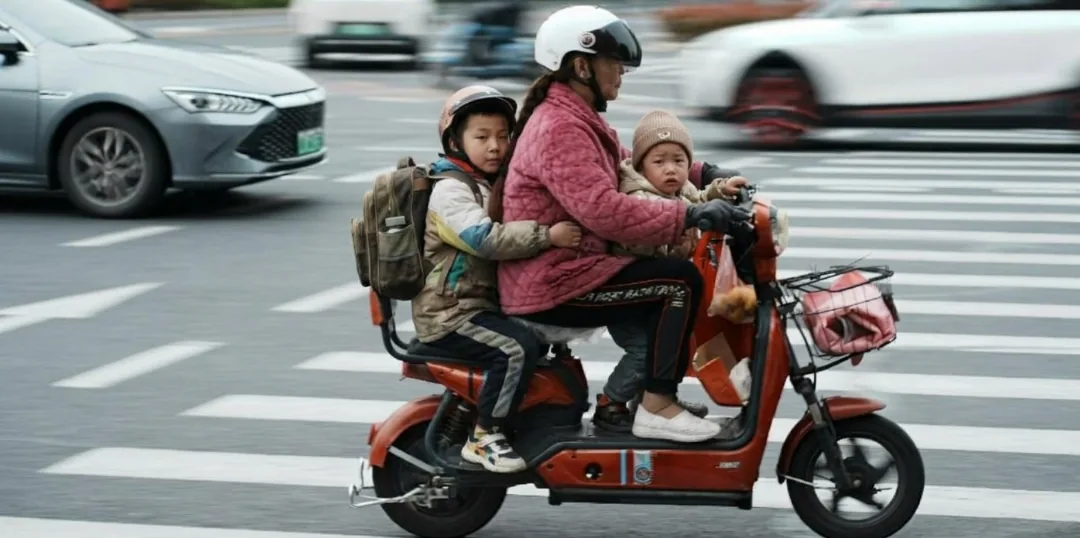
Let’s start with daily travel. If the family only has a two-wheeled electric bike, one child can still legally ride along, but two children means it is illegally over capacity. You cannot drop off one child and then go home to pick up the other—that is not realistic. The same goes for urban middle-class families buying a car. Considering family needs, a young couple with one child plus a pair of grandparents fits exactly in a five-seat car. But if it is two children plus a pair of grandparents, that is six people, and a five-seat car is overloaded. You have to consider switching to a six- or seven-seat car, and the cost of buying a car immediately rises by a notch.
Now let’s talk about housing. Many urban families live in three-bedroom apartments. The couple takes one room; if the children are of the same sex, they can share a room, but if they are of different sexes, they each need their own room, and the three rooms are exactly used up. If three generations live under one roof, the elderly take one room, the couple takes one room, and the remaining room goes to the children. Having one child is still fine, but having two children who happen to be of different sexes creates a conflict. And switching from a three-bedroom to a four-bedroom involves a very large price difference in many cities.
Traveling long distances is even more so. Taking one child on a train or plane is still manageable; taking two, holding one with each hand while also carrying large bags and small packages, and if you get distracted for a moment, one child runs off. Three children need not even be mentioned—it is a completely different level of difficulty.
This is not like traditional agricultural society, where “more children just means more chopsticks.” Back then, children were raised free-range, there were not even cars in the village, and the biggest safety risk was just playing by the pond. Now the logic is completely different. Safety risks in the city, educational investment, and the cost in time and energy all multiply with each additional child.
So I believe that the current tax policy indeed needs improvement in terms of structure.
Looking at international experience, quite a few countries with low fertility rates have adopted a design of increasing deductions by birth order in personal income tax. In Hungary, starting from January 2026, a family can enjoy a monthly tax benefit of 20,000 for one child, 40,000 per child for two children, and 66,000 per child for three or more, and mothers of two children can even enjoy a lifetime exemption from personal income tax. In South Korea, for child tax credits, one child gets an annual deduction of 250,000 won, two children get 550,000 won, and for three or more, an additional 400,000 won is added for each additional person. In addition, giving birth to a first child earns an extra 300,000 won deduction, a second child 500,000 won, and a third child 700,000 won. The signals these designs send are very clear: having one more child means greater marginal support.
There are similar calls in domestic academic circles. Some experts suggest that on the existing basis of 2,000 yuan per child per month, the deduction standard for the second child should be raised to 3,000 yuan and for the third child to 4,000 yuan, implementing tiered deductions. Some studies also point out that the special additional deduction for children’s education has the most obvious incentive effect on the willingness to have a “second child,” and suggest that the deduction amount increase with the number of children. Among people’s congress representatives, there is also no shortage of suggestions to “double the deductions for two-child and three-child families.”
Of course, China currently chooses the “universal burden reduction” route. Childcare subsidies do not distinguish by birth order—3600 yuan per year for the first, second, and third child alike—and personal income tax deductions are equal for each child. This design has its rationale: first let everyone have the first child, let families having their first child feel institutional support, and then consider subsequent childbearing decisions. But the problem is that when the marginal cost of raising a second or third child is far higher than that of the first, equal support can hardly truly leverage those families who are “hesitating about whether to have a second one.” In fact, when the two-child policy was relaxed in earlier years, some places even saw a “data spectacle” where the birth rate for first children was not as high as that for second children.
In the final analysis, it is not that the policy lacks a direction of encouraging childbearing, but that the intensity and structure are still insufficient to make families feel, when doing the math, that “having one more child is clearly more worthwhile.” On paper it is “supporting childbearing,” but from the family ledger’s perspective, with one, two, or three children, the current tax policy still shows no essential difference.