
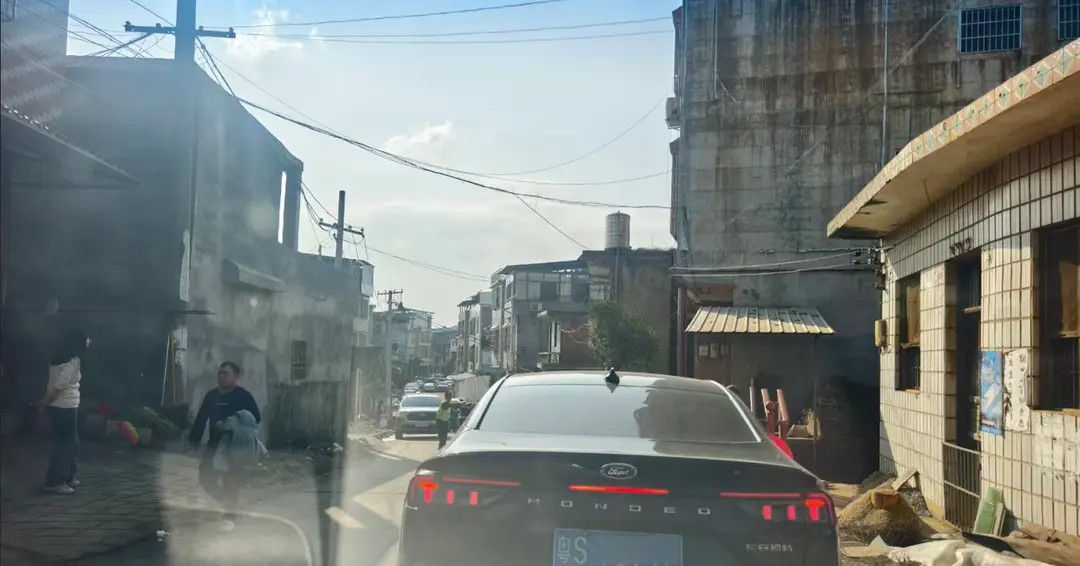
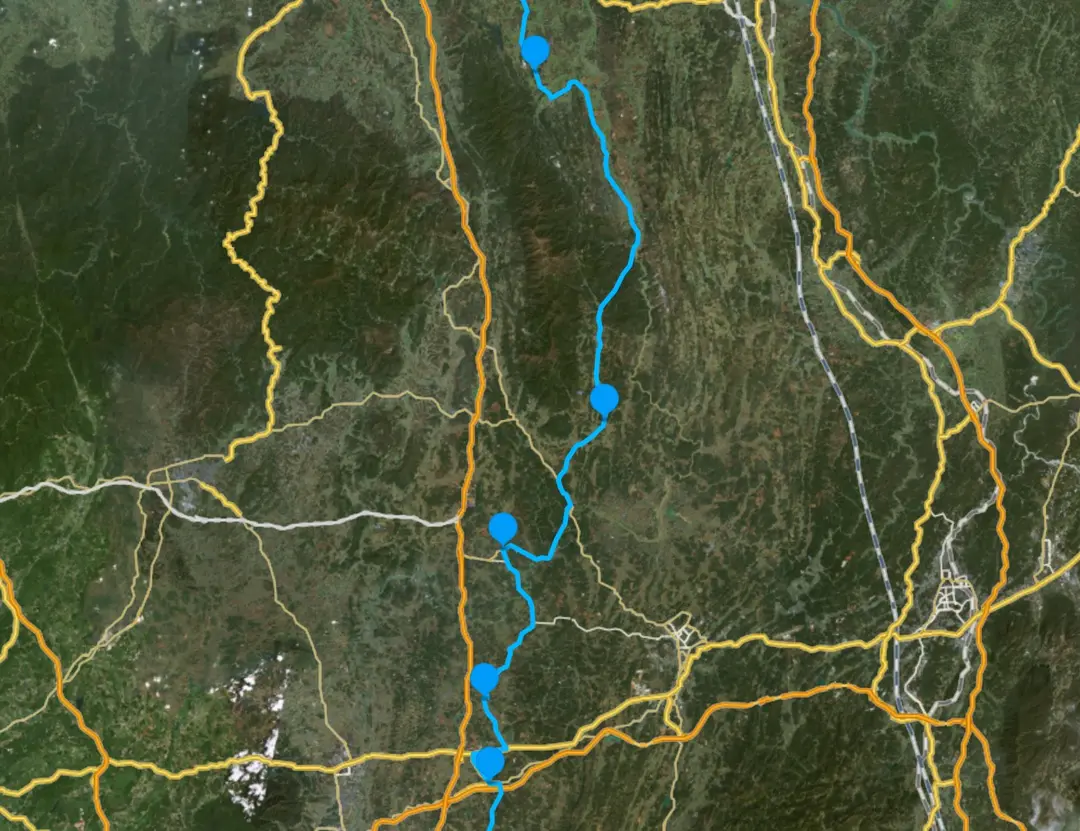
On the morning of the sixth day of the Lunar New Year, I set off from Hunan back to Guangdong. Covering 650 kilometers took 18 hours, setting a personal record for both the longest single drive and the longest traffic jam. To avoid a hundred-kilometer stretch of congestion between Changning and Linwu on the Xuguang Expressway after merging from the Huachang Expressway, I spent 8 hours navigating provincial, county, and township roads, covering a total of 250 kilometers.
It was this rural journey that gave me a new perspective on Hengyang and the southern Hunan region.
The Mountain Roads Weren’t Difficult
For over a decade, I’ve mostly traveled between Hunan and Guangdong via expressways, with only occasional trips on national highways. For instance, during the 2019 Spring Festival, to avoid congestion on the Erguang Expressway, I took G107, G358, and S260 between Linwu and Sihui. What left the deepest impression then was that the national and provincial roads in Guangdong were generally in good condition, with many stretches feeling almost like “no-man’s-land”—few cars, few people, making risks more manageable. The only issue was the many mountain curves, which made nighttime driving stressful.
The 200-plus kilometers of mountain roads I took after exiting the expressway at Changning were similar. Most were undivided cement roads, but driving during the day wasn’t particularly challenging. After all, the last few hundred meters of cement road to my hometown is only a little over two meters wide.
In a sense, the mountain roads weren’t the problem, nor was the road condition. What really caught my attention was the appearance of the towns along the way.
The Complicated Face of Rural Hengyang
Around the year 2000, when I had just started middle school, I visited my third aunt for New Year’s greetings. Her home was in a Hengyang township bordering our county. It seemed more mountainous, remote, and poorer than my hometown, yet the roads were noticeably better.
At the time, my third aunt said something I’ve always remembered. She said Hengyang was an “industrial county,” while our Shuangfeng was an agricultural county, so Hengyang had better roads and a stronger economy, something Shuangfeng couldn’t match for a long time.
Back then, we almost always went to Hengyang for everything: taking buses to Hengyang stations, seeing doctors at Hengyang hospitals, getting ultrasounds during pregnancy in Hengyang, shopping in Hengyang, attending university in either Changsha or Hengyang, and even hiring monks for religious ceremonies—those from Nanyue Mountain were considered more “authentic.”
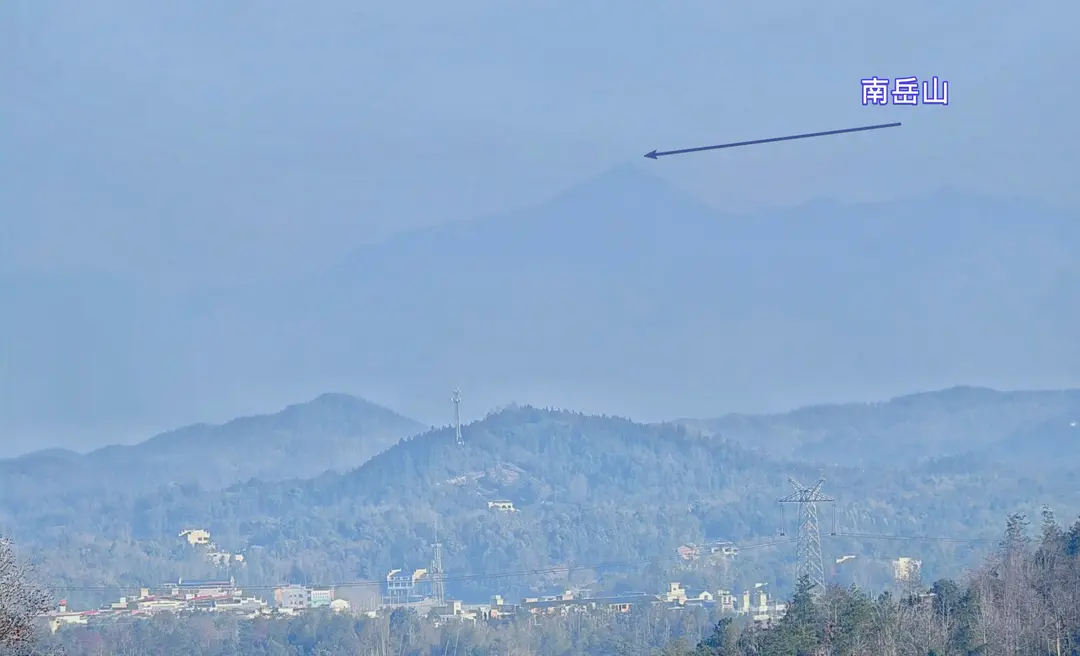
In my mind, Hengyang was the default “central city” for our surrounding area.
In contrast, Loudi, the prefecture-level city that Shuangfeng nominally belongs to, has barely registered in my life. In over thirty years, I’ve only been to downtown Loudi once.
But this time, traveling south from Changning through the town centers of Pengtang Township, Xiling Town, and Baisha Town, I felt a clear sense ofdrop(disparity).
The roads were worn, the streets messy, and the overall appearance seemed stuck in a certain era.
Most storefronts were traditional variety stores, small restaurants, and pool halls. At a glance, it was hard to find any recently renovated facades. Shops with uniform signage, floor-to-ceiling glass, LED-lit signs, and minimalist styles common in cities were almost nowhere to be seen.
Most were just ground floors of self-built houses converted into shops—rolling shutters pulled up, a few shelves arranged, and business began. There was no sense of design or branding.
It felt strange.
As if time around 2010 had been paused.
A Puzzling Comparison
Since childhood, I’ve heard that places like Changning and Leiyang were more developed than Shuangfeng, being established county-level cities. Logically, living standards should be higher, and commerce more vibrant.
But the reality didn’t match this perception.
Even though my hometown is in one of Shuangfeng’s most remote townships, the town center still has milk tea shops, snack stores, bakeries, and fast-food outlets. Brands found in cities, like Snack You, Mixue Ice City, and burger and fried chicken chains, are basically all there. During the Spring Festival, I even waited over an hour with my child to buy milk tea.
Barbecue stalls are even more common. Over a dozen operate year-round, scattered around the town center and surrounding settlements. At night, you can see “smoky haze” filling the streets, with young people gathered around chatting.
Yet on the streets of Changning, I hardly saw any barbecue stalls. It wasn’t just quiet; it lacked that bustlingthe smell of cooking(lively atmosphere).
I initially thought it might be a population issue.
But checking the data made this seem unlikely. From 2010 to 2020, Changning’s population decreased by only a little over 20,000, while Shuangfeng’s dropped by over 100,000. By the numbers, Shuangfeng should appear more “declined.”
But the town streets presented a completely different picture.
The Matter of Rural Housing
Another detail.
Before the Spring Festival, a friend from Chenzhou remarked to me withsigh with emotion(emotion) that while passing through Loudi, they saw densely packed villas lining the rural roads, thinking our rural areas were doing quite well.
I was skeptical at the time, feeling it might be “mutual flattery.” How could Loudi, a hilly, mountainous area in central Hunan that seems “unloved by both province and prefecture,” compare favorably to theirthe backyard garden of the Pearl River Delta(Pearl River Delta backyard)?
But after traveling through Hengyang and Chenzhou this time, I realized they might have been right.
In many villages I passed through in Changning, Guiyang, and Jiahe, I noticed very few newly built modern villas. In some villages with dozens of houses, you couldn’t find a single decent three-story Western-style house.
In Shuangfeng, it’s hard to drive a few hundred meters without seeing a villa with a distinctly modern-style gatehouse. Some villages have almost entire rows rebuilt.
More importantly, this renewal isn’t just in the villages but also in the towns. Town streets are being updated, and village houses are being renewed, simultaneously.
This leaves me somewhat perplexed.
Shuangfeng has more obvious population outflow yet appears more “modern” in town appearance and rural housing. Changning has relatively stable population numbers, but its towns and villages seem more “stagnant.”
Where has the money gone? Where have the people gone? Where is the drive for renewal coming from?
I don’t really have answers.
Another Rural Scene in Chenzhou
Heading south from Changning into Guiyang, my expectations had already lowered, so the situation didn’t seem as bad.
This stretch passed through Qiaoshi Township, Heping Town, Chunlingjiang Town, and Haotang Town in Guiyang County; Puman Township and Xinglang Town in Jiahe County; and Maishi Town in Linwu County. Among these, Xinglang Town, being close to Jiahe County’s urban area, had noticeable industrial zones and standard urban roads. More importantly, I could clearly sense a trend toward “clustered settlement.”
Chenzhou’s rural areas aren’t as severely scattered as those in Loudi and Hengyang. The roadsides aren’t lined with sporadically placed self-built houses but rather more sizable villages, much like in Guangdong. Some villages even have a unified style, resembling small communities.
Agricultural production also appears more systematic. Cash crops like tobacco, tea oil, and citrus are grown in concentrated areas. Even on Guiyang’s “Lotus Avenue,” I saw many peculiar “family farms” by the roadside, giving a sense of large-scale agricultural production reminiscent of Northeast China. The feeling was that Chenzhou’s rural land seems to be utilized in an organized manner rather than fragmented farming.
This might reflect two different development paths. The rural areas in Hengyang seem to suffer from the aftermath of industrialUpdate(renewal) following early industrialization driven by mineral resources. In contrast, Chenzhou is pursuing agricultural scale, county-level industrial support, andconnecting with the Pearl River Delta market(connecting with the Pearl River Delta market).
Multiple Facets of Regional Differences
The biggest takeaway from this detour isn’t a simple judgment of which place is better, but the clear differentiation in developmentrhythm(pace) and appearance across different parts of Hunan.
Against the same backdrop of outbound migration and population decline, some townships appear active in renewing housing and streets, while others seem more like they’ve been paused.
Behind this could be differences in local preferences, cultural psychology,inertia(inertia) of industrial paths, or evensubtle difference(subtle differences) in local governance and planning.
I also tried to find an answer I could accept andwent out of my way to look it up(specifically looked up) the 2024 statistical bulletins for several counties. Comparing the data actually clarified manydoubt(doubts).
For example, Changning, as an established county-level city, hassignificantly higher than(significantly higher) registered population,permanent resident population(permanent resident population),urbanization rate(urbanization rate),total retail sales of consumer goods(total retail sales of consumer goods), andbuilt-up urban area(urban built-up area) compared to Shuangfeng. Its industry is supported byleading enterprise(leading enterprises) like Wukuang Copper and Zhuye Nonferrous Metals, giving it a larger economic scale and a more complete urban framework.
Shuangfeng’s characteristics, however, lie in morefine structure(subtle structures). It has higher numbers and coverage rates forUrban Employee Pension Insurance(urban employee pension insurance),Employee health insurance(employee medical insurance), andwork-related injury insurance(work injury insurance). Although its county town’s built-up area isn’t large, theprivate sector(private economy) is active. Nearly one-third of the county town’s area is occupied by private manufacturing enterprises, quietly changing the traditionalimpression(impression) of an “agricultural county.” Particularly noteworthy are thedeposit and loan balances(deposit and loan balances). Shuangfeng’s total deposits andhousehold deposits(household deposits) are higher than Changning’s,perfectly aligned(precisely matching) the real rural ecosystem: money stays in people’s hands, used more for building houses and township consumption, hence livelier streets and more active rural renewal.
The real difference between the two places might not be in strength or weakness, but inpath(path). Changning follows a path of big cities, big industry, andmass concentration(high concentration). Shuangfeng, despite population outflow, hasvibrant civil society(vibrant private sector),township self-motivation(township self-drive), andsmall-scale, dense, and vibrant community life(small, dense, livelihood-oriented prosperity).
Traveling through the landscapes of southern Hunan, I’ve become increasingly convinced: judging whether a place hasvitality(vitality) shouldn’t rely solely on GDP orsize of the urban area(urban area size). One must also look at whether towns havethe smell of cooking(bustling life), whether streets are being updated, whether ordinary people are willing to spend money locally and build their homes. Some places may not look “new” but are operating steadily. Some places may have declining populations but are modernizing quietly in their own way.
The rural areas of southern Hunan are never a single template. They are simply walking different paths toward the same destination called “Life is getting better” (life getting better).