
A couple of days ago I watched a video that mentioned the term “paper tiger” quoted by Trump originated from Mao’s Selected Works. At the time I felt something was off, because I vaguely remembered seeing this term in some older thread-bound vertical-edition novels. So I casually looked it up, and unexpectedly, once I started checking, things became complicated.
From Mao’s Selected Works
The phrase “All reactionaries are paper tigers” in Mao’s Selected Works is something almost every Chinese person should know, and the widespread use of the three characters “paper tiger” is largely thanks to this. Therefore, most people naturally take it as the source without much thought, which is quite understandable. However, from a “textual research” perspective, I still want to seek the true origin of this term.
From a Cantonese Dictionary
There is a common online claim that the source of “paper tiger” is the 1828 book A Vocabulary of the Canton Dialect compiled by the British missionary Robert Morrison. I searched around online but couldn’t find a PDF version of this book. However, from common sense, if a term is included in a dictionary, it obviously means the term was already “widely circulated” before that. Taking a dictionary as the origin of a term clearly doesn’t make sense.
From Ming-Qing Novels
When I queried this question on Tencent Yuanbao, Yuanbao suggested that the earliest appearance of “paper tiger” can be found in the Qing novel Guwangyan. In Chapter 15 of that novel, there is the sentence: “Up to now my master is just a paper tiger, originally fake, only good for scaring children and country folk.” I checked carefully and found that this claim likely originates from an article on the Huayu Bridge website titled “Also Discussing the Origin of ‘Paper Tiger’.” But in the same article, the author also mentions finding this expression in Dream of the Red Chamber. Additionally, the author traces it to the Ming dynasty novels Jin Ping Mei Cihua and Chanzhen Yishi, with the former likely completed around the Wanli era, circa 1600, and the latter around the end of the Tianqi period, that is, about 1627.
From Late Yuan and Early Ming Novels
At this point I actually felt a bit stuck. After all, previous researchers had already traced it back to the Wanli period. But I was still unwilling to give up and switched to another AI to continue asking. Surprisingly, Qianwen concluded that the origin of “paper tiger” is in Water Margin. Now this became interesting.
I immediately searched the full text of Water Margin, but unfortunately, I didn’t find the three characters “纸老虎”. However, I did find the concept of “纸虎”. Although “paper tiger” and “paper tiger” (纸虎) differ by one character, they essentially carry the same meaning. In Chapter 25 of Water Margin, when Wu Dalang catches Ximen Qing in the act of adultery, Pan Jinlian curses Ximen Qing loudly: “Seeing a paper tiger, you get so scared you fall over!”
Wu Dalang rushed to the door and pushed it with his hand, but it wouldn’t open. He could only shout: “What a fine deed!” The woman held the door shut, panicking, and said: “Usually you talk big like a bird’s beak, showing off your great boxing skills, but when it’s time to act you become useless. Seeing a paper tiger, you fall flat on your face!” These words from the woman were clearly instructing Ximen Qing to strike Wu Dalang and escape. Hearing this from under the bed, Ximen Qing was reminded of the idea. He crawled out and said: “Lady, it’s not that I lack ability, but for a moment I lost my wits.” He then pulled open the door and shouted: “Don’t come near!” Wu Dalang was about to grab him when Ximen Qing swiftly kicked out with his right foot.
Following this line of thought, I also looked at novels from the same period as Water Margin, especially those by Luo Guanzhong and Feng Menglong. After all, Luo Guanzhong was the disciple of Shi Nai’an, and the novels of these three have the widest circulation and the most content.
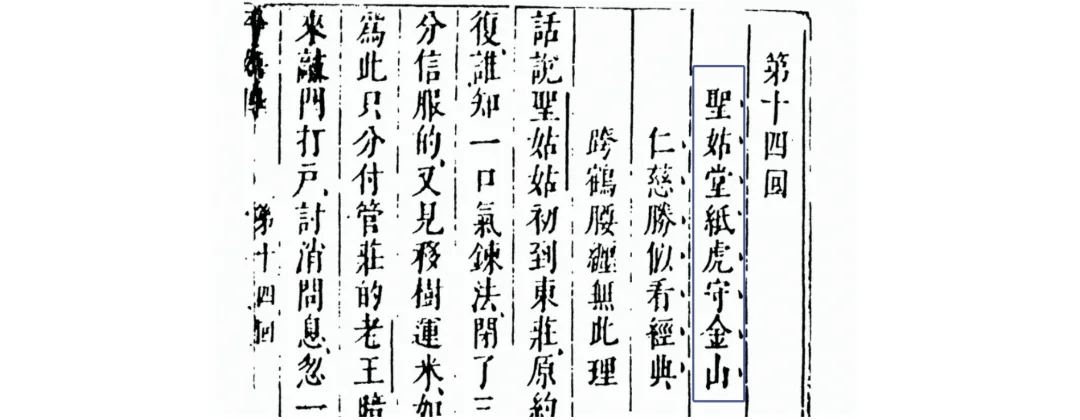
So in Luo Guanzhong’s Pingyao Zhuan I also found the concept of “paper tiger”, and it even appears directly in the title of Chapter 14: “Holy Aunt Hall’s Paper Tiger Guards JinShan, Shuijing Garden Zhang Luan Meets Mei’er.”
“Paper Tiger” Before the Song Dynasty
Having traced it to the late Yuan and early Ming, I basically already had the answer in my mind. To verify, I searched several ancient text databases, but the “paper tiger” results were all about actual paper-cut tigers, with no metaphorical usage like the modern one.
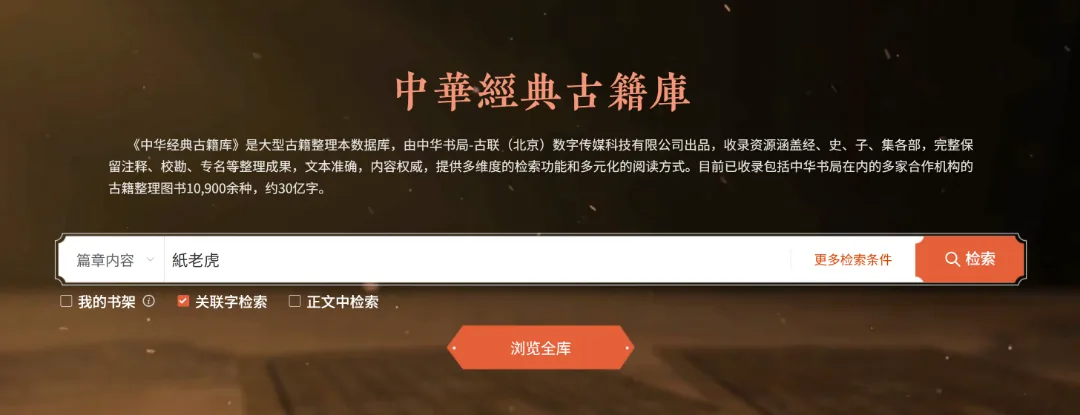
However, the process wasn’t entirely fruitless. I suddenly saw a Tang dynasty reference possibly related to Buddhist scriptures mentioning “paper tiger”. But upon clicking, oh boy, it turned out to be an OCR recognition error. The original text was “二十六纸” and “虎耳太子经”, completely unrelated to “paper tiger”. It was just that ancient people didn’t use punctuation, so the two characters happened to be adjacent.
But it was this Buddhist scripture-related search result that made me think further—perhaps I could search Buddhist scriptures. After all, general ancient text search engines only include a small portion of Buddhist literature. For a broader search, a specialized database is needed.
Unfortunately, I didn’t find any information related to “paper tiger” or “paper tiger” in Buddhist scriptures before the Song dynasty. However, I did find a Ming dynasty text San Yi Ming Meng Shuo, which clearly records a Chan master saying to his disciple after the disciple bowed and then acted arrogantly: “You are just one paper tiger.” This usage is exactly the same as the modern one.
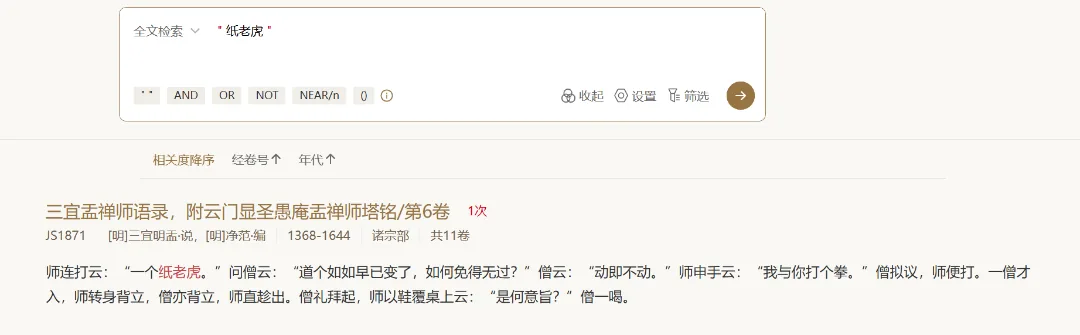
A monk bowed and rose. The master said: “Wrong.” The monk gave a shout. The master raised his staff in a striking pose and said: “This order should be carried out by the senior seat.” The monk swung his sitting mat in a circle. The master grabbed him and said: “Why not speak a sentence?” The monk said: “I’m afraid it will become a mess.” The master struck repeatedly and said: “One paper tiger.” — [Ming] San Yi Ming Meng · Shuo, compiled by [Ming] Jing Fan
Conclusion
So, if I must give a conclusion, I prefer this understanding: The concept of “paper tiger” formed during the novel-writing period of the late Yuan, Ming, and Qing dynasties, possibly absorbing and borrowing from folktales circulating at the time, or perhaps simply invented by the authors themselves. Regardless, this concept already appeared during the time Shi Nai’an (c. 1296–c. 1370) was writing Water Margin, since Shi Nai’an was only compiling and editing. The specific events inside trace back to the Liangshan uprising in the Northern Song period in 1119. By the early Ming period when Luo Guanzhong lived (c. 1330–c. 1400), the concept of “paper tiger” had already been used multiple times. By the late Ming, even Buddhist literature began using the “paper tiger” concept. Later, in the Qing dynasty, whether in Dream of the Red Chamber or various other novels, the “paper tiger” concept became increasingly widespread, to the point that even regional dialect dictionaries included it. Then in 1946, phrases like “All reactionaries are paper tigers” and later “U.S. imperialism is a paper tiger” gave the term comprehensive global promotion, so much so that foreigners eventually started using it too.
Sometimes the answer to a question isn’t that important, but peeling back these layers one by one is itself very interesting.