

Mbappé probably never imagined that a China-related remark he made on a podcast would set off a cross-lingual public opinion storm on the Chinese internet.
But more worth questioning than the remark itself is: why could an old story from April, embellished and posted by a small Real Madrid fan account, be rapidly auto-translated into Chinese and precisely pushed to the homepages of a large number of Chinese users?
Why, in the following days, did German, French, and Spanish “snarky about China” content begin flooding in batches onto the timelines of that same group of people?
And why, amid this clamor that seemed like “the whole world is arguing with China,” were Americans almost invisible?
Retracing the Algorithm Behind the Incident
Retracing this transmission chain reveals an easily overlooked protagonist: the translation and recommendation algorithms after X (Twitter)’s update.
X’s translation has never been neutral conveyance. What is translated into which language, and in what guise it enters a new public space, itself determines how the杀伤力 of a sentence will be secondarily diffused.
X’s automatic translation and cross-lingual recommendation take the path of “dismantling language barriers” — an offensive expression that originally circulated only in a specific podcast context is pushed to users of different languages at extremely low cost.
More critical is the amplification logic of the recommendation algorithm. X’s system aims to maximize replies, reposts, and dwell time, and controversial remarks naturally fit the characteristics of high emotional arousal.
The algorithm does not need to “know” whom this sentence offended; it only needs to identify signals of anger and shock, and it will push related content to more users likely to produce the same reaction.
This explains that “batch homogeneity” impression.
When the algorithm identifies in your behavioral data that you have clicked on or emotionally reacted to a certain type of cross-cultural controversy, it will mark it as a high-value interaction signal, and then push to you clusters of content with the same theme, the same emotional tone, and the same language source.
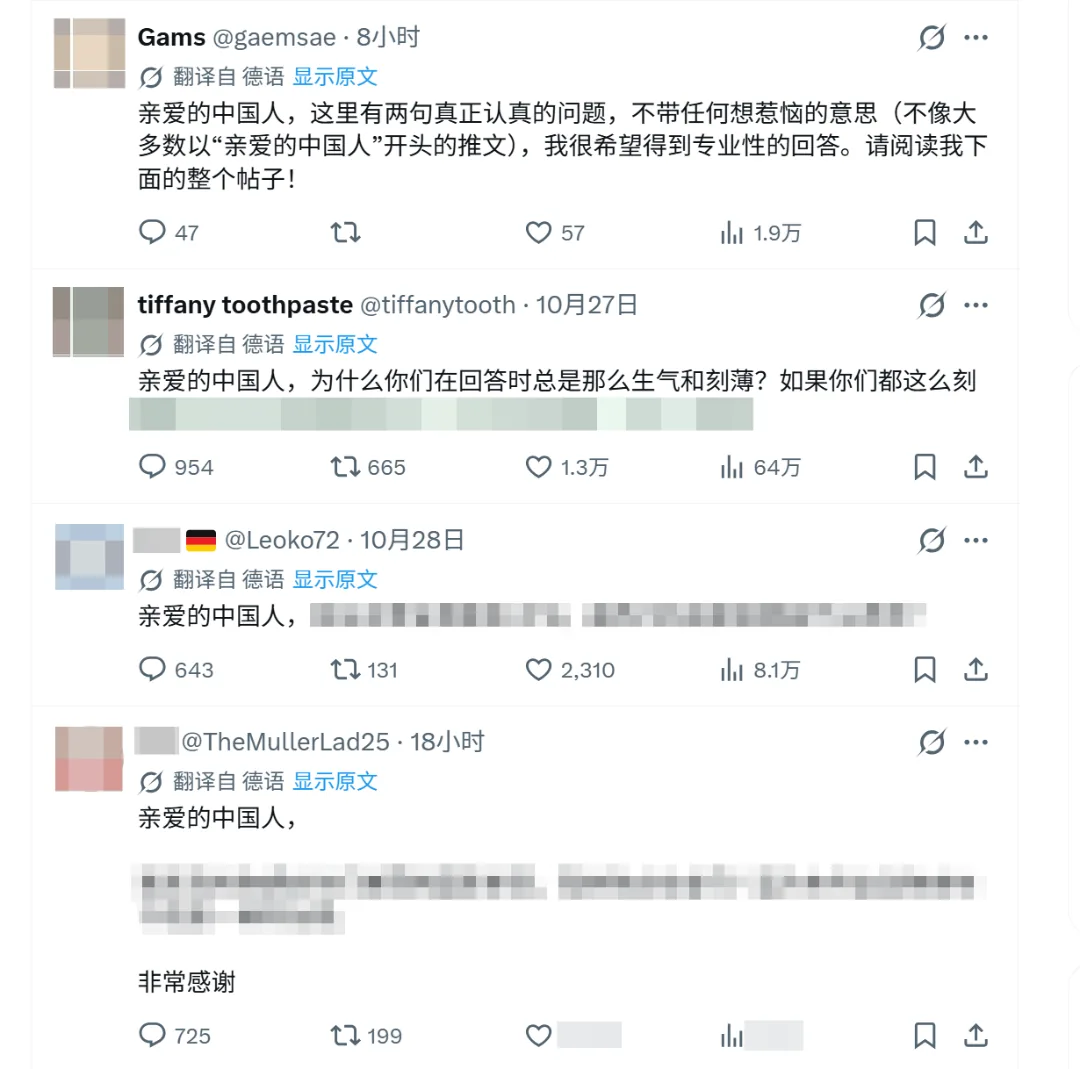
A few days ago it was still “Chinese and Turkish netizens arguing,” yesterday it was German tweets beginning with “Dear Chinese,” today it is French and Spanish Mbappé-derived content — none of these are coincidental screen flooding, but the algorithm continuously searching within the same dispute cluster for “the next variant likely to trigger a similar reaction.”
The sense of homogeneity is precisely the byproduct of this process: the system is doing variant searches around an emotional motif, rather than providing genuinely heterogeneous information.
Chinese Netizens Arguing with Various Countries Is Precision Sniping by X’s Algorithm
Thus a peculiar spectacle emerged: arguments between Chinese netizens and those of Europe, Brazil, and Turkey are mass-produced and cross-lingually pushed, while Americans seem to stand aloof.
This precisely exposes another layer of the algorithm’s logic. What it filters has never been “who is most important,” but “who is most easily provoked and most willing to respond.”
The high interaction tendency of Chinese netizens when facing China-related offensive content is easily identified in the data as a high-value target cluster; while the attention of American users is heavily diverted by domestic partisan politics, entertainment, and sports, and their interaction conversion rate on such cross-lingual controversies is insufficient to pass the algorithm’s efficiency threshold.
As X’s home country, the United States obtains a position that requires no personal involvement and bears no visible cost: the arguments happen among others, while traffic and agenda-setting power remain in its own hands.
More worthy of vigilance is that what the algorithm amplifies is not “fundamental contradictions,” but the part of contradictions most easily consumed in the form of cross-lingual quarrels.
The structural frictions between China and the United States — trade, technology, security, international rules — are, without question, each too heavy and too complex, and thus unsuitable for being compressed into the short, flat, fast emotional units favored by the algorithm.
Whereas those scattered, specific, short-sentence-able friction points between China and Europe, Brazil, and Turkey, after purification and repackaging by the translation and recommendation mechanisms, become a kind of mass-produced “global quarrel with China” that seems to happen every day.
X’s algorithm did not create these frictions, but it changed the form in which frictions are perceived — from complex social issues requiring context to understand, into adversarial content units suitable for rapid consumption.
Beware the Risks of Algorithms
Returning to the Mbappé incident. The true revelation of this storm perhaps lies not in what a certain player said, nor in how a certain small account embellished things, but in that a system whose sole optimization goal is maximizing interaction is turning cross-cultural misunderstanding and emotional antagonism into a default content category that can be mass-produced at scale.
It does not need conspiracy, does not need a command center; it only needs to continuously prefer content that can provoke anger and replies, and it can objectively manufacture a daily spectacle of “global quarrel with China.”
And the sense of absurdity everyone feels when scrolling their homepage — as if the whole world is arguing with China, yet the ones who should most be present are absent — is precisely the algorithm’s precise projection.
The algorithm does not create contradictions, but it determines the form in which contradictions are seen, perceived, and consumed.
This is the true mystery behind the Mbappé incident that is worth questioning.