
Recently, a relative of Old T was injured and hospitalized after accidentally falling on their way home from work. According to the injury assessment, it would take at least six months after surgery to regain the ability to work. Their biggest concerns were: 1. Will they be able to keep their job? 2. How can they secure their basic livelihood during this period when they are unable to work?
This case is not an isolated one. In daily life, accidental injuries or sudden illnesses often disrupt people’s routines, especially in the current context of high employment pressure. How to use legal systems to cushion against such risks has become a focus of attention for many.
Medical Period
When encountering this issue, the first thing that came to mind was a document issued by the Ministry of Labor 31 years ago: Regulations on the Medical Period for Enterprise Employees Who Are Ill or Injured for Non-Work-Related Reasons (Ministry of Labor Document No. 479, 1994). According to this regulation, when an employee stops work for medical treatment and rest due to illness or non-work-related injury, the enterprise must not terminate the labor contract within the specified period. This period is legally referred to as the “medical period.”
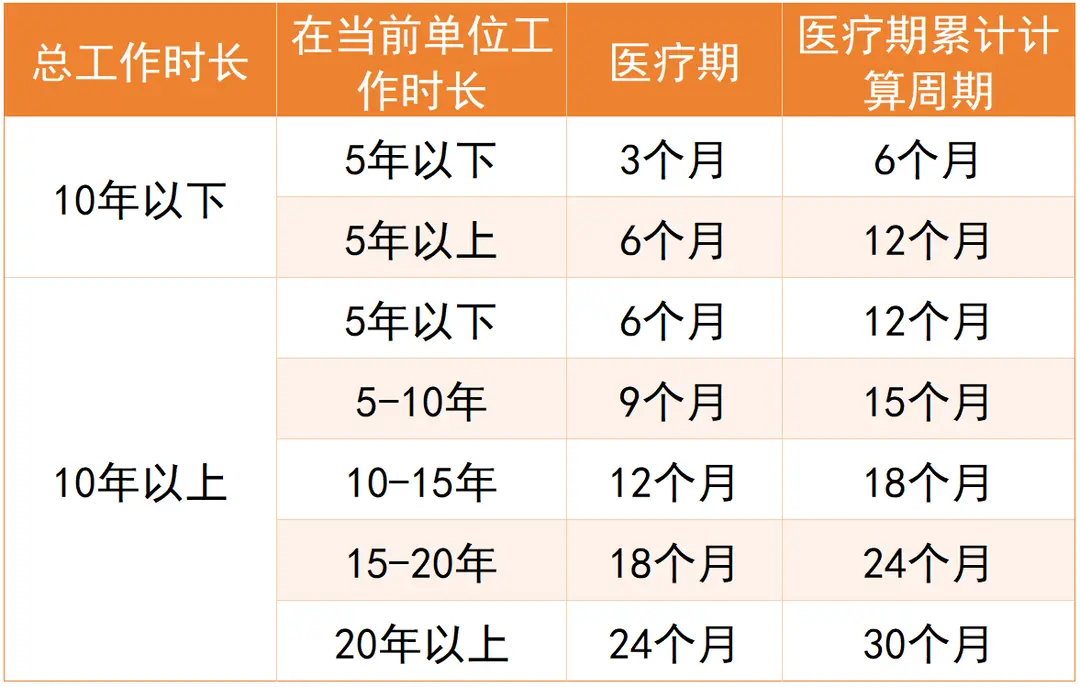
Under this regulation, employees who are unable to work due to illness or injuries sustained outside of work are entitled to a medical period of 3 to 24 months, calculated based on their total years of service and their tenure at the current employer.
Regarding wages and social security benefits during the medical period, according to the Ministry of Labor’s 1995 Notice No. 309, the payment must not be less than 80% of the local minimum wage standard. This means that even if an employee is unable to work due to illness, they are entitled to a statutory minimum living allowance during the medical period.
- During the treatment period for employees who are ill or injured for non-work-related reasons, the enterprise shall pay sick leave wages or disease relief fees in accordance with relevant regulations within the prescribed medical period. Sick leave wages or disease relief fees may be lower than the local minimum wage standard but must not be less than 80% of the minimum wage standard. — Notice of the Ministry of Labor on Issuing Opinions on Several Issues Concerning the Implementation of the Labor Law of the People’s Republic of China, Ministry of Labor Document No. 309, 1995.
Additionally, according to Article 42 of the Labor Contract Law, employers are prohibited from dismissing employees during the medical period through economic layoffs or non-fault-based termination of labor contracts. This provides basic protection for workers, ensuring they do not face the risk of unemployment while recovering their health.
Controversies Surrounding the Medical Period
A concept that has recently gained popularity online is the “poverty line,” which describes how ordinary Americans can easily fall below this line due to job loss or unexpected illness or injury, leading to bankruptcy or even homelessness. In contrast, China’s medical period system offers a valuable buffer, allowing workers time to recover without immediately losing their jobs and income sources.
Of course, when the Ministry of Labor promulgated the medical period regulations in 1995, the country was still transitioning from a planned economy to a market economy, with a large number of employers being state-owned or collectively owned. Some people naturally question whether it is still necessary for private enterprises, which now account for over 80% of employment, to bear this “social responsibility.” After all, it seems unreasonable on the surface for enterprises to bear the losses caused by employees’ personal illnesses or non-work-related injuries. In some long-established enterprises, there are indeed cases where a few “senior employees” exploit loopholes in the medical period system, abusing medical certificates to take extended leave without working, hoping for the enterprise to terminate the labor contract and pay a one-time economic compensation, which has caused some negative impact.
In recent years, there have been calls to reform the medical period regulations and instead strengthen the social insurance system. For example, as of May 1, 2024, the Labor Insurance Regulations were officially repealed, sparking renewed discussions and a trend toward unifying sick leave wage standards. After the repeal, some regions, such as Shanghai and Guangzhou, further clarified wage standards during the medical period to balance the interests of enterprises and workers. Additionally, some scholars have suggested that the government and employers share the burden of sick leave wages during the medical period. For instance, employers could bear the first three months, after which the enterprise and social security funds would share the costs proportionally to alleviate pressure on enterprises and improve the protection system. However, overall, in a socialist country, the medical period system, which serves as a clear safety net with public welfare characteristics, is undoubtedly highly necessary. Until a new comprehensive protection system replaces it, it will likely continue to be implemented.
Issues Related to the Medical Period
To be honest, it is somewhat unusual in the current legal system for a notice and regulation to have been in effect for over 30 years and to be continuously cited in legal documents. In judicial practice, people often prefer to reference the latest legal provisions and regulations to argue a case. Unfortunately, in the case of the “medical period,” there is no new nationwide regulation. Moreover, because the Ministry of Labor’s notice from that time was relatively vague on many issues, it has easily led to disputes in practice.
For example, regarding medical period wages, the Ministry of Labor only set a minimum standard in Notice No. 309, stipulating that it must not be less than 80% of the minimum wage standard. However, the specifics of how and how much to pay vary across regions. Some provinces and municipalities have copied the provisions of Notice No. 309 through local legislation; others have replaced the minimum wage standard with the employee’s average monthly wage from the previous year and applied a new proportion; and some have issued local notices to detail various scenarios, raising standards for enterprises with good economic performance and allowing appropriate reductions for those with poor performance.
Another common dispute concerns the handling of situations after the medical period expires. If the medical period ends and the worker is still unable to perform their original job, the employer must attempt to arrange alternative work. If no suitable arrangement can be made, the contract may be terminated with economic compensation. However, in practice, whether the enterprise has fulfilled its obligation to “arrange alternative work” and whether such arrangements are reasonable often become points of contention.
A few years ago, I collaborated with several local corporate legal personnel and lawyers to study the tendencies in arbitration and adjudication regarding the “medical period” in local judicial practice. This included issues such as whether the average wage for calculating economic compensation for labor contracts for employees on long-term sick leave should be based on their pre-medical period average wage or their average wage during the medical period; whether employees with special illnesses (such as cancer, mental illness, or paralysis) are uniformly granted a 24-month medical period; and what wage standards apply when employees continue to take sick leave under the “medical period” after the work-related injury停工留薪期 (stopping work for medical treatment with pay) ends. Overall, for areas where the rules are unclear, judicial practice generally follows the principle of prioritizing the protection of workers’ rights and interests. Of course, when there is clear evidence that an employee is abusing the system, rulings may also lean toward the enterprise to balance the interests of both parties.