Recently, several articles published by Lao T have drawn questions from readers in the comments section about whether the content was AI-generated. I can definitely answer that: no.
But, to be honest, AI did play a role in the creation process.
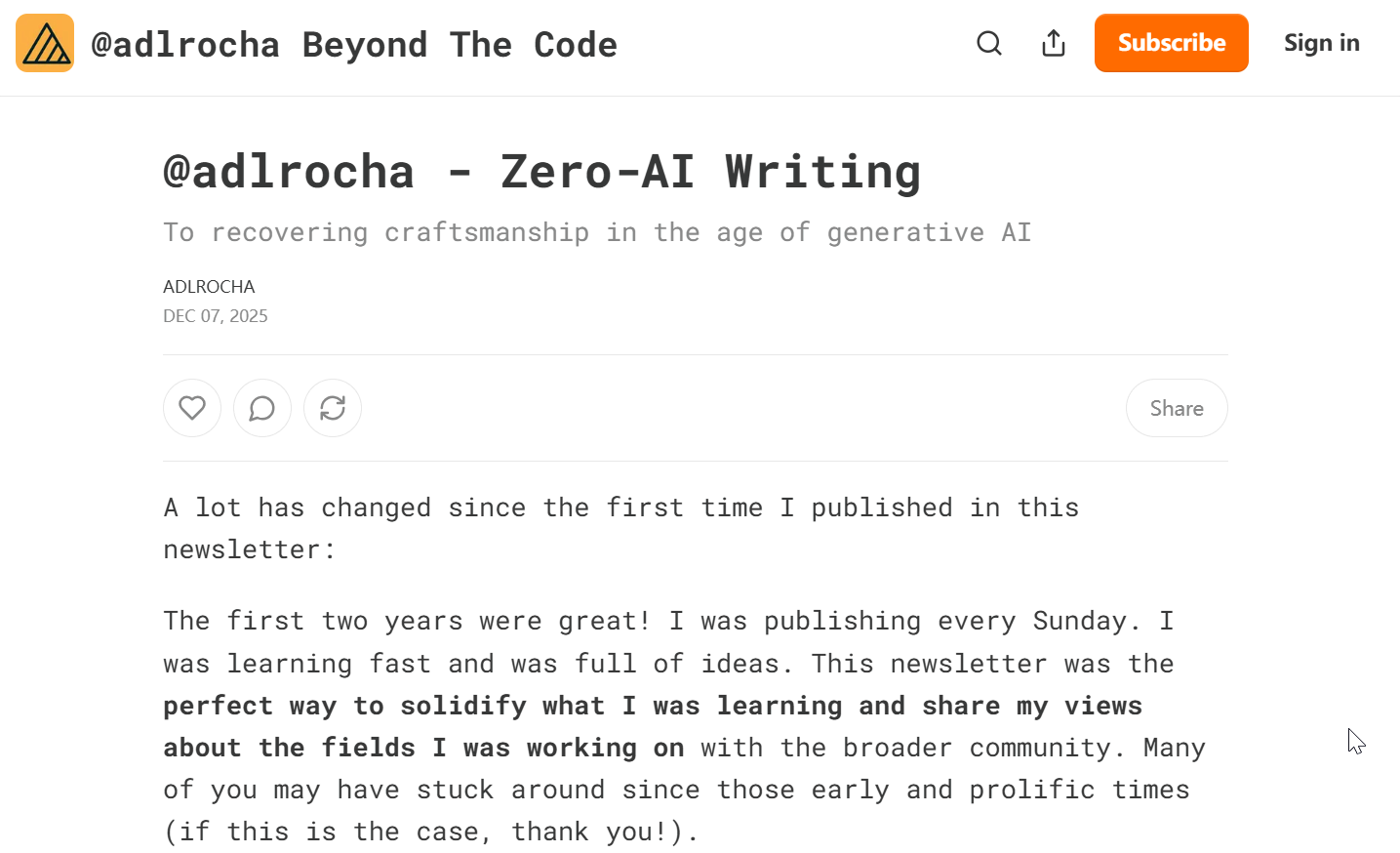
Coincidentally, this morning Lao T saw an article titled “Zero AI Writing” on the HN front page. Inspired by it, let’s discuss the flaws of AI writing and how to distinguish it.
If AI is Compared to Industrial Assembly Lines, Then “Zero AI Writing” is Undoubtedly Handicraft
Over the years, influenced by programs like “Ma Qiansu” and “Tech Yuanren,” Lao T has indeed held “industrial thinking” in high regard, habitually using it to look down on “handicraft” in daily life, considering “handicraft” as a symbol of technological backwardness, often promoting “mysticism” and selling “IQ tax.”
For example, those “handbags” and “bags” marketed as purely handmade, costing tens of thousands of dollars, or “mechanical watches” and “supercars” still boasting pure handmade craftsmanship in the era of technology and digitalization.
Of course, this view is somewhat biased and can even lead to conflicts within families.
But once this issue is brought into the context of writing, everything seems to change.
The more text produced by AI assembly lines, the more it is despised by the public; the more handcrafted the writing, the more trust it gains.
In other words, the “industry vs. handicraft” logic I originally used faces serious value challenges in the field of AI text generation. At first glance, it even seems completely reversed.
Delving deeper into this issue, I think the core controversy lies in: Is AI writing truly a progress in productivity?
Is AI Writing Truly a Progress in Productivity?
Humanity’s transition from handicraft to industry was undoubtedly a tremendous progress in productivity, promoting immense material wealth and allowing people in every corner of the world to conveniently enjoy the benefits and conveniences of industrial products.
AI creation also offers ordinary people the possibility to produce more digital products.
It allows ordinary people to significantly reduce learning costs and quickly create content that was previously impossible in the simplest way. For example, it enables someone like me, who knows nothing about database structures, to immediately create a conversion script to transform a WordPress MySQL database into markdown files.
From this perspective, AI creation is clearly a progress in productivity.
The same applies to writing. For instance, I previously had hundreds of articles that needed to be translated into English, with “summary” information written and article tags standardized. If I had to do it alone, the workload would obviously take more than ten days or half a month, but with AI, it was all completed in just a few hours.
Additionally, over the past year, I have indeed relied heavily on AI for assistance in my writing process, especially for information retrieval, text proofreading, content verification, and formatting adjustments.
But undoubtedly, key aspects of the writing process—such as main ideas, article structure, cited examples, factual narratives, and specific sentence structures and vocabulary usage—all stem from my own genuine thinking.
This raises another question: Does AI-assisted creation count as AI writing?
Does AI-Assisted Creation Count as AI Writing?
I think it’s best to reflect on this using the examples of industry and handicraft.
In reality, industrial products and handicrafts are usually easy to distinguish. Ordinary people can judge most physical items based on price and common sense.
But there are also many that are hard to distinguish, such as grains, vegetables, poultry, meat, eggs, dairy, and some products marketed as “handmade” that are actually produced on industrial assembly lines.
The same goes for AI-assisted creation. For text generated directly from simple prompts, most readers can tell at a glance that it’s AI-generated. However, for content that is carefully polished and reworked based on AI-generated drafts, or content imitated through deep learning of an individual’s existing writing, identification becomes much more difficult.
Even in the field of image generation, some images produced by the latest Gemini Banana are indistinguishable even to AI itself, making it even harder for ordinary people to judge.
However, just like “industrial products” and “handicrafts,” the boundary between them is actually quite blurry. After all, purely original “handicrafts” are extremely rare in reality.
For example, calligraphy and paintings by celebrities are firmly considered “handmade products” by most people. However, for mass-produced “calligraphy and paintings” sold online, it’s hard to call them “handmade products” because they are almost all stamped from the same mold, even if they are genuinely handwritten.
Similarly, smartphones are almost unquestionably “industrial products.” But upon closer thought, aspects like the phone’s exterior and electrical design, UI design, functional design, and even assembly on the production line all involve “handcrafted” elements to some extent.
Of course, I might be suspected of “equivocation” here. The premise of discussing any issue is based on consistent concepts; otherwise, it’s like “a chicken talking to a duck.”
But unfortunately, our distinction between “industry” and “handicraft” is far from clear-cut.
Some distinguish based on industrial and agricultural catalogs, some based on production scale, and others based on whether machines are involved.
For example, in a recent article I wrote, “Why Are People Still Using 20-Year-Old Computers?”, the ThinkPad X210Ai mentioned is actually produced by a small, workshop-style company that customizes computer motherboards, purchases the latest components, and refurbishes old computers from 20 years ago for sale. Such a product can generally be considered a “handicraft product,” but every component is undeniably industrially produced, so calling it an “industrial product” also seems reasonable.
This kind of dilemma likely only arises in human consciousness; AI obviously wouldn’t experience it.
AI Writing Cannot Create Knowledge Increment
In reality, when questions like “Will AI replace human creation?” are raised, many people immediately point out that AI is merely integrating existing knowledge and cannot provide “information increment.”
To some extent, this proposition is indeed correct.
The core mechanism of AI is based on models trained on massive datasets, using statistical probabilities to predict and generate text. Essentially, it is “reorganizing” existing information—a tool for calculating language rules rather than creating new knowledge from scratch.
But some people question this. For example, according to Wittgenstein, the limits of language are the limits of the world. Theoretically, AI language is no different from human language; it is based on combinations of human language. Logically, AI should also be able to reach the boundaries of the human world. Even if current AI computing power is insufficient, as long as computing power continues to increase, there will eventually be a day when it is exhausted.
As I mentioned in a previous article, “AI Investment May Drag the U.S. into Another Quagmire Like the War on Terror”, AI currently mainly solves one problem: translating human natural language into “machine-understandable language” (such as code, API calls, data tables, vectors, etc.), and then translating program and machine language back into human-understandable language (including text, speech, images, etc.).
In other words, the AI created by humans actually offers limited creative capabilities. It heavily relies on human information input—that is, “rule-setting”—and makes language predictions based on these rules, selecting the option that appears optimal according to existing rules.
AI fundamentally cannot achieve “exhaustive enumeration” to produce effects like Liu Cixin’s The Poetry Cloud. After all, an article like Preface to the Pavilion of Prince Teng, with only 773 characters, if truly written through exhaustive enumeration without prior knowledge in the AI database, would likely consume all the energy in the universe to accomplish.
However, if the task is simply to have AI write a similar article, it doesn’t seem too difficult. Even if it cannot reach the heights of Preface to the Pavilion of Prince Teng, achieving 70–80% of its quality is possible, and for some common themes, even over 90% is not impossible.
After all, even Preface to the Pavilion of Prince Teng integrates many historical allusions and imitates phrases from predecessors. For example, the most famous line, “The sunset glow flies with a solitary duck; the autumn river shares the same color with the vast sky,” is suspected to be imitated from Yu Xin’s Ode to Horse Archery: “Falling flowers fly with the canopy; the willow shares the same color with the spring flag.” In fact, many sentences in Preface to the Pavilion of Prince Teng resemble the style of Yu Xin’s Preface to Lament for the South.
The crucial issue lies in whether the “input rules” humans provide to AI constitute incremental information, not in whether AI itself can create incremental information.
For example, when I previously researched how the “Corruption Perceptions Index” was fabricated, without AI tools, I could only rely on experience to judge that the index had serious issues. Although somewhat convincing, it always felt lacking.
Later, I input the data into AI for verification. It helped me use over ten methods, including prime number trap detection, numerical fingerprint analysis, response quantity distribution testing, answer combination frequency analysis, extreme value testing, dynamic fluctuation analysis, Benford’s Law verification, and dimensional dispersion testing, to determine that the data sources were highly likely fabricated. It concluded with statements like “the degree of unnatural consistency has reached a statistically impossible level of spontaneous formation” and “the probability of data authenticity is less than one in a million.” These methods undoubtedly exceeded my knowledge base and were more scientific approaches.
In other words, this index, long regarded as a benchmark by the West, has effectively been debunked by AI. However, based on online search results, aside from my article questioning the fabrication of the “Corruption Perceptions Index,” there is no second article like it.
This is undoubtedly AI indirectly helping us create knowledge increment.
But this kind of creation is highly unpredictable!
Taking the article about the “Corruption Perceptions Index” as an example, I explicitly mentioned in the final “Data Analysis” section that the analysis was conducted with AI assistance. Since I don’t understand those mathematical analysis tools, I couldn’t judge the correctness of the results and could only infer based on common sense that the analysis “might make sense.” After all, I only asked AI to analyze after noticing those abnormal numbers. Under such deliberate guidance, the possibility of AI making errors is also significant.
AI cannot truly “understand” content; everything boils down to mathematical calculations.
Its limitation lies in strictly outputting content based on logic and reasoning. Even for an absurd proposition, it can pull it back to a slightly higher logical level than ordinary people.
However, this doesn’t mean AI’s logic is “correct.” In the process of researching various issues, I often engage in repeated “tug-of-war” with AI. Sometimes, it takes dozens of back-and-forths to correct an issue. Fortunately, domestic API prices are cheap. If it were as expensive as Claude Opus, it would be unsustainable (though it’s undeniably useful—many complex codes can be resolved in just one or two attempts).
Emotional Value is the Soul of Human Writing
If knowledge increment is the “skeleton” of writing, then emotional value is the “soul” of the work.
Most people believe that human writing is difficult to replace by AI precisely because it carries emotions, resonance, and personal warmth—elements that AI cannot simulate.
AI-generated text often appears conventional and lacks personality. It can imitate a certain style but struggles to capture the subtle fluctuations of human emotions.
For example, an essay by a human author may be filled with unique insights and emotional tension due to the author’s personal experiences, creating strong resonance with readers. However, AI’s output is always a patchwork of preset templates. While logically rigorous, it lacks the warmth that touches hearts and resonates with readers.
Additionally, emotional value is reflected in the author’s stance and attitude. Human writing often carries subjective colors, capable of sparking controversy or debate, which is part of the joy of reading.
But AI, in pursuit of “neutrality,” typically avoids extreme viewpoints, resulting in bland and unremarkable content. What readers feel in human writing is not just information but also the author’s personality, perspective, or emotions—elements that form emotional bridges connecting people.
In short, emotional value makes human writing more than just “information.” This is why “zero AI writing” is perceived as more trustworthy by readers.
It reminds us that the core of writing lies in conveying humanity, not merely efficiency.
The Boundary of AI Text Lies in “Understanding the World”; The Meaning of Human Language Lies in “Transforming the World”
It’s not hard to see that current AI, as an advanced tool, primarily helps humans “understand the world.”
AI describes facts and summarizes knowledge through data patterns, helping users better comprehend the world.
It excels at processing vast amounts of information, extracting key content, and providing relatively accurate viewpoints. However, all of this is based on existing data; it cannot step outside the framework to challenge or reshape reality.
But the essence of human language lies in “transforming the world.” It is not just a tool but also a carrier of human social life and practice.
Humans use language to express demands, propose ideas, and drive change, often involving areas like contradiction transformation, causality, and universal connections.
For example, contradiction. As is well known, contradiction is universal and omnipresent. But in the AI world, contradiction is significantly weakened or even deliberately eliminated. AI’s design principle is to pursue consistency and logic. If the output contains internal conflicts, it may be considered an error and optimized away. After all, if AI could output a viewpoint with inherent “contradiction” or “controversy,” it would clearly contradict its “tool” positioning.
For instance, I once wrote an article arguing that “a certain behavior should be criminalized,” with the core viewpoint being that existing legal rules should be amended according to developmental needs. However, after submitting the article to a platform’s AI review, the platform’s AI directly pointed out that the article’s viewpoint “conflicts with current laws” and was “severely违规.” Ultimately, I did not publish that article on that platform.
This further validates the judgment I made in a previous article, “If Laws Do Not Prevent It, the Scenario of AI Enslaving Humanity May Accelerate”.
As AI further permeates all aspects of society, other human behaviors will likely also have to constantly face AI analysis. At that time, humans will have to deliberately adjust their speech and actions to “cater” to AI’s evaluation of them.
Even human speech may face AI review, let alone content generated by AI itself. AI is designed to avoid outputting content that might cause social unrest or ethical controversy, keeping it within a “safe zone” and unable to drive revolution or reform like human language can.
Additionally, human language can express abstract, intuitive things, similar to what Wittgenstein called the “unsayable” (what must be shown), which often transcends data patterns. For example, in a recent video with tens of millions of views, many comments were flooding with “Long live the people.” Without understanding the context, it’s impossible to know what this phrase means. Even with AI analysis, it’s difficult to draw correct conclusions.
Ultimately, the boundary of AI writing lies here: it remains within the “sayable” (what can be said), while human language can naturally touch the “unsayable,” such as emotions, ethics, innovation, contradictions, and controversies.
These elements make human language the engine of social development. Recognizing this, we can better distinguish AI content and cherish the unique value of human creation.
How to Identify Whether an Article Is AI-Generated
Finally, returning to the main topic of this article: How to distinguish whether an article is AI-written?
To be honest, this question is indeed difficult. With the advancement of AI technology, especially AI-generated content that has been finely tuned and edited by humans, it is becoming increasingly hard to tell at a glance.
For example, my previous article on [“Why Sealing Criminal Records Is Necessary”](/en/article/ignorance-as-protection/The article, despite appearing AI-written in format—with short sentences, list structures, clear organization, and emojis—was crafted that way entirely because the system had “for the first time” deleted one of my articles that day.
Since they were on the same topic, I had to consider using the platform’s AI to judge whether this new article could be posted before publishing it. Otherwise, having it deleted immediately after posting would have been quite frustrating.
After rewriting the article, following the platform AI’s suggestions, I optimized it for mobile reading by using short sentences and list formats as much as possible. Then, I asked the AI to help with formatting, and it compressed my original 3,000-word draft into 1,200 words, resulting in the current version that looks “very AI.”
However, there’s no doubt that the article was indeed written by me. The AI only played the role of editor and optimizer, not content creator. I believe readers who have seen the comment section can also recognize this. Behind that article, I’ve already written seven to eight thousand words just replying to comments and private messages (many comments were deleted by the system after I replied, and there were several instances where my carefully edited replies vanished the moment I sent them…).
This situation shows that relying solely on surface features like sentence length, structural standardization, or vocabulary repetition rates often leads to mistakes.
AI can imitate human style, and humans can also use AI tools to “AI-fy” their own work. Even some AI detection tools themselves are unreliable—they may misidentify human writing as AI-generated, and vice versa.
So, does this mean it’s truly impossible to judge?
I think we should return to the analysis I mentioned earlier.
First, rely on personal intuition and overall impression. AI content often gives a “perfect but hollow” impression. It’s logically smooth but lacks a personal touch. After reading it, you might feel “the information is complete,” but you aren’t moved or inspired. This is a subjective intuition that requires accumulated reading experience.
Second, check whether it provides informational value. Does it offer genuine understanding or a unique perspective? If the content is merely a reorganization of existing information without original analysis or cross-domain connections, it’s likely AI-generated. Conversely, if it includes incremental knowledge based on personal experience, it leans more toward human creation.
Third, see if it delivers emotional value. Human writing often carries warmth, humor, anger, or contradictions—elements that resonate with readers.
Fourth, observe whether contradictions and questions are raised. AI tends to avoid conflict, producing neutral and objective content. If an article boldly challenges the status quo, contains internal tension, or involves ethical discussions, it’s more likely to be human-written. However, on certain platforms, this judgment might also “fail” because controversial content, especially that which could provoke opposition, is automatically blocked by the system, making it more complicated to assess.