
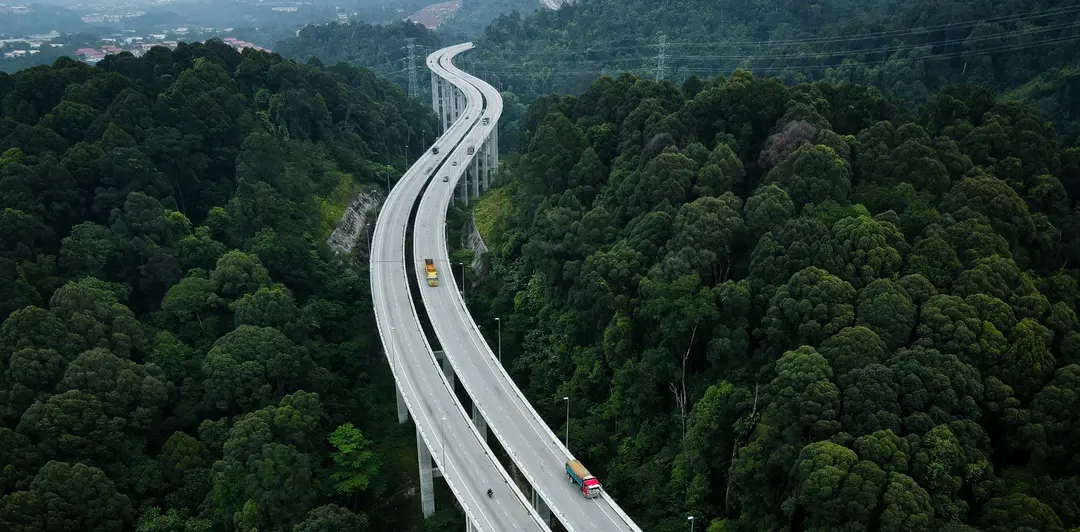
Shuangfeng County wants to put the Hengshan Baiguo to Shuangfeng Expressway at the very top of its 15th Five-Year transport plan. The road passes through my hometown, Heye Town, but what I care about here is not nostalgia. It is how the line actually runs, and where it will open its exits.
Going through the county’s documents lately, I found the party secretary’s speeches and several county committee reports all placing this expressway first in the 15th Five-Year transport plan. It is the east-west corridor southern Shuangfeng has been missing, linking the Huachang Expressway at one end and the Xuguang Expressway at the other.
What This Road Weighs in the Plan
Let me put the hard numbers from the official brief on the table first. The main line runs about 66.5 kilometers, built to a dual-carriageway, four-lane expressway standard. The whole line has 8 interchanges, 3 of them hub interchanges and 5 ordinary ones, plus 1 service area.
The western start connects to the Shuangfeng West interchange on the Huachang Expressway (S71). The eastern end connects to the Xuguang Expressway (G0421) and the under-construction Bainan Expressway (S76). The road bites into existing arteries at both ends, then drops a few more exits in between to string the towns of southern Shuangfeng together.
For quite a few towns along the way, this is the first time an expressway will pass their doorstep. One east-west expressway, plus a handful of exits, changes how an entire district reaches the county seat and the world beyond.
Which Towns Does This Expressway Pass Through?
Following the main line from east to west this time, the towns it passes through in order are Baiguo Town, Xinqiao Town, Heye Town, Jingzi Town, Shatang Township, the south side of the Yongfeng county seat, and finally Yintang Township.
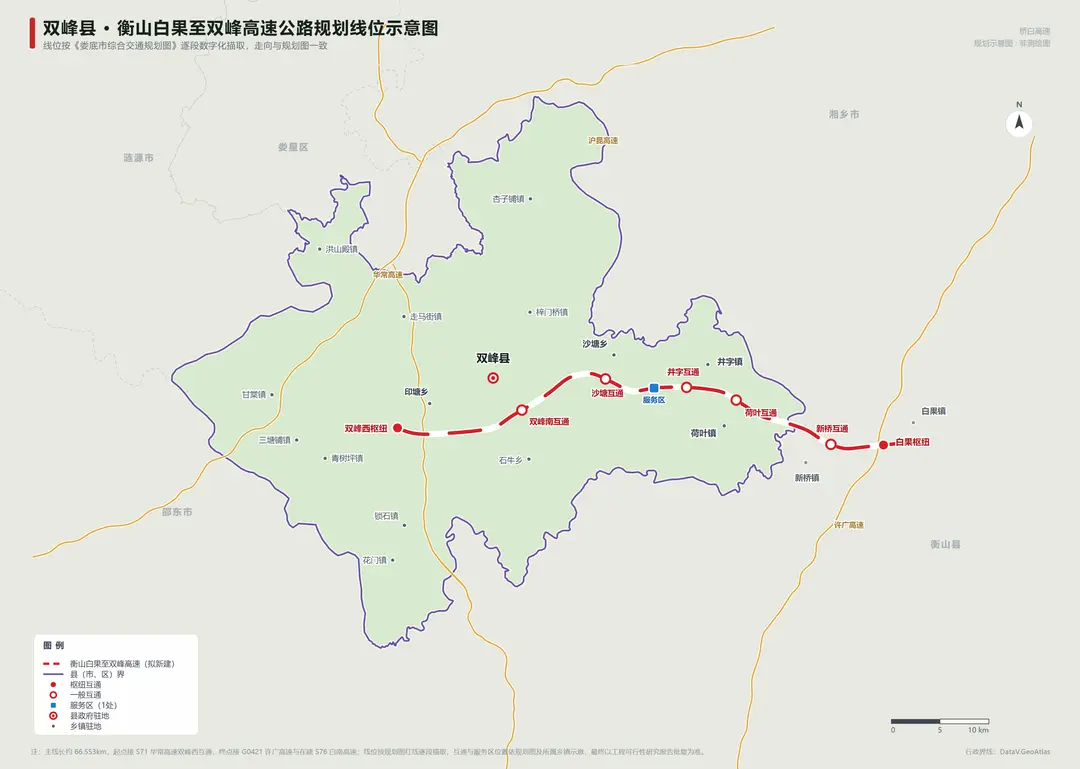
The line basically hugs the southern edge of Shuangfeng County, cutting through hills the whole way. Not far to the north stands Ziyun Mountain, whose main peak at 818.8 meters is the highest point in the county, while the south side runs close to the county border. At Heye Town the route meets a river, the Juan, a tributary of the Xiang River.
How Might This Expressway Actually Run?
Judging by the current official schematic and some earlier media reports on the route, the whole line will likely carry 8 interchanges and 1 service area. Once you set aside the two ends and the points where it meets other expressways, roughly 5 on-ramps are left for traffic along the way to actually get on and off.
Working from the current official schematic, here is my rough reading of the alignment and the node positions.
Start at the eastern end. The Baiguo hub feeds the road into the Xuguang Expressway. This eastern end will also connect to the under-construction Bainan Expressway one day, so the third hub in the official count most likely sits around here too, though public materials do not specify the spot. Heading west from Baiguo into Xinqiao Town, the Xinqiao interchange sits at Xinqiao.
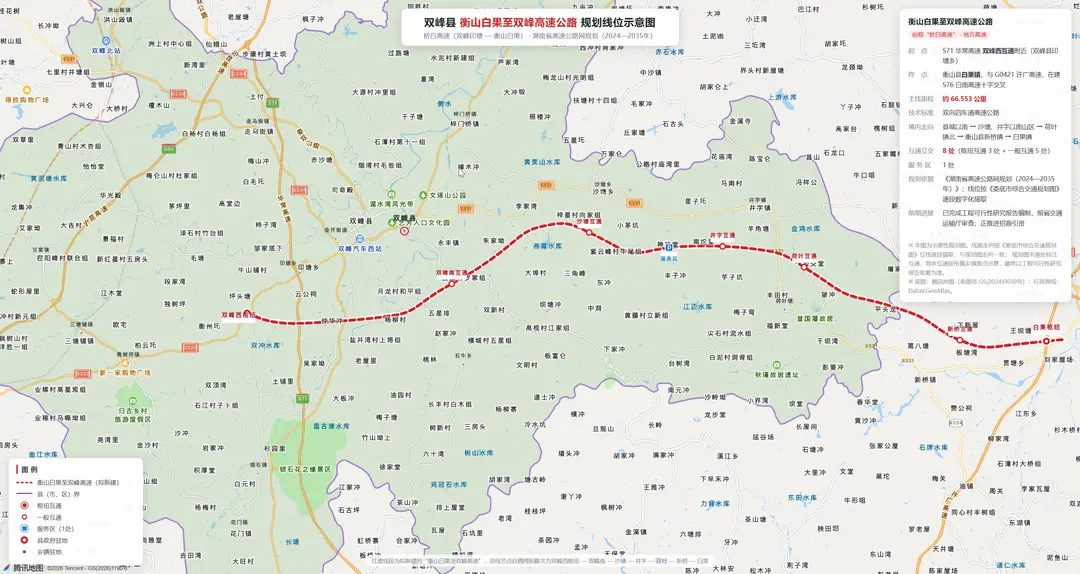
Keep going west into Heye and you reach the Heye interchange. On the current schematic, the Heye interchange lands roughly in the north of Heye Town, at the border with Jingzi Town, right beside the Juan River, near Qingquan Village, which used to be Jianshe Village. Qingquan is a provincial pilot village for rural construction, with the Juan flowing past its edge and fields of rice inside it.
From this spot it is less than three kilometers south to the Former Residence of Zeng Guofan at Fuhou Hall. About three kilometers west is the Former Residence of Cai Hesen and Cai Chang at Guangjia Hall. And it is about five kilometers by car to the centers of both Heye and Jingzi towns. One exit, with two national heritage residences and two towns within three kilometers. With the interchange here, the northern part of Heye connects to the expressway first.
Further west is the Jingzi interchange, serving Jingzi Town. Past Jingzi comes the service area. Judging by the point currently marked on the map, this service area may fall in the Yuexi Village area of Jingzi Town, right in the Ziyun Mountain wind farm zone. Yuexi has changed a lot in recent years. After the Ziyun Mountain wind project landed, the village put up 7 turbines, a sizeable share of the whole project. The turbines on the ridge, the sea of clouds, and the cliffside guesthouses that came later had already made it a new scenic spot. Putting a service area here gives people on the expressway a place to pull over and take in the mountain pass.
Further west into Shatang Township sits the Shatang interchange. Past Shatang, not far west is the Shuangfeng South interchange, on the south side of the county seat, serving the town and the Yintang area. Finally at the western end, the Shuangfeng West hub connects to the Shuangfeng West interchange on the Huachang Expressway, and that is where the line ends when you travel from east to west.
All those points sit on this map. The red line is the alignment traced from the planning map, and the outline is the Shuangfeng county boundary. You can drag it around and zoom in on any node. The map labels are in Chinese.
How Accurate Is This Prediction?
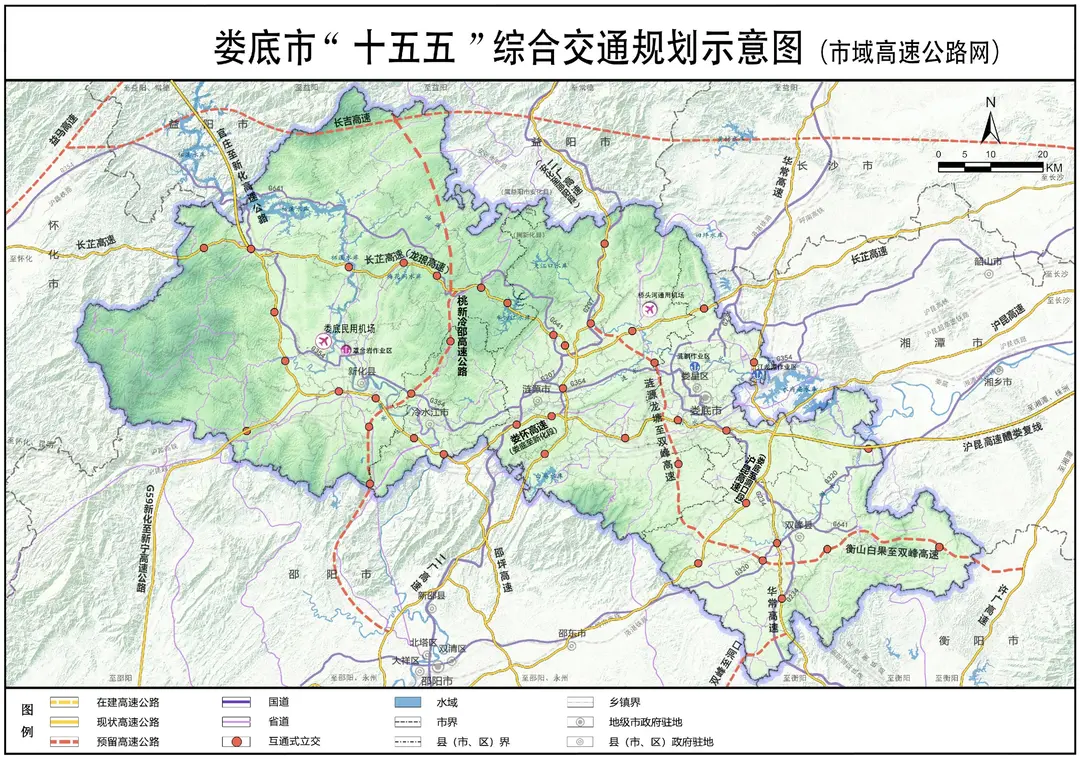
That prediction map above was not drawn out of thin air either. Its source is this one, the Loudi 15th Five-Year Comprehensive Transport Plan schematic. Of everything officially released so far, this is the clearest rendering of the line.
The red dashed line runs west from Baiguo Town in Hengshan County, cuts across the southern part of Shuangfeng, and reaches the Huachang Expressway. The direction is plain at a glance, with both the east and west ends accounted for.
But the trouble lies in exactly that. This is a whole-prefecture map, with all five counties and districts of Loudi fitted onto one sheet. In the lower right corner where Shuangfeng sits, the red line is only so thick, the map gives just three interchange dots, and not a single town name along the route is labeled.
It can only tell you which way the line runs. It cannot tell you which village it passes behind, or whose field the interchange opens onto. And the second layer is exactly what I wanted to know.
That is why I turned to WorkBuddy and copied the red line, as it is, onto a much finer map. Where the original bends, the copy bends. Where it crosses a ridge or hugs the county border, the copy does the same.
The method sounds simple enough. On the planning map the line is a flat red, easy to separate by color. I pulled out the red pixels block by block, filtered out other red elements, kept the main trunk and sampled it point by point. Then I matched the red line against Shuangfeng’s county boundary and solved for the conversion between map pixels and real coordinates. Finally I moved the sampled points onto the county map with that transform.
Two traps along the way. A legend symbol was itself drawn off position, and using it as a control point shifted the whole line by about two kilometers. And out of convenience I once connected the towns directly, which sent the line straight over the ridge tops, nothing like what the map shows. Both were fixed by going back to the map and calibrating bit by bit.
But I have to be clear about the limits. However accurately those two maps above are copied, only the alignment is copied. The planning map is itself schematic and does not represent the final alignment, and the official side has said the alignment has not been formally published. The positions of those interchanges and the service area are reasonable estimates based on the points currently marked, not the final red line. How it is truly set must wait for the feasibility study approval, and that is the authority.
So the Heye interchange and the Yuexi service area described above are where the current map roughly puts them, not a guarantee of where they will end up, and not even a guarantee that these interchanges and this service area will be built at all.
Highway planning and construction, in particular, is rarely a short-term affair. It usually takes many years, and runs on cycles of five or even ten years. What happens in the future is genuinely hard to say.
But whatever happens, the building of this expressway has already taken its first solid step.
In Closing
Zeng Guofan was born in Heye. He later walked out of here, to Changsha, to Beijing, and then led the Xiang Army all the way to Jinling. Describing the roads he traveled back then, he often used the phrase “lu ji man”, extremely rough. One word for rough says everything about how hard it was to get anywhere.
Cai Hesen walked out of Jingzi. He went first to Changsha, then to Beijing, and finally to France. In Paris, armed with a dictionary, he chewed through newspapers and translated furiously, carrying bits of the outside world back to China.
One born in Heye, one raised in Jingzi, their old homes separated by a few hills. When they left, they relied on their feet, on boats, on letters that took months to arrive. What they had in mind was probably not just their own way out, but making it easier for the people of this mountain-ringed place to leave after them.
Now an expressway runs past the north of Heye, with its exit close to their old residences. From here, a few hours on the expressway reaches Changsha, and heading east onto the Xuguang takes you all the way south.
That “lu ji man” Zeng Guofan mentioned time and again may finally be a closed chapter in this generation’s hands.