
Recently, I have seen many “bad ideas” on short-video platforms, claiming that the Hormuz submarine cables are a “trump card” in Iran’s hands. If the several submarine cables in the Strait of Hormuz are cut, the global Internet will be paralyzed instantly.
This statement sounds indeed terrifying, saying that those thin glass fibers carry about 17% of global traffic, and behind them are data centers in Saudi Arabia, the United Arab Emirates and other countries supported by Google, Oracle and Microsoft. But honestly, if you take a close look at the operation mode of submarine cables, you will know that this claim is untenable.
Submarine Cable Damage Is the Norm
Submarine cable breaks are, in fact, just as common as land cable breaks. Just like underground cables being dug up during road construction, bridge building or pipeline laying, submarine cables are constantly at risk of various damages. According to statistics from the International Cable Protection Committee (ICPC) and the International Telecommunication Union (ITU), there are an average of 150 to 200 submarine cable faults worldwide every year. This means that on average, every two days, a submarine cable somewhere on Earth experiences a break, power leakage or signal interruption.
Among these, about 70% to 80% of damages are related to fishing trawlers and anchoring of commercial cargo ships. In busy waterways (such as the Strait of Hormuz or the Strait of Malacca), due to complex seabed terrain or illegal vessel operations, anchors accurately hook and break cables, just like excavators cutting underground optical fibers. Even in the early days of submarine cable construction, shark bites out of curiosity about the electromagnetic fields generated by electric currents were also frequent entries on fault reports.
The key point is that despite such a high frequency of faults, ordinary people hardly see news about “network outages caused by a cable being broken by a fishing boat” in daily reports. The reason lies in the fact that the operation of submarine cables is never a solo effort, but a highly industrialized, process-oriented and intricate system. For telecom giants and Internet giants, cable breaks are not “accidents” but “inevitable” routine maintenance costs.
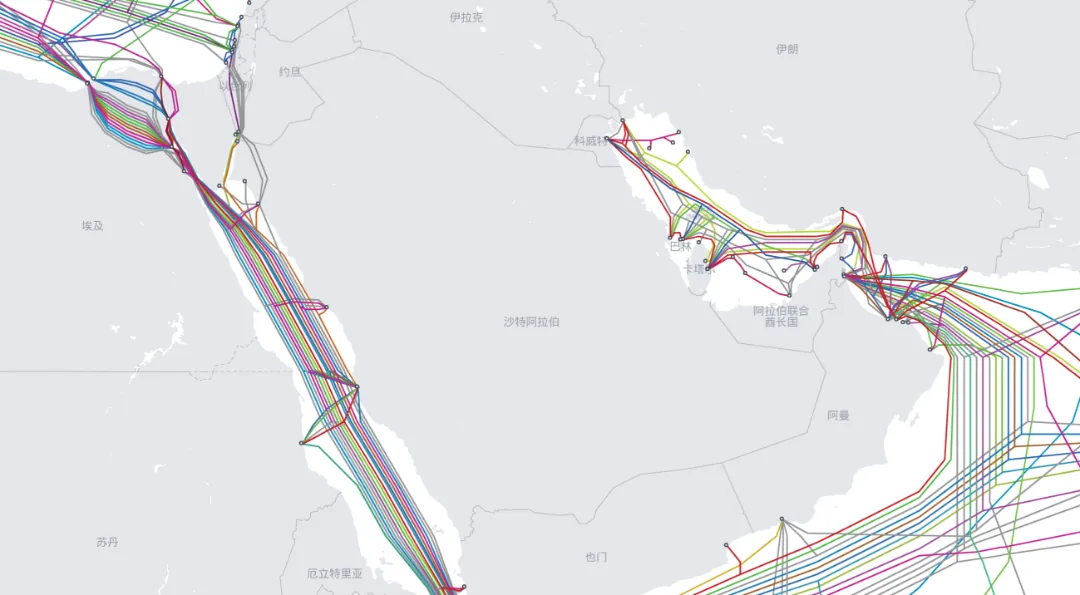
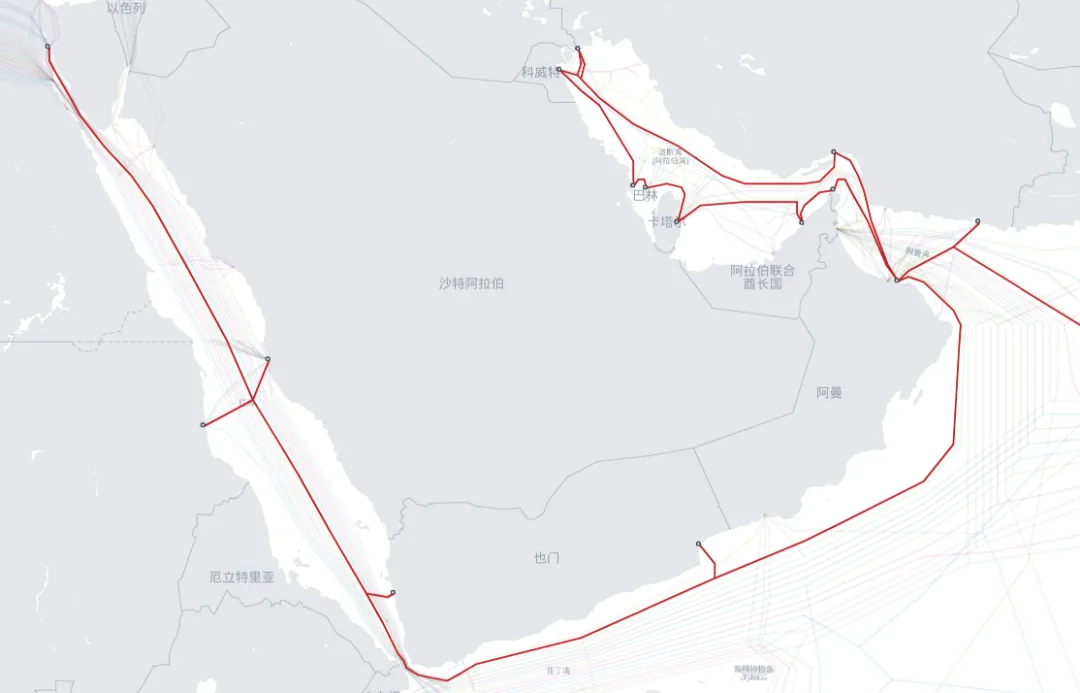
In fact, a look at the distribution of Middle East submarine cables reveals that only 9 cables pass through the Strait of Hormuz, compared with as many as 29 passing through the Red Sea. In the context of the global cable layout, the few cables under the Hormuz seabed are hardly a big deal.
If we examine the 9 submarine cables under Hormuz one by one, we will find that their impact would actually be quite limited even if they were cut. For example, even if both the inbound and outbound segments of the Falcon cable built by Alcatel-Lucent in the Hormuz section are cut, it can still connect to Middle Eastern countries through 5 entry points in Saudi Arabia, Yemen, Egypt, Oman and others. These entry nodes, in turn, may intersect with other submarine cables. At most, it would affect the network speed of several nodes within the Persian Gulf, and would not cause a network disconnection.
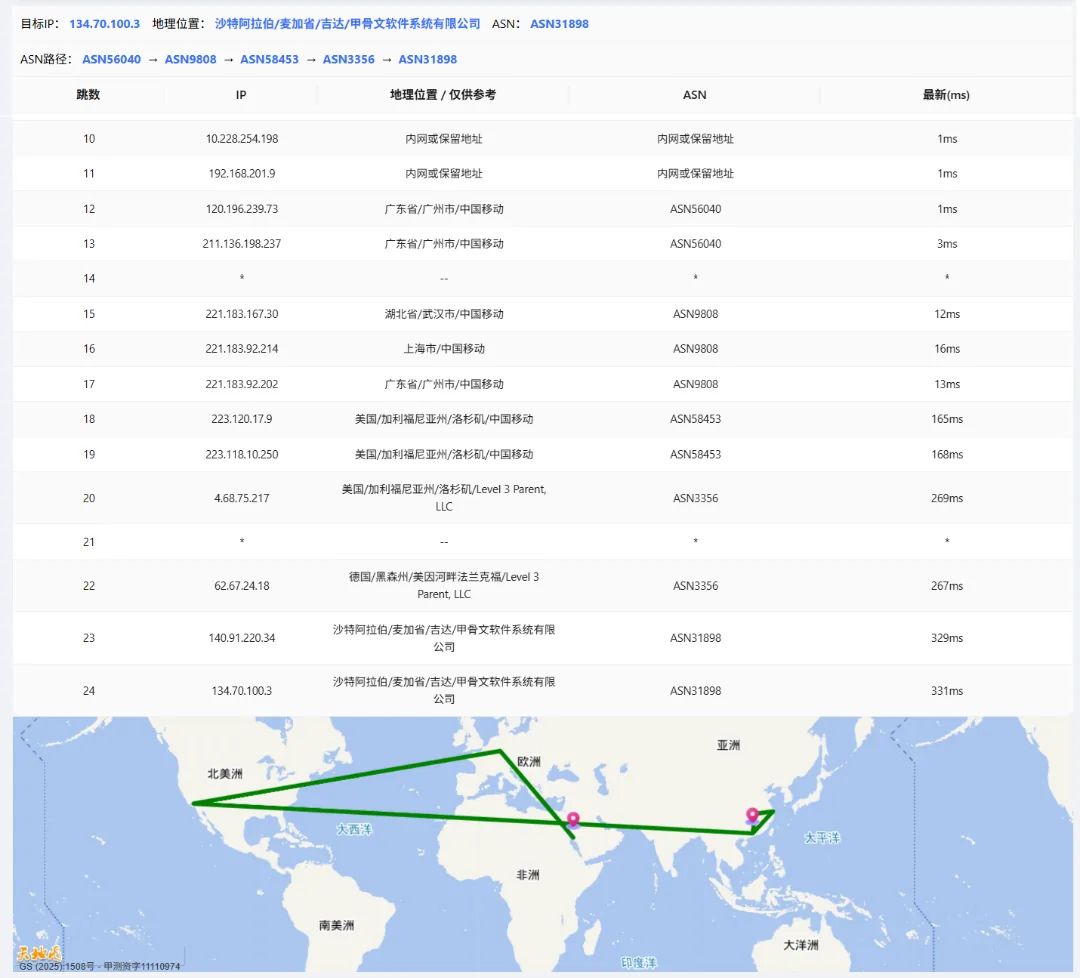
For instance, I randomly tested a line from China Mobile Guangzhou to Oracle’s Jeddah Data Center in Saudi Arabia, and it can be seen that the default route goes around North America and Europe, without passing through the Indian Ocean at all.
Submarine Cable Maintenance Is Not Difficult
Many people imagine submarine maintenance to be as difficult as landing on the moon, thinking that humans cannot dive to repair cables at depths of several kilometers in the ocean. In reality, cable maintenance does not require such operations.
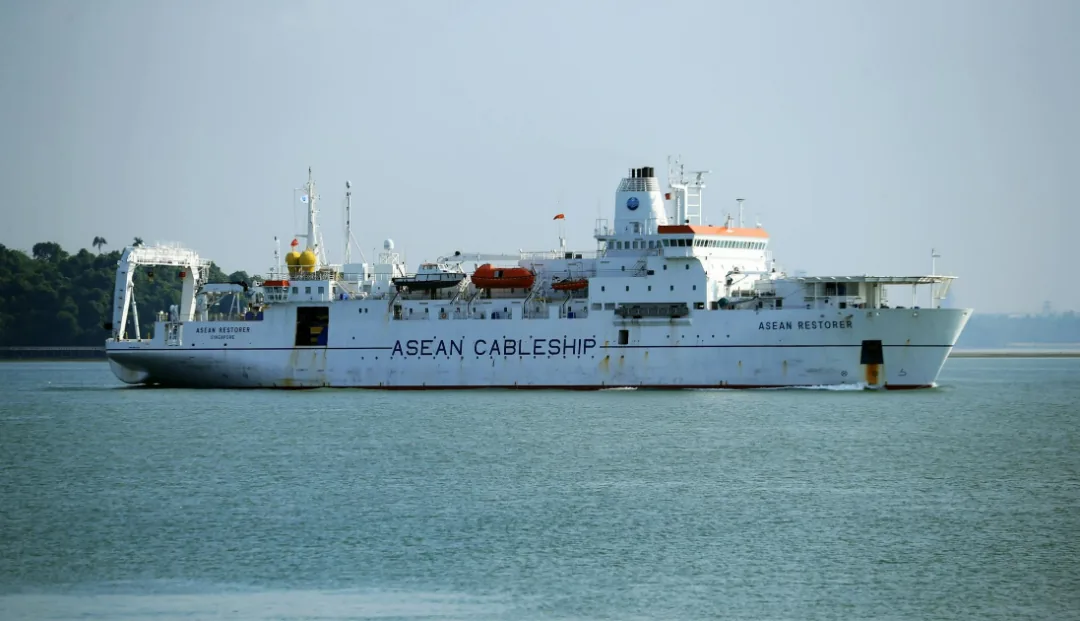
Modern engineering achieves incredible precision in locating fault points. Shore stations can quickly lock the breakage thousands of kilometers away within a very small error range through optical pulse reflection technology. Next, professional cable-laying ships will rush to the scene like ambulances, lower remotely operated vehicles (ROVs) to retrieve the broken ends, and perform fusion splicing in on-board laboratories.
For those wealthy IT giants, if a certain sea area becomes unsafe due to disputes, they will not even bother with on-site repairs, but will directly choose to “reroute”. The cost of laying a new line to bypass the disputed sea area is merely tens of millions of dollars for these giants, which is equivalent to an insurance premium compared to the billions they have invested in data center infrastructure in these regions.
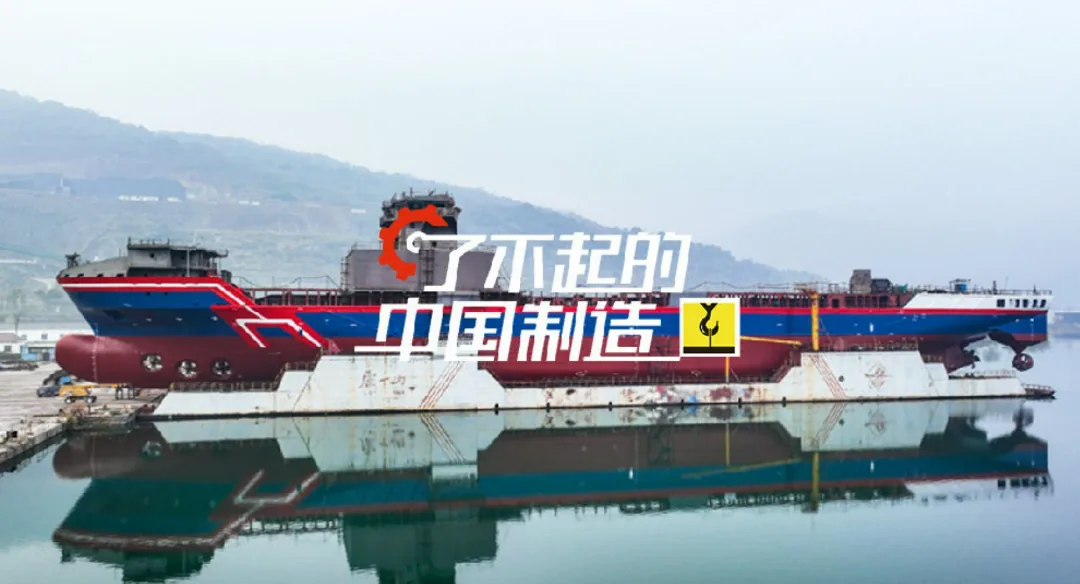
Furthermore, modern professional cable-laying ships have extremely high laying efficiency. For example, the Longyin 9, launched in Jiujiang, Jiangxi in 2023, can lay tens of thousands of kilometers of submarine cables in one go, with the process taking only a few weeks. These professional ships are either laying cables or repairing them on a daily basis. Moreover, there are currently 60 to 70 professional maintenance ships worldwide, sufficient to handle anomalies in various sea areas across the globe in a short time.
Internet Redundancy Design Is Beyond Imagination
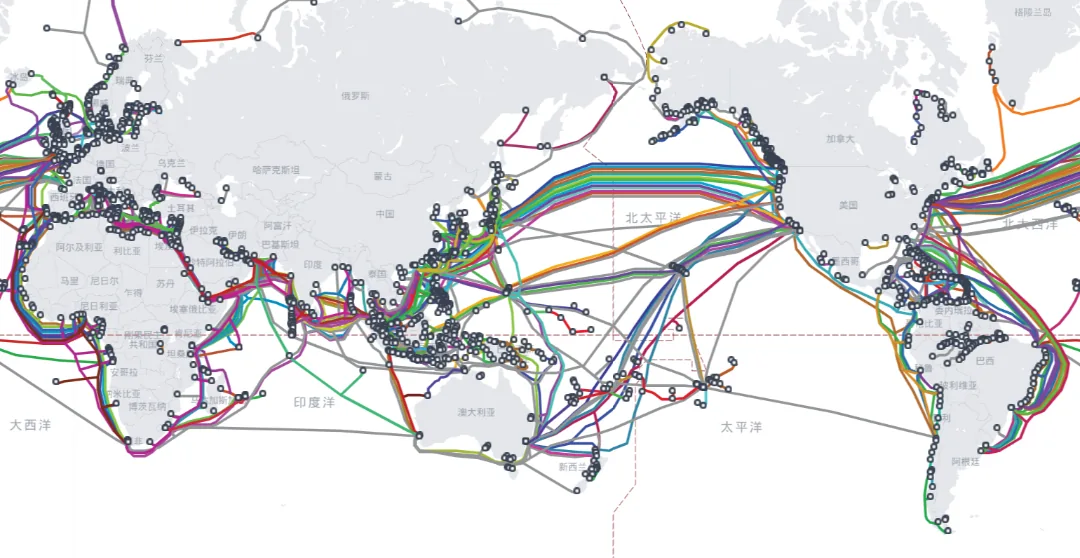
As mentioned earlier, there are hundreds of undersea cables currently operating globally, totaling millions of kilometers—enough to circle the Earth dozens of times. In fact, in our daily use of the internet today, we are not exhausting these physical resources; rather, there is a significant amount of “idleness” and “detouring.” This involves a core logic: whether a physical line is connected is one thing, but how the carrier directs your traffic is another.
Many people don’t understand why my test from Guangzhou to Saudi Arabia detours through North America. Logically, the physical distance through Malacca and the Indian Ocean is shorter. This is actually a commercial choice at the carrier (ISP) level. In the global internet landscape, there are complex “peering and transit” settlement relationships between carriers. If your carrier hasn’t negotiated a partnership with the owner of a specific “shortcut” cable, or if the traffic fees for that route are too high, the carrier will default to a route that is physically longer but commercially cheaper. This kind of “detouring” is extremely common in daily networking, proving that even if the shortest physical line breaks, your data packets are already accustomed to “shuttling” through servers in different countries.
Above this commercial logic, what truly ensures the network “won’t break” is BGP (Border Gateway Protocol) at the IT company level. If carriers decide your default path, then BGP is the intelligent navigation system in the hands of IT giants. BGP monitors the health of tens of thousands of routes worldwide. When it senses that a physical cable in the Strait of Hormuz has completely snapped and the link layer has failed, it reacts within milliseconds, automatically switching the data flow to other available partner links.
This redundancy design is actually the “survival gene” from the birth of the internet. After all, ARPANET, the predecessor of the internet, was originally designed to survive extreme environments like nuclear war. Its core logic is distribution. In the legal contracts of modern tech giants, they often explicitly require “triple-path heterogeneity” or even higher levels of backup.
This means that even if someone were to turn the seabed of the Strait of Hormuz upside down, data flows could still enter through other physical lines. At most, it would add a bit of the “detour latency” that already exists, without significantly affecting the global network.
On the contrary, service failures of the internet giants themselves are likely to cause a much greater impact. After all, if a cable snaps, you can reroute; but if Cloudflare experiences consecutive configuration failures like it did this year, or if an underlying cloud service like AWS suffers a “major outage,” that is the real pain point. Compared to the tangible glass fibers under the sea that can be respliced at any time, these “black box” software architectures and service logics have become the more fragile Achilles’ heel of the modern internet.