
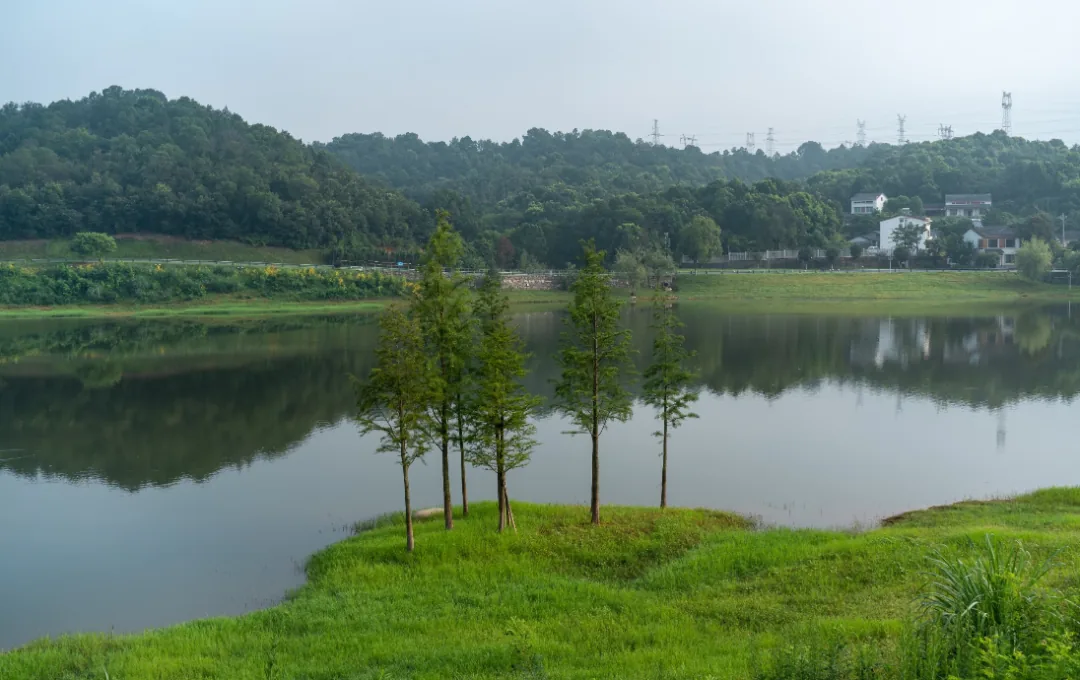
A few days ago, I kept discussing the CCTV exposé about the rice planting area fraud in Jianghua County, Hunan, on Zhihu and WeChat. That discrepancy of over 100,000 mu was cobbled together using “two sets of ledgers.”
Yes, it was fraud, but the comments from netizens were actually quite fair; most could view the outcome objectively. In the process, I kept asking myself one question: since you could easily figure out the result with a satellite or a simple yield estimate, why did it take so long for this fraud to be exposed?
Then it dawned on me. Because a deeply entrenched idea is stuck in many people’s heads: the countryside must remain stable, it must serve as a safety net, it is the ultimate fallback. In order to uphold the correctness of this idea, a respectable number must be maintained on paper. Whether reality can hold up — no one really bothers to check.
Those over 100,000 mu of fictional rice in Jianghua didn’t just appear out of thin air. They were scripted in advance by a notion that has been popular for decades.
I Used to Believe the Countryside Was a Fallback, Too
To be honest, when I was a kid, I really believed the phrase “the countryside is a fallback.”
Back then, it was a simple thought: at worst, I’ll just go back and farm. I’d done it since childhood, having become the main farm laborer at home by the age of ten or so. Could I possibly starve?
Later, after spending a long time in the city, I went back to my hometown for Chinese New Year less and less. Earlier this year, when I returned to the village to visit my uncle, he told me that my cousin’s daughter — his granddaughter — was the only baby born in our entire village the previous year.
Those words hit me hard. At its peak, our village had over 600 registered residents. Now, in a whole year, only one child was born. And this little girl, in all likelihood, will leave the village someday, just like my other female cousins who married out. Other young people who start families outside certainly won’t bring their children back to the village to raise them.
I tried to think a bit further ahead. In twenty years, thirty years at most, our village will probably be left with only a dozen or two retired old people — and that’s only if you count the generations from the 1970s and early 80s who still have some attachment to the land. Beyond that, there may not even be such people.
At that moment, I suddenly realized that the phrase “at worst, I’ll just go back” rolls off the tongue easily, but if I really went back, I probably couldn’t even support myself.
Later, I took a closer look and found that the people who still believe this phrase fall roughly into two groups: those who have already left, have no intention of returning, and use it to comfort others as well as themselves; and those who don’t have to worry about making ends meet anyway and are fantasizing about a happy rural life.
And those truly affected by this phrase are the ones tacitly assumed to be “able to go back.” They are assumed to have an exit option, forever. Because of this, their difficulties in the city become less urgent, less deserving of attention, and fewer people care. “Who cares, if they can’t make it there, they can always go back and farm anyway.”
A Fallback Without Large-Scale Feasibility
After the Jianghua story broke, I deliberately went and looked up some public data — things like national grain output, hybrid rice planting volumes, agricultural output value, and planting areas for various crops.
In the process, I came across the statement that “China’s agricultural output value is six times that of the United States.” This completely reset my understanding of the country’s capacity.
I used to think that the U.S., with its massive farms, heavy machinery, and huge output as a major agricultural exporter, would have far higher output value than China. But as it turns out, China’s per capita agricultural output value is actually 50% higher than that of the U.S. Feeding the entire nation hasn’t been a problem for a long time.
But what’s more interesting isn’t the value itself, but how it is generated.
When I pieced the data together, I realized it’s essentially the work of a small group of professional farmers, plus hundreds of millions of migrant workers in cities putting in their “spare time.”
In other words, very few people in the countryside are truly farming full-time nowadays. Large tracts of land have been transferred to large-scale grain growers, cooperatives, and agricultural companies, propping up yields through mechanization and scale. The vast majority of the remaining smallholders are basically retired elderly people or migrant workers who come back to help for a few days during the busy season — that’s all it takes.
In this state alone, the output value has already reached the historical peak of human agricultural production. Piling more people into it would be utterly meaningless.
After all, there’s a very simple principle in economics: human demand has an upper limit, especially for biological necessities. One and a half billion people, three meals a day — you can only eat so much. It’s not as if you can change from three meals to five or ten.
Throwing one more person into agriculture won’t increase output by much. It will only dilute the already meager farming income, turning one person’s subsistence into two people barely scraping by.
So the issue of “going back to farm” isn’t about whether it’s possible or not; it’s that there is no large-scale economic feasibility. You can go back, yes, but can the income from that piece of land support you to live even a minimally modern life? This is a basic calculation anyone can do.
Actually, when you think about it, today’s post-90s and post-00s generations have very little connection to the countryside, especially the post-00s. From the time they became aware, they have basically been living in the largest industrial nation in the world, and there are now roughly 300 million post-00s. Regardless of whether their household registration says “rural” or “urban,” their actual growth path is essentially no different from that of city kids. From school to future work, their entire life framework is urbanized. The vast majority have never even held a hoe. For them, “going back to farm” is not a fallback option — it’s a fairy tale, a completely nonexistent choice, or even a push into a dead end.
But speaking of hoes, I’m reminded of my own family’s few mu of land.
It was called farmland, but really it was a few terraced fields in a mountain hollow. You had to cross two hilltops to get there, and the entire valley was just a tiny patch of cleared flat land. In 2009, when I was still in college, the village mentioned that there was a policy for returning farmland to forest we could apply for. My grandfather flatly refused. He said, if we give up the fields, what will we eat when there’s no food?
He had feared famine his entire life; in his bones, he only trusted the land.
In the end, no earth-shattering event occurred. It was just that after I graduated, I never went back to help with farm work, and the family had no surplus labor. Those few mu of land just lay fallow. For over fifteen years.
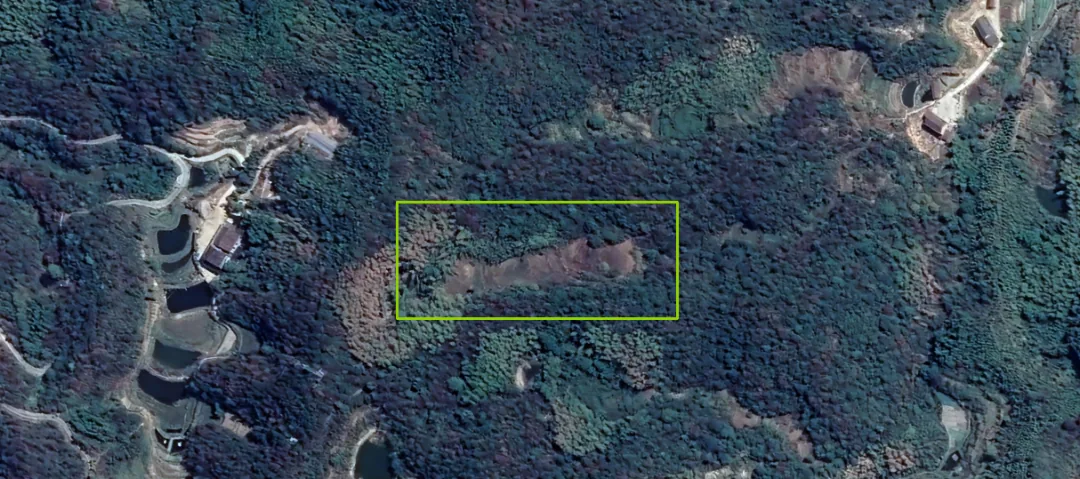
Once, out of curiosity, I opened a satellite map and tried to locate that spot. I zoomed in, further and further — I couldn’t tell at all that it was once farmland. It had merged with the surrounding shrubs and trees, the outline no longer distinct. Let alone a path — no one had walked there for over a decade, so how could there still be a road?
My grandfather probably never dreamed that the field he stubbornly guarded would end up being taken not by some policy, but silently swallowed by time. Along with the fear of “no food,” vanished without a trace.
So whom is this “fallback” really for?
The answer might be: it’s for the data to see, for the reports to see. Just like those over 100,000 mu of rice in Jianghua — they grow on paper, not in the soil.
Some Theories About Agriculture and Rural Areas Don’t Hold Up to Scrutiny
Over the years, I have read a fair number of articles discussing agriculture, rural areas, and farmers. A certain academic refrain appears repeatedly: the countryside is China’s “ballast stone,” its “reservoir” for coping with crises.
When I used to read this, I thought it made a lot of sense. But later, I slowly discovered a problem: the people saying these things seem to be no longer rural residents themselves, and they never ask whether “the water in that reservoir is willing.”
They tell you that the countryside can absorb the unemployed, but they don’t tell you how those people would live after being absorbed. They tell you that the land is the ultimate guarantee, but they don’t tell you that a massive number of young people have no connection to the land anymore.
They employ an extravagantly romantic grand narrative, depicting the countryside as a base that can always support everything. Yet, to sustain this illusory base, the price paid by ordinary people is quietly omitted.
What saddens me the most is how this fallback fantasy forces many ordinary families — including myself — into a brutal “double drain.”
In order to survive in the city, we take on decades of loans at a young age, emptying our savings to buy a foothold in the city; meanwhile, to preserve that illusory “fallback” back in the old village, we have no choice but to grit our teeth and spend a fortune building a house that we can’t even stay in for a single day all year. “One home in the city, one home in the countryside” — burning money on both ends, suffering on both ends.
Those beautiful words never became a real fallback for anyone; they just completed a bout of self-gratifying emotion in the arena of public opinion, ultimately turning into a heavy double burden squarely on our shoulders.
The Rural Account Isn’t That Simple to Calculate
I’m not saying that the countryside has no value. In fact, every time I go back to my hometown, I can see changes. The roads are better, there are more new houses, milk tea shops, parcel pickup stations, food delivery, and even those who used to run motorbike taxis have switched to ride-hailing cars.
But these changes precisely illustrate a counter-intuitive fact: the vitality of the countryside comes not from the setting of being a “fallback,” but from the radiation of the urban economy.
The money for those new houses was earned working outside. The business for those milk tea shops is supported by young people coming home for the holidays. The parcels in those town parcel stations contain things bought from e-commerce platforms. Even the seeds, fertilizer, and machinery of modern agriculture are all dependent on cities.
The countryside is no longer an isolated arcadia. It and the city are two ends of the same line. When the city sneezes, the countryside catches a cold.
If the urban economy truly faces a major problem, expecting the countryside to remain unscathed, or even to backstop the situation, completely reverses cause and effect. The premise for a fallback to work is that the path itself is passable. And every brick on this modern rural path was laid by the city.
What I’m Really Worried About
At this point, I want to make clear what exactly is making me uneasy.
I’m not saying the countryside is unimportant, nor am I saying we shouldn’t build up the countryside. On the contrary, I think what the countryside really needs is down-to-earth attention, not romanticized imagination.
What worries me is that the continued popularity of the “countryside is a fallback” narrative will turn into a kind of spiritual anesthetic. It makes decision-making less urgent, and provides a justification for delaying resource allocation — after all, there’s still a fallback, so what’s the rush?
But the fact is, several hundred million people have already left. They are renting, working, raising children, and paying social security in cities. Their fallback is not in the village; it’s in their city apartment, in their social security account, in the interview notice for the next job. For them, true security is not a distant paddy field, but whether this city in front of them is willing to accept them.
Rural land is, at best, a temporary patch applied to the older generation of agricultural population during a transitional period. It has fulfilled its phased mission, and is by no means a blueprint drawn for the new generation.
The Real Fallback Is to Press On Relentlessly
After writing all this, I’m not actually trying to negate the concept of “bottom-line thinking.”
People always need some bedrock of reassurance, and so does a country. But in recent years, especially since the trade war in 2018, I’ve increasingly felt a heavy knot in my chest. It seems every time external pressure mounts, someone pops up and says, “It’s fine, at worst we can fall back to a small-scale peasant economy; we can survive by being self-sufficient.”
Bottom-line thinking is a bedrock, not a shield. A bedrock allows you to dare to charge forward; a shield lets you feel justified in not charging at all. You can set your bottom line on food security, on energy independence, on industrial chain backups, but you cannot set your bottom line as “at worst, let’s all go back to an agrarian society.” That’s no longer a bottom line; that’s surrender.
Speaking bluntly, if there ever comes a day when we need to “retreat to the countryside” on a massive scale, it would not be our own choice — it would be forced upon us. It would be because our industrial upgrade was strangled, because external suppression reached a life-or-death intensity, because of a complete decoupling, all-round sanctions, being torn violently from the global system.
On that day, the question wouldn’t be “should we go back to farming?”
Farming can’t solve trade sanctions. Farming can’t block an aircraft carrier fleet on the other side of the ocean.
That would be a problem of 1.4 billion people being pushed down by the head on this earth, a problem of the right to development, a problem of whether we can survive standing up.
So, viewed on this scale, the phrase “the countryside is a fallback” is no longer a question of right or wrong — it’s a question of a vision that is far too narrow. It reduces a hard battle about the fate of a nation to a petty calculation of daily life.
The more you think there’s a fallback behind you, the less you dare to press the accelerator all the way down. A fallback, sometimes, is not protection, but a drag. It makes you hesitate, makes you leave room for yourself, makes you, at the very moment you should be pressing relentlessly forward, can’t help but look back and take a few steps in that direction.
And that single glance back could mean a gap of an entire generation. A gap that a generation cannot close.
Sometimes I think, a country that can build aircraft carriers, large passenger jets, and lithography machines should see a completely different world from a country still calculating whether a few mu of thin land can feed its people.
This is not looking down on agriculture, nor is it looking down on farmers. It is to say that the cards in our generation’s hand are not those few mu of land on the hill; they are the drones in the factory, the new energy vehicles on the production line, and the 112 VLS cells of the Type 055 destroyer. If we play these cards well, agriculture will naturally find a better way to thrive. If we don’t, no one will have it good.
Rather than spending effort maintaining an illusory fallback, it’s better to bet everything on moving forward. Blaze a trail for industrial upgrading, crack the hard nuts of core technology, and weave a tight net of urban acceptance capacity and social safety. Let the countryside no longer be treated as a container for holding the bottom, but as a piece of land that is seen for what it is.
This is the only path that our generation should take.