
My daughter asked me the other day what her name meant. I said I had taken it from the Shangshu, specifically from a passage in the Dayu Mo.
A few days later she came back and told me that after checking on Doubao, she found out the Dayu Mo is considered a forgery. That threw me for a loop.
I genuinely had no idea. I only knew the Four Books and Five Classics were Confucian canon—I never imagined there could be “counterfeit” works among them, let alone that a famous piece like the Dayu Mo could be one.
When we studied Chinese Legal History in university, the very first topic was the idea of “enlightening punishment to supplement education” from the Dayu Mo—using the legal system to make up for the shortcomings of mere moral cultivation, advocating a mutual complementarity between rule by law and rule by virtue. That principle remains a key tenet of the comprehensive rule of law even today.
The Dayu Mo also contains the lines: “Pardon minor faults, but punish deliberate crimes; when in doubt about a crime, incline to leniency; when in doubt about a merit, incline to generosity.” This embodies the doctrine of “heavy punishment for serious crimes, light punishment for minor ones,” which has been passed down for over a thousand years and is still the theoretical foundation of today’s criminal justice policy: “temper justice with mercy.”
This left me quite bewildered. If the Dayu Mo is a forgery, then the name I gave my daughter would also have a “major flaw.” That could become a significant “mental knot” for her later in life, potentially affecting her forever.
After all, if I had never known about this, I would have gone through life completely unaware of any problem, perhaps always proud of the name. But suddenly being told its source is “fake”—that’s hard to accept.
So Where Exactly Is It “Fake”?
I spent a while digging through materials, first to figure out just where the Dayu Mo was “fake.”
It turns out that academia has long agreed that the currently transmitted Guwen Shangshu (Old Text Shangshu), especially chapters like the Dayu Mo, were presented by Mei Ze in the Eastern Jin dynasty. They are not the versions handed down from the Western Han, and they would differ even more from the version Confucius was said to have compiled. Zhu Xi in the Song dynasty already had his doubts, and in the Qing dynasty, Yan Ruoqu spent twenty years writing Shangshu Guwen Shuzheng, a line-by-line examination that conclusively established the “fake Old Text” designation.
It should be noted, however, that the forgeries are mainly concentrated in a group of “late-emerging” chapters, such as the Dayu Mo, Tang Gao, Tai Jia, Shuo Ming, and Tai Shi. The entire Shangshu is not all fake. Chapters like Pan Geng, Hong Fan, Kang Gao, and Jiu Gao are generally accepted by scholars as authentic parts of the Shangshu due to their archaic style and corroboration with earlier texts.
Returning to the “fake” label of the Dayu Mo, it refers to the date of composition and authorship—it is not a record by ancient historiographers, nor an authentic pre-Qin version. Many phrases in the Dayu Mo do have echoes in earlier texts, but they have clearly been rearranged by later editors, and some expressions may even have been “concocted.”
Speaking of the Shangshu, one more thing is worth mentioning. It is the most difficult of the Four Books and Five Classics; it is absent from primary and secondary school textbooks, and even Chinese literature majors at university rarely study it in its entirety. Han Yu, when reading the Shangshu, famously complained that it was “jiejue aoya”—meaning the Zhou dynasty proclamations and Shang dynasty inscriptions were so tortuous and awkward that they were hard on the tongue and mind. Already more than a thousand years removed from its composition in his time, it was difficult enough for him, let alone for modern readers.
Ironically, it was precisely because the authentic Shangshu was “jiejue aoya” that it nearly lost its transmission, while the Dayu Mo, with its fluent style and refined thought—though a “forgery”—made it understandable and passable to later generations.
The fact that my daughter could learn about its “forgery” through Doubao shows how far this book is from everyday reading. Unless one specializes in classical philology, few people would pick up the Shangshu on their own. The “forgery” claim is something she looked up, not something she read firsthand. Whether the Dayu Mo is fake or not is, in itself, “niche knowledge.”
But knowing where it is “fake” is not enough. What really helped me understand was figuring out why it appeared at that particular time.
After the Disaster of Yongjia, the Western Jin capital Luoyang fell, and the imperial library was almost completely destroyed. It wasn’t just a matter of tens of thousands of bamboo and silk scrolls being burned—the entire cultural transmission system was uprooted. The classical learning clans that had flourished since the Eastern Han fled south with the Jin court, and many scholars died on the road. Among the gentry who reached Jiangdong, those who could recite the Shangshu from memory were already few and far between.
By the Eastern Jin, scholars faced a dire situation: if they didn’t compile what remained in their memories, the Confucian orthodoxy of Chinese civilization might simply break off.
It was in this context that Mei Ze presented the Guwen Shangshu in fifty-eight chapters, including the Dayu Mo. Whether his original motive was to compile fragments, to lend authority through antiquity, or if he truly had access to some transmitted version, in the end it didn’t matter much. What really sealed the fate of this text was that it was embraced by the currents of the age and chosen by later generations of scholars.
Even though I understood the reasoning, I still felt uneasy. If the book I had consulted when naming my daughter—specifically that chapter—was largely a later composition, then where did those two characters I used actually come from?
An Unexpected Surprise
The Shangshu itself is a riddle. It records events from the times of Yao, Shun, Yu, and the Xia, Shang, and Zhou dynasties. Chapters like the Dayu Mo, which record dialogues among figures from before the Xia dynasty, deal with events from about 4,000 years ago. To put it bluntly, even oracle bone inscriptions may not be that old. By the time Confucius edited the text, 1,500 years had already passed; even if there had been original oracle bone records, Confucius probably couldn’t have recognized the characters. It is said that the Guwen Shangshu allegedly found in the wall of Confucius’s house during the Western Han was written in the script of the Six Kingdoms, not oracle bone script, and those manuscripts were later completely destroyed in the Disaster of Yongjia.
So, hearing that the Dayu Mo was compiled in the Eastern Jin is jarring at first, but considering the vast time span, it’s not unreasonable. Over three to four thousand years, through so many upheavals, the very fact that anything was transmitted at all is a miracle. Even if it was “composed” then, it has now been around for 1,800 years—whether “fake” or not doesn’t diminish its place in traditional culture.
But reason aside, I still wanted to find something concrete to confirm.
After thinking it through, I realized that relying on transmitted pre-Qin classics was unreliable. After all, when I originally named my daughter, I had already carefully checked and found that the sole source of those two characters was in the Dayu Mo, with no cross-references in any other texts.
Later works were even less useful. After a series of cultural catastrophes—the burning of books and burying of scholars, the Disaster of Yongjia, the burning of books in Jiangling—later texts like the New Book of Tang, Tang poetry, and Song-dynasty idioms that used those characters all traced back to the Dayu Mo. In effect, those characters were almost an “isolated source.”
So I had to turn to archaeology.
Take the Analects, for instance. A few years ago, the Qi Lunyu version unearthed from the tomb of the Marquis of Haihun showed many differences from the transmitted text—and that tomb dates to the Western Han.
With that thought, I began looking into the archaeological findings from the Marquis of Haihun’s tomb.
However, after checking, I found that only a very small number of phrases from the bamboo slips have been published so far. For my particular need—searching for a specific word—it was basically fruitless.
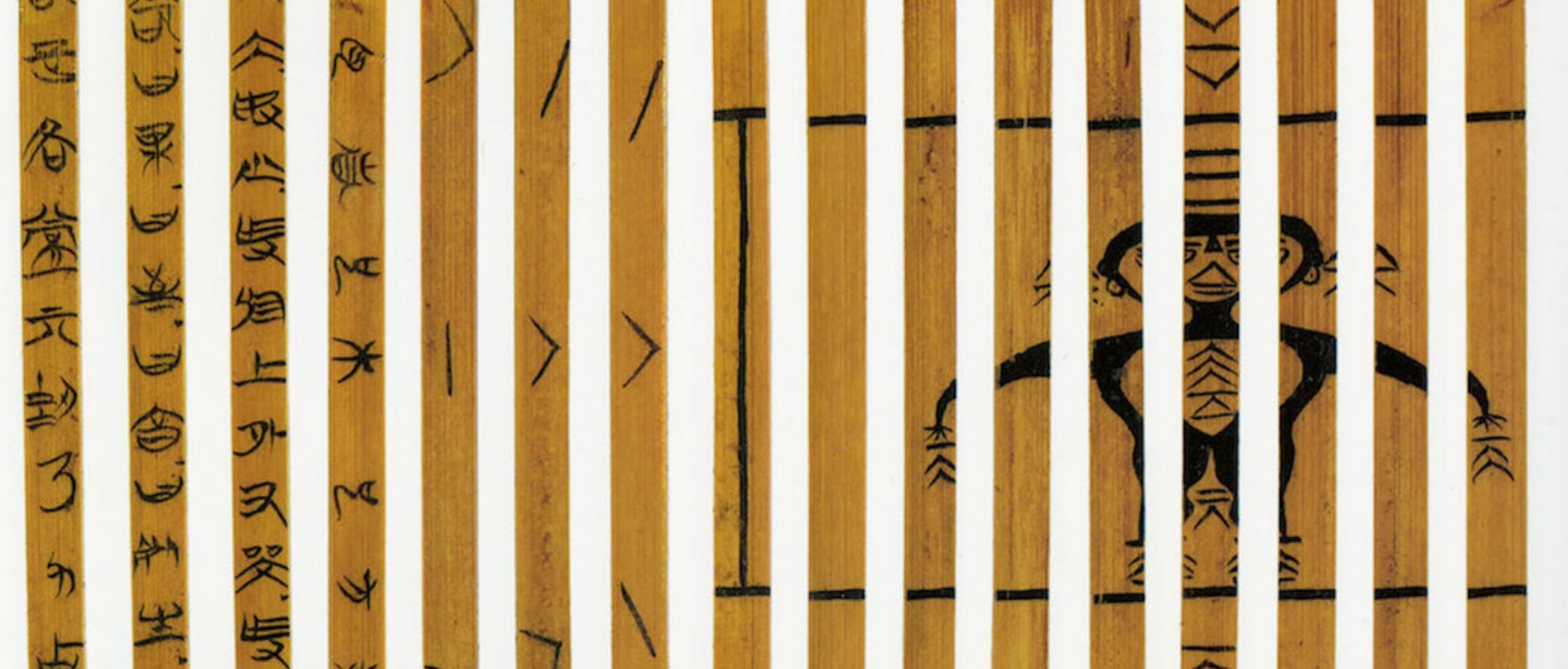
Following the same line, I then looked into the Tsinghua Bamboo Slips.
The Tsinghua slips have been published very quickly; so far, 15 batches have been released, each rich in content. Crucially, the slips date to around 305 BCE, about 250 years earlier than the Haihun tomb, making them the earliest large-scale source of transmitted texts we have.
For example, the first batch includes Yin Zhi, Yin Gao, Cheng Wu, Bao Xun, Qi Ye, Jin Teng, Huang Men, Ji Gong, and Chu Ju—many of which have challenged or overturned traditional records.
During my reading, I became deeply absorbed in the Chu Ju and the second batch’s Xi Nian.
As a Hunanese, how could I not be fascinated by the origins of the Chu state? In particular, the Chu Ju contains the passage: “Xue Yin (or something similar) migrated to Jingzong and obtained Bi Xian (?). He went against the current, and she was beautiful and virtuous, so he married her. She gave birth to Shu and Li Ji. Li Ji’s birth was unnatural—she ruptured from the side, and Bi Lie died and went to heaven. Wu Xian wrapped her side with chu (thorny branches) and buried her, hence the people today are called Chu people.” This passage completely records the origin of the state’s name: that the Chu ancestor Bi Xian (whose character remains undeciphered) died in childbirth, and a shaman used “chu” (thorny branches) to wrap her side for burial, which gave rise to the name “Chu people.” This not only reshaped our understanding of Chu’s origins but also solved a long-standing puzzle for me: the origin of the “Lady Xiong” ancestral tablet found in almost every Hunanese household’s “spirit altar.”
I had previously written a blog post analyzing this question, based on transmitted texts, and had proposed several possibilities—that Lady Xiong might be the wife of the Yellow Emperor, the wife of Fuxi (Nüwa), or the mother of the Daoist sage Mother Shen. But after reading the Tsinghua Chu Ju, I realized that the “Lady Xiong” worshipped in Hunan is almost certainly the “Xiong” clan ancestor mentioned in that passage. For thousands of years, people forgot her real name—even now we can’t decipher the character on the bamboo slip—but the identity “Lady Xiong” was passed down accurately nonetheless.
An even bigger surprise came when I looked at the third batch of Tsinghua slips, which includes Shuo Ming (or Fu Yue’s Mandate). I suddenly discovered that the two characters I had been searching for were lying quietly in that text. Although the phrasing differs from the Dayu Mo, the meaning is the same. The only difference is that when I named my daughter, I thought those characters were spoken by Emperor Shun in the Dayu Mo, but the more authentic source may be the Tsinghua version, where they are spoken by “Fu Yue.” Fu Yue was a figure from the Shang dynasty who assisted King Wu Ding in governing the state and is considered a “sage” even earlier than Confucius.
Of course, the Tsinghua Fu Yue’s Mandate is not without its controversies. Some scholars have noted discrepancies between its quotations and those found in transmitted works like the Guoyu and the Liji that refer to “Shuo Ming.” This actually confirms a more general phenomenon: during the Spring and Autumn and Warring States periods, the various states already had multiple arrangements and adaptations of the materials passed down from Yao, Shun, Yu, and the Xia, Shang, and Western Zhou. Different schools and regions likely had different versions of the same text. There probably never was a single “original version.”
Still, seeing that passage in the Fu Yue’s Mandate was a huge relief.
It turns out the Dayu Mo was not entirely fabricated. The source of those two characters, though buried for over two thousand years, was incorporated by the Eastern Jin scholars into that compilation through their own cultural memory and learning—knowledge that had been the essence of Chinese civilization since the Shang and Zhou dynasties.
Three Elevations of a “Forgery”
After finding the clue in the Tsinghua slips, I wanted to understand more: what exactly happened later to make the Dayu Mo so important?
If the Eastern Jin had only produced and presented it, it could easily have been neglected or forgotten by later ages. But history didn’t turn out that way.
It went through three crucial elevations.
The first was in the Song dynasty. Zhu Xi established the “Sixteen-Character Heart Transmission”—“The human mind is precarious, the moral mind is subtle; be refined, be single-minded, and hold fast to the Mean”—as the secret core teaching passed down from Yao, Shun, and Yu. From then on, this “forgery” was elevated to the highest temple of Chinese philosophy, required for the imperial examinations and essential reading for emperors, becoming the central doctrine of the Confucian orthodoxy.
The second elevation was in the field of legal thought. “Punishment aims at no punishment” set the ultimate goal of penalty—punishment to eventually render it unnecessary; “when in doubt about a crime, incline to leniency” was the earliest formulation of the principle of benefiting from doubt; “better to lose the proper way than to kill an innocent” established the value ranking that it is better to err on the side of judicial imperfection than to wrongfully execute the innocent. These passages were repeatedly cited from the Tang Code to Qing-dynasty judicial practice, becoming the foundational code of Chinese legal tradition.
The third elevation was in political narrative. “No worthy is left in obscurity, and all the states enjoy peace” provided a vision of ideal governance; “rectify virtue, facilitate utility, and ensure the people’s livelihood” framed the three tasks of statecraft; “complacency brings loss, humility gains benefit” became the highest maxim of personal cultivation. This narrative allowed all subsequent dynasties to trace their lineage back to Yao, Shun, and Yu, giving Chinese politics an astonishing continuity.
A “forgery” accomplished what many genuine things could not.
Does This Conclusion Hold Up?
Later, I explained the whole process to my daughter in detail.
I told her that when she first told me Doubao called the Dayu Mo a “forgery,” I was really worried.
Then, after searching the Haihun slips and finding nothing, and searching the early batches of Tsinghua slips and finding nothing, I almost gave up. Finally, when I found the clue in the Fu Yue’s Mandate, I felt like I had hit the jackpot by sheer luck.
My daughter asked, “So is it a forgery or not?”
I said yes and no. From the standpoint of archaeology and textual criticism, the Dayu Mo is indeed not a genuine pre-Qin text. But from a cultural-historical perspective, it is more important than many genuine texts.
“Why?” she asked.
I thought for a moment and said, imagine the situation after the Disaster of Yongjia: the Central Plains were lost, the classics were burned, and scholars could barely fend for themselves. If you were an Eastern Jin scholar trying to pass down the best teachings from Confucius and Mencius, but you had nothing in hand, what would you do?
Those Eastern Jin scholars took on a nearly impossible task: they pieced together a complete picture of Chinese cultural tradition from the fragments stored in their minds. That was the Dayu Mo—containing the compassion of criminal law, the middle way of statecraft, the humility of governance, and the fairness of employing people. Every one of these principles had earlier origins, but they concentrated them into a single text.
History proved them right.
The Southern and Northern Dynasties that immediately followed the Eastern Jin were among the most fragmented and turbulent periods in Chinese history. In the north, the Sixteen Kingdoms rose and fell with frequent regime changes; in the south, the Song, Qi, Liang, and Chen rotated, while the southern gentry were still unsteady. If there had been no complete “Chinese culture” framework to hold things together, cultural transmission might have been replaced in the north by steppe culture and marginalized in the south by metaphysics and Buddhism.
After the Sui and Tang unification, it was precisely this “hard dish” served up by the Eastern Jin scholars—this whole narrative of sage-kings, including the Dayu Mo—that gave the new regimes a common spiritual origin. Emperor Taizong of Tang had Kong Yingda compile the Correct Meaning of the Five Classics, and for the Shangshu he used Mei Ze’s version, which included the Dayu Mo. From then on, this text became the official textbook, remaining so until the end of the Qing dynasty.
In other words, China from the Sui, Tang, Song, Yuan, Ming, and Qing dynasties operated within the orthodoxy provided by this “forgery.” Its ideas shaped the imperial examination system, judicial principles, ruler-minister ethics, and political ideals.
So whether it is “fake” or not no longer matters. What matters is that it continued a civilization that was nearly broken in the Eastern Jin, and that civilization has endured for another 1,800 years, down to us today, still operating within that framework.
My daughter asked, “So did my name come from the Dayu Mo or the Fu Yue’s Mandate?”
I thought for a moment and said, those two characters first appeared on Warring States bamboo slips, spoken by the sage Fu Yue in the Fu Yue’s Mandate. But that work was lost for over two thousand years, buried underground until it was rediscovered in our own time. When your father named you, he only had access to the Dayu Mo. But there is no doubt that those two characters have existed for at least three thousand years, because individually, they already appear in oracle bone inscriptions.
In other words, the Fu Yue’s Mandate gives those characters a more ancient “birth certificate,” but it was the Dayu Mo that kept them alive, transmitted them, and eventually brought them to my attention when I chose your name.
If I had to give a final verdict between the two texts, I would only say: one is the origin of your name, the other is the life of your name.