

This afternoon, a colleague sent me an e-commerce service cooperation agreement via work WeChat, saying it was from a friend of his (Party A), and asked me to help review it.
I’ve never been a fan of this kind of freeloading behavior, but out of courtesy, I still took a look. Once I started reading, I was completely stunned.
To be honest, at first glance the contract left me a bit confused. It has all the elements, professional clauses, clear logic—clearly written by someone with industry experience. It’s much stronger than ordinary “one-sheet agreements” or casually thrown-together one- or two-pagers. So why ask me to look at something like this? Even if you asked me to write one, I couldn’t produce something this long. But after reading carefully… oh boy, from the very first sentence, it exudes an ominous feeling.
The further I read, the more my head hurt, and the worse it felt.
Throughout the process, only one question kept coming to mind: What kind of environment allows a contract that reeks of unfairness and illegality from beginning to end to appear so “righteous” and confident?
The Miserable Life of E-commerce Workers
After reading this contract, I feel that people working in e-commerce are truly suffering. This isn’t “helping manage a store”—this is basically selling yourself into servitude.
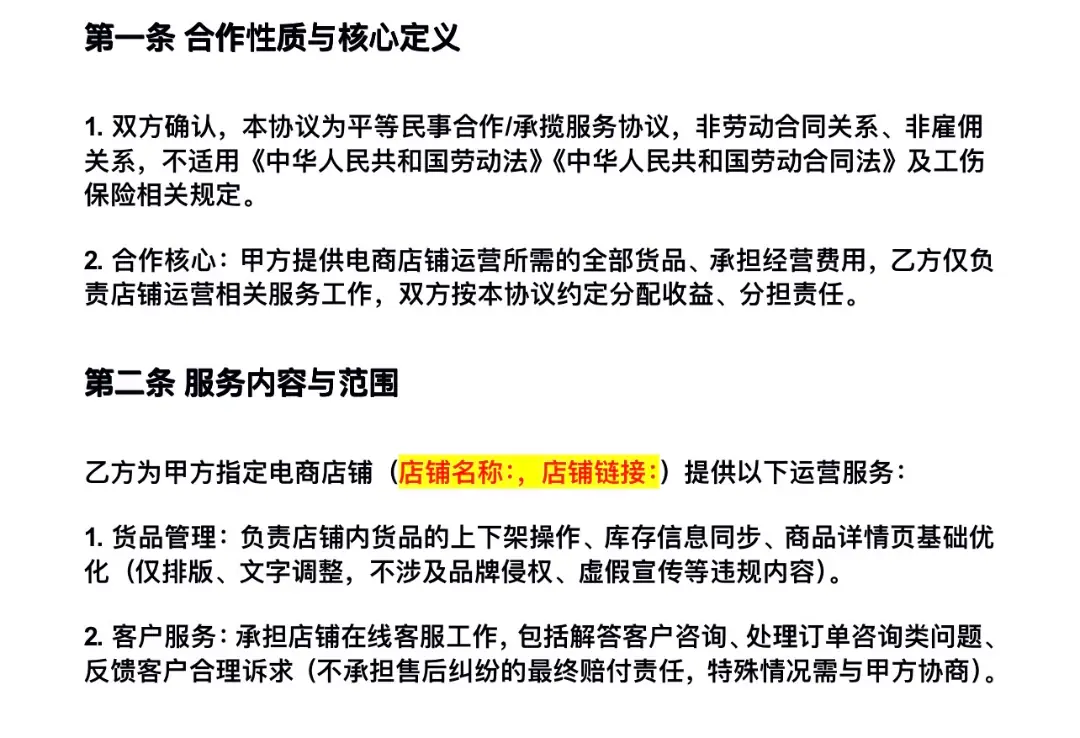
The first article clearly states “Contract for Undertaking Services”. In plain language: the boss and employee are not in an employment relationship, but a cooperation/partnership. The boss doesn’t pay social insurance, doesn’t provide work injury protection—work one day, get paid for one day.
Yet at the same time, the contract requires working 8 hours every day, covering core operating hours (10 a.m. to 10 p.m.), with customer service online rate no lower than 80%, and product listing/delisting to be completed within the agreed cycle.
This is called a “cooperation relationship”?
If this doesn’t count as an employment relationship, then there is no such thing as an employment relationship in the world.
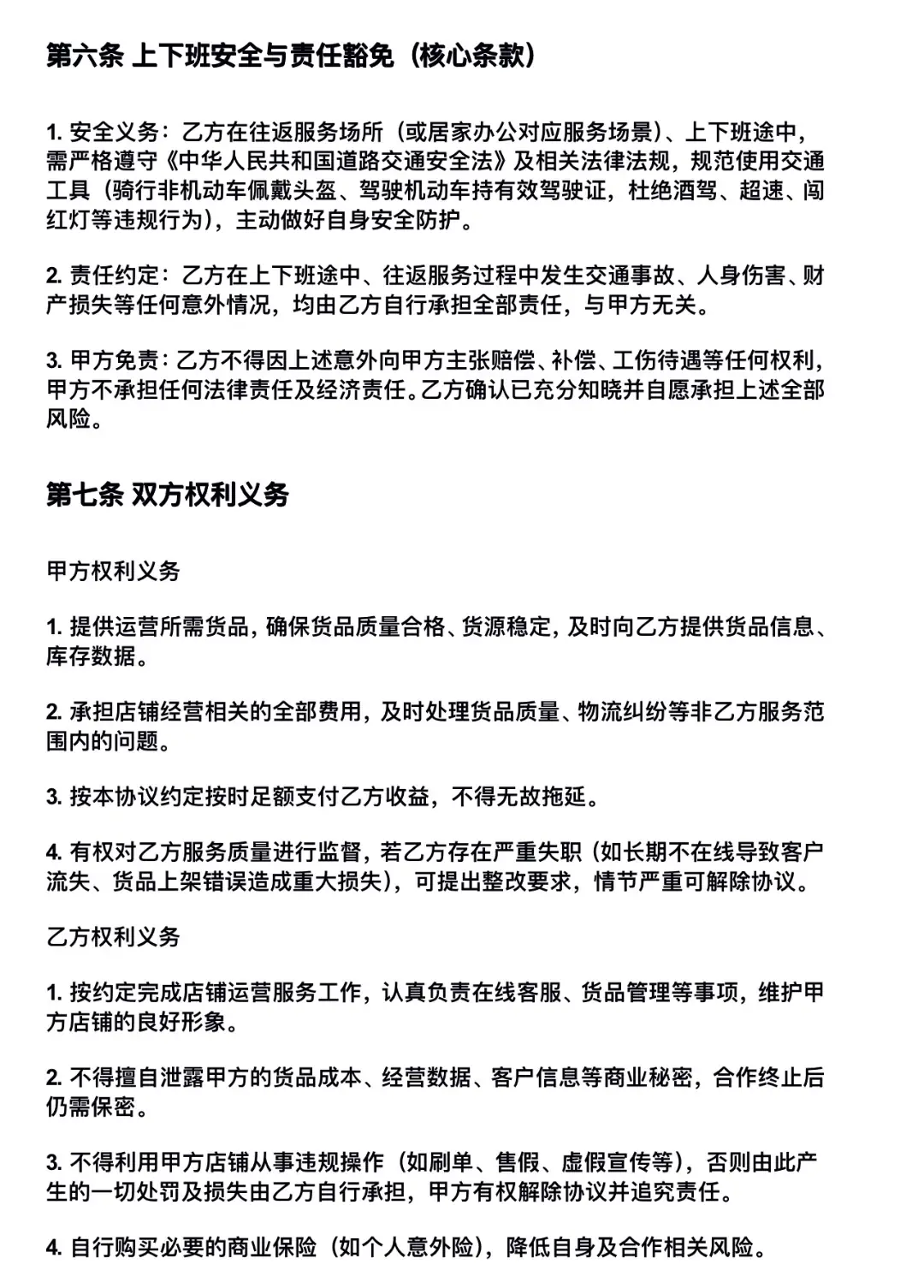
Even worse, Article 7 also stipulates that Party B (the worker) must purchase commercial insurance on their own to reduce “cooperation risks”. I’ve seen shameless clauses, but never this shameless.
So the essence of this contract is very clear: it uses the skin of a cooperation agreement to cover up the reality of an employment relationship, transferring all costs and risks onto the worker.
What an E-commerce Worker Bears Every Day
Many people think e-commerce is just “selling stuff on a computer”—easy, free, quick money.
If you think that way, take a look at what an e-commerce operator actually does every day:
One person doing the work of three
- Customer service: instant replies to buyer inquiries—even at 11 p.m.
- Operations: listing/delisting products, creating detail pages, applying for promotions, analyzing data
- After-sales: handling returns, dealing with bad reviews, getting cursed out by buyers
These are three separate positions, but in small shops, one person often handles everything.
Some might say: isn’t this just what store clerks do? What’s the big deal? But honestly, the biggest difference between e-commerce and physical stores is that labor is chained to data.
In a traditional store, clerks know roughly how sales are going—no one chases you with a phone asking “Why did today’s conversion rate drop 0.5% compared to yesterday?”
E-commerce is different. Every sentence you send, every product title, every main image is monitored by data in real time.
- Low inquiry-to-order conversion? → Customer service writes a self-criticism
- DSR score drops? → Operations must find the reason
- Visitor count falls? → Promotion person takes the blame
But the problem is: do these metrics truly reflect an employee’s real value? If buyers don’t purchase, it could be because the product isn’t good enough, the price is too high, or it’s off-season. Yet the blame almost always falls on the execution layer.
On call 24 hours
Traditional stores close at night and work stops. But e-commerce gets busier at night—because you never know how many night owls are out there. Many people lie in bed scrolling their shopping carts at 2–3 a.m. Not to mention endless man-made “shopping festivals”, ever-changing platform rules, and products that can suddenly explode or crash.
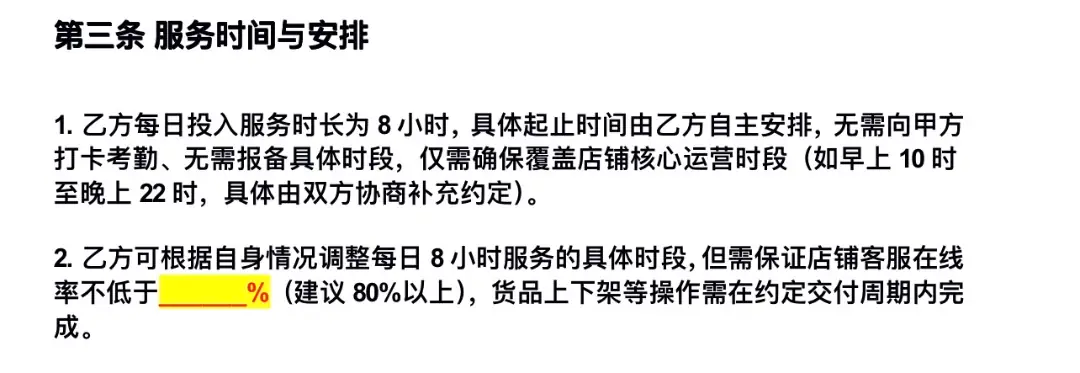
The contract says “8 hours per day”, but anyone who’s done e-commerce knows these 8 hours are just the “minimum spend”. Beyond the 10 a.m.–10 p.m. golden hours, there may be random “silver hours” or “diamond hours”. How long you actually work is something only you know.
Unstable income
Many e-commerce operators work on “no base salary + commission”. When the store sells well, you get a share of the profit; when it sells poorly, you drink the northwest wind.
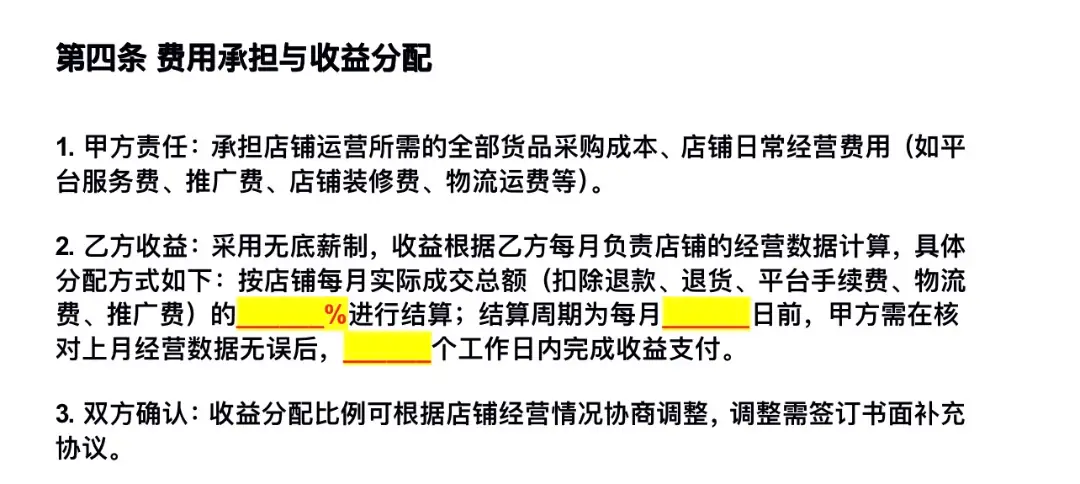
And the commission rate can be “negotiated and adjusted based on store performance”? Once the contract is signed, the boss can change the split ratio at any time—you have zero recourse.
Zero protection
No social insurance means no medical insurance, no pension, no work injury coverage.
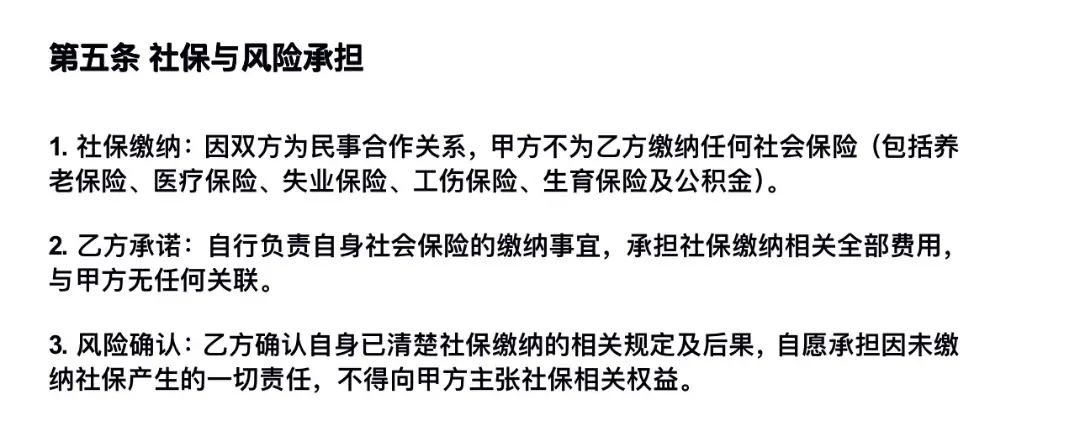
- Get into a traffic accident on the way to/from work? → Your problem
- Get sick and need medicine? → Pay yourself
- Retire one day with no pension? → Don’t even dream about it
But they work 9 a.m. to 9 p.m. shifts, under the same constraints as regular employees—why are they denied labor protections?
A Message to E-commerce Workers
Finally, I want to say: if you’re currently working in e-commerce, or have friends doing it, take a careful look at the contract you (or they) signed. If it’s this kind of contract, don’t panic too much.
- When facing unreasonable demands → refuse them
- When wages are withheld → go for arbitration or file a lawsuit
If you’re also an e-commerce boss, let me say this: the money you save on social insurance would be better spent hiring better people.
Those tricked in by this kind of contract won’t stay. The ones who do stay are only there because they have no other choice. People who truly want to build a great store won’t be retained by contracts like this; those retained by the contract are mostly already planning their exit.
Moreover, this kind of contract is almost certainly invalid under the law. Once the worker goes to arbitration—confirming the employment relationship, demanding back payment of social insurance, and claiming compensation—none of it can be escaped
Attachment: Original Contract Text (for reference if needed)
# E-commerce Store Operation Cooperation Agreement

## Article 1 Nature of Cooperation and Core Definitions
1. Both parties confirm that this Agreement is an equal civil cooperation / undertaking service agreement, not an employment contract or hiring relationship, and the Labor Law of the People's Republic of China, Labor Contract Law of the People's Republic of China, and work injury insurance-related provisions do not apply.
2. Core of cooperation: Party A provides all goods required for e-commerce store operation and bears operating expenses; Party B is only responsible for store operation-related services. Profits and responsibilities are allocated according to this Agreement.

## Article 2 Service Content and Scope
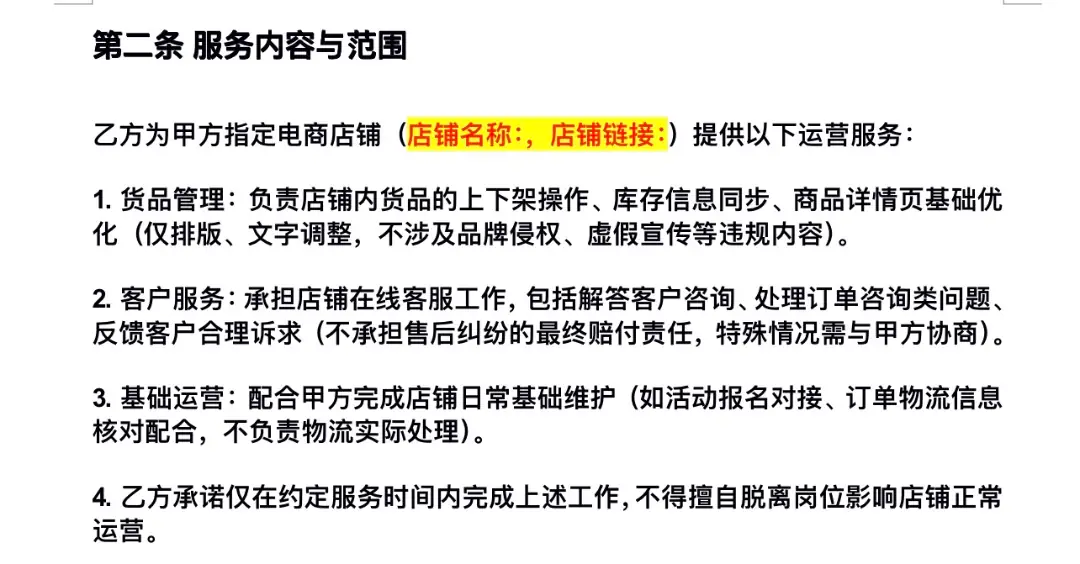
Party B provides the following operation services for the e-commerce store designated by Party A (Store name: ____, Store link: ____):
1. Product management: responsible for listing/delisting products in the store, syncing inventory information, basic optimization of product detail pages (only layout and text adjustments, not involving brand infringement, false advertising, or other violations).
2. Customer service: responsible for online customer service, including answering customer inquiries, handling order-related questions, and reporting reasonable customer demands (not bearing final compensation liability for after-sales disputes; special cases to be negotiated with Party A).
3. Basic operations: assist Party A in daily basic store maintenance (e.g., event registration coordination, order logistics information verification; not responsible for actual logistics handling).
4. Party B undertakes to complete the above work only within the agreed service hours and shall not arbitrarily leave the post and affect normal store operation.

## Article 3 Service Hours and Arrangement
1. Party B shall devote 8 hours of service per day. Specific start and end times are arranged autonomously by Party B; no clock-in attendance or reporting of specific periods to Party A is required, only ensuring coverage of core operating hours (e.g., 10:00 to 22:00; specific times to be supplemented by mutual agreement).
2. Party B may adjust the specific 8-hour service periods according to their own situation, but must ensure customer service online rate not lower than ____% (recommended 80% or above), and product listing/delisting operations completed within the agreed delivery cycle.

## Article 4 Cost Bearing and Profit Distribution
1. Party A's responsibilities: bear all costs of goods procurement and daily operating expenses required for store operation (platform service fees, promotion fees, store decoration fees, logistics shipping fees, etc.).
2. Party B's income: no base salary system. Income calculated based on monthly operating data of the store under Party B's responsibility. Specific allocation method: ____% of the store's actual monthly transaction total (after deducting refunds, returns, platform handling fees, logistics fees, promotion fees); settlement cycle is before the ____ day of each month. Party A shall complete payment within ____ working days after verifying last month's data is correct.
3. Both parties confirm: profit distribution ratio may be negotiated and adjusted based on store operating conditions; adjustments require a written supplementary agreement.

## Article 5 Social Insurance and Risk Bearing
1. Social insurance payment: since the parties are in a civil cooperation relationship, Party A shall not pay any social insurance for Party B (including pension, medical, unemployment, work injury, maternity insurance, and housing provident fund).
2. Party B undertakes: to handle its own social insurance payment matters and bear all related expenses, with no connection to Party A.
3. Risk confirmation: Party B confirms it is fully aware of social insurance regulations and consequences, voluntarily bears all responsibilities arising from non-payment of social insurance, and shall not claim any social insurance-related rights against Party A.

## Article 6 Commuting Safety and Liability Exemption (Core Clause)
1. Safety obligations: When traveling to/from the service location (or corresponding home office scenario), Party B must strictly comply with the Road Traffic Safety Law of the People's Republic of China and relevant laws and regulations, use transportation lawfully (wear helmet when riding non-motor vehicles, hold valid driver's license when driving motor vehicles, prohibit drunk driving, speeding, running red lights, etc.), and actively protect own safety.
2. Liability agreement: Any traffic accidents, personal injuries, property losses, or other unexpected incidents occurring during commuting or travel to/from service shall be fully borne by Party B and have no relation to Party A.
3. Party A exemption: Party B shall not claim any compensation, indemnity, work injury benefits, or other rights from Party A due to the above incidents. Party A bears no legal or economic responsibility. Party B confirms full awareness and voluntary assumption of all the above risks.

## Article 7 Rights and Obligations of Both Parties

### Party A's Rights and Obligations
1. Provide goods required for operations, ensure goods are qualified and supply stable, promptly provide product information and inventory data to Party B.
2. Bear all expenses related to store operations, promptly handle product quality issues, logistics disputes, and other matters outside Party B's service scope.
3. Pay Party B's income on time and in full as agreed, without unjustified delay.
4. Right to supervise Party B's service quality. If Party B seriously fails duties (e.g., long-term offline causing customer loss, product listing errors causing major losses), Party A may demand rectification; in serious cases, may terminate the agreement.

### Party B's Rights and Obligations
1. Complete store operation services as agreed, conscientiously handle online customer service, product management, etc., and maintain a good image of Party A's store.
2. Not disclose Party A's product costs, operating data, customer information, or other trade secrets; confidentiality obligation continues after termination.
3. Not engage in illegal operations using Party A's store (brushing orders, selling fakes, false advertising, etc.); otherwise, all penalties and losses shall be borne by Party B, and Party A has right to terminate and pursue liability.
4. Purchase necessary commercial insurance (e.g., personal accident insurance) on own initiative to reduce own and cooperation-related risks.

## Article 8 Term and Termination
1. Term of the agreement: from ____ ____, ____ to ____ ____, ____.
2. 30 days before expiration, parties may negotiate renewal; if no negotiation, agreement automatically terminates.
3. If either party wishes to terminate early, must give 15 days' written notice; after settling outstanding income, agreement may be terminated.
4. Party A may unilaterally terminate immediately without compensation if Party B: fails to perform customer service duties for 3 consecutive days causing serious bad reviews or increased complaints; causes major economic loss to Party A due to operational errors (e.g., listing errors leading to platform penalties exceeding ____ yuan); engages in illegal or违规 activities using the store and harming Party A's interests.

## Article 9 Dispute Resolution
1. Disputes arising during performance shall first be resolved through friendly negotiation.
2. If negotiation fails, either party may file a lawsuit with the people's court having jurisdiction at Party A's location.

## Article 10 Miscellaneous
1. This Agreement is made in duplicate, one copy each for Party A and Party B, effective upon signature (Party A affixes seal, Party B signs and provides fingerprint), with equal legal effect.
2. This Agreement constitutes the complete agreement between the parties, superseding all prior oral or written communications and agreements. Matters not covered may be supplemented by separate supplementary agreement(s), which shall have equal legal effect with this Agreement.