

Every Chinese person who has taken middle school history knows one formula: Tang Dynasty ceramics = “south green, north white”. The southern Yue kilns produced celadon (secret-color porcelain), and the northern Xing kilns produced white porcelain (like silver, like snow). Textbooks say so, museums display it this way — it’s practically common sense.
But this common sense has a huge blind spot.
In 1998, a Tang Dynasty shipwreck was discovered by fishermen near Belitung Island, Indonesia, later named the “Batu Hitam” (Black Stone). This Arab sewn-plank dhow carried about 70,000 Chinese ceramics, dated to around 826 CE. Following the “south green, north white” logic, you’d expect roughly equal amounts of Yue celadon and Xing white ware. But the actual data is shocking: about 60,000 pieces were Changsha ware, accounting for over 85%. Yue and Xing together barely made up the remainder.
The Binh Chau wreck discovered in Quang Ngai province, Vietnam in 2013 — the subject of the Hacker News front-page article I mentioned in Series I — tells the same story. Changsha ware again dominated the cargo, with Yue and Xing wares present in small quantities and visibly inferior quality compared to their Belitung counterparts.
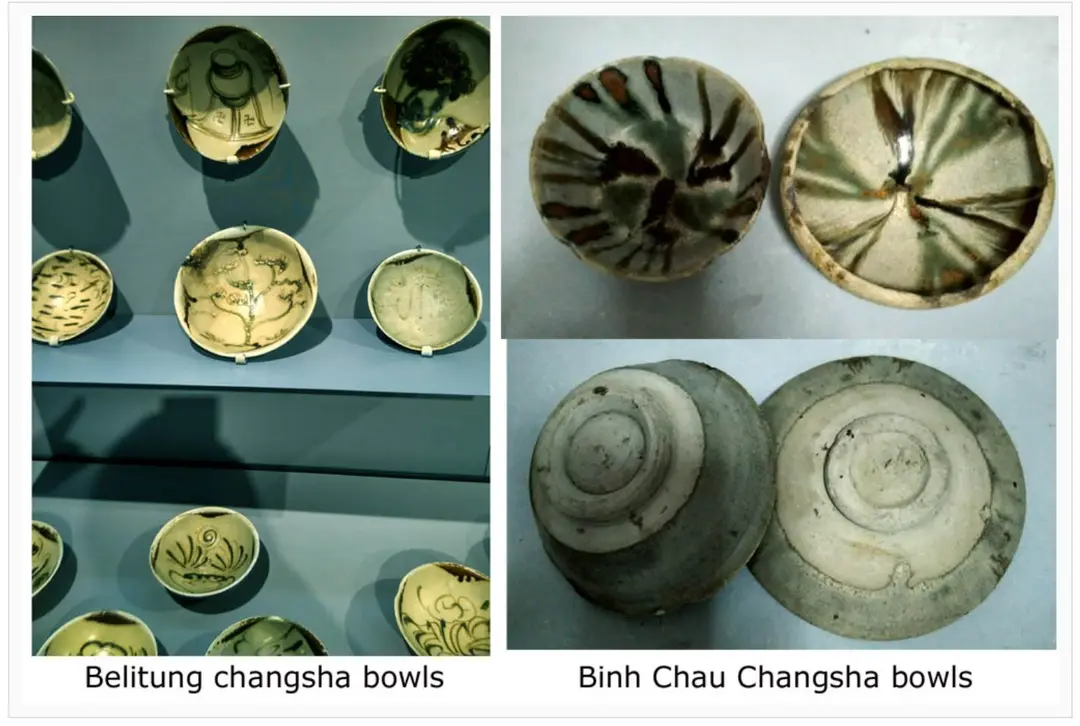
Two shipwrecks, separated by about 50 years and two thousand kilometers, deliver the same verdict: The main force of Tang Dynasty export ceramics was not Yue ware or Xing ware, but Changsha ware — which barely registers in ceramic history today.
The World’s First “Color” Porcelain
Changsha ware’s core competitiveness was first and foremost technological.
Before the 9th century, ceramics worldwide were essentially monochrome — green, white, or brown, with colors naturally produced by metal oxides in the glaze. Changsha ware broke this pattern, pioneering high-temperature underglaze painted decoration.
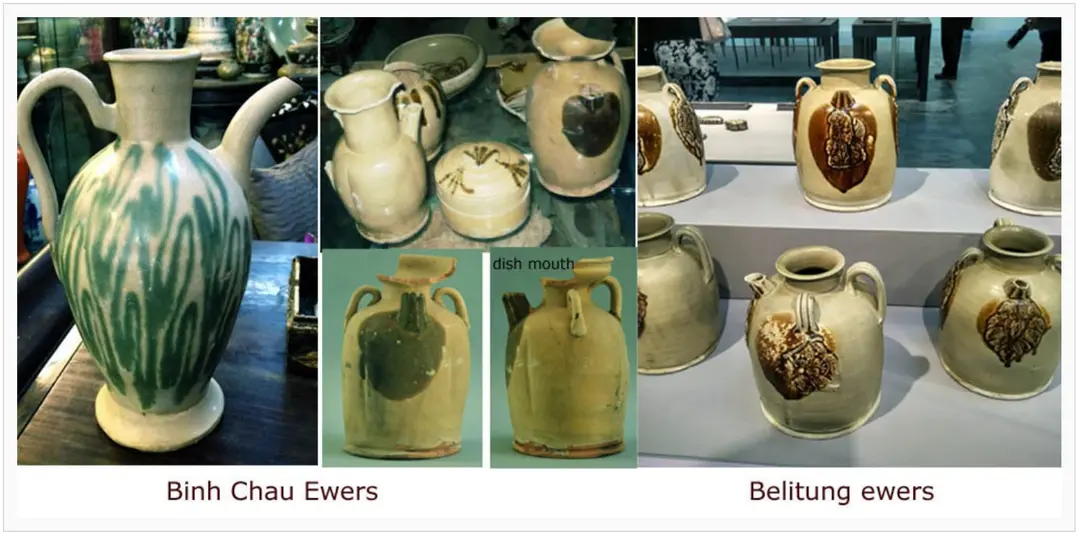
In simple terms, Changsha artisans first painted patterns on the bisque body using iron and copper pigments, then applied a transparent glaze and fired everything in a single high-temperature firing. The finished product had the brown-and-green painting protected under the glaze — non-fading, non-peeling, non-scratching. This seems unremarkable today, but in the 9th century it was a technological leap: it was the world’s first kiln to mass-produce colored ceramics.
Specifically, Changsha ware had two types of underglaze decoration. One was copper red, using copper oxide in a reduction atmosphere to produce red — the earliest high-temperature copper-red underglaze in Chinese ceramic history, predating Yuan dynasty underglaze red by four centuries. The other was brown and green, using composite iron and copper pigments to fire brown and green, enabling complex painted patterns.
For Middle Eastern and Southeast Asian buyers, the visual impact of these colored ceramics was incomparable with monochrome celadon. Tang Yue ware certainly had its “green of a thousand peaks” reputation, but that was a literati aesthetic — subtle, requiring cultivated taste to appreciate. Changsha ware’s brown-and-green painting was vibrant, direct, instantly understandable.
The 9th Century’s “Cross-Border E-Commerce” Mindset
What’s most astonishing about Changsha ware isn’t its technology — it’s its understanding of market demand.
The 9th-century Changsha potters had essentially figured out a complete cross-border e-commerce playbook.
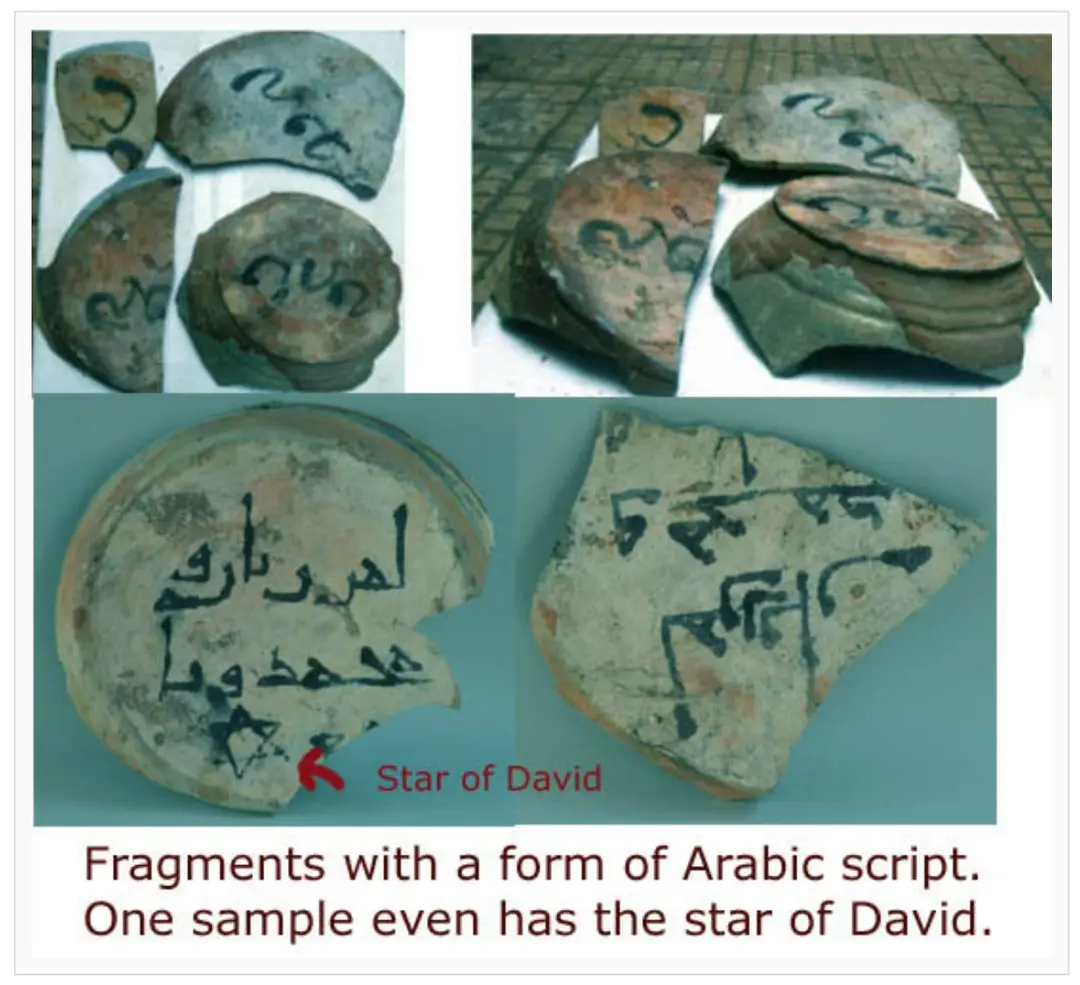
First, customized motifs. Changsha ware featured exotic decorative patterns extensively — palm tree motifs, coconut palm designs, Central Asian dancer figures. These patterns had almost no market in China itself, but Middle Eastern buyers found them instantly familiar. More directly, Changsha bowls carried Arabic script painted in brown pigment. The Changsha Tongguan Kiln Museum now houses a “green-glazed brown-and-green Arabic-inscribed bowl”, with the Arabic identified as the name of Allah or auspicious prayers. This wasn’t graffiti scratched by merchants — it was painted on before firing by the kiln workers. It was product customization by a Chinese factory for the Middle Eastern market.
Second, the cost-performance strategy. Changsha ware’s body clay was not high quality — it was coarse clay from along the Xiang River, firing to a gray-brown, porous body. But the Changsha potters used a clever technique: applying a layer of white slip over the coarse body to conceal the rough base color, then painting and glazing on top. This way, low-cost local materials could produce visually decent finished products. In today’s terms, this was “cost reduction and efficiency enhancement”.
Third, the southward logistics advantage. The Changsha kilns were located in today’s Tongguan town, Wangcheng District, Changsha City, right on the Xiang River. The Xiang flows north into Dongting Lake, connects to the Yangtze, and then through the Lingqu Canal (built during the Qin Dynasty) goes south into the Pearl River system, ultimately reaching Guangzhou — the Tang Dynasty’s largest foreign trade port. From Tongguan kiln to Guangzhou port, all water route, all low cost. By comparison, the Yue kilns were on the Zhejiang coast and the Xing kilns were in inland Hebei — neither had the water transport advantages of Changsha.
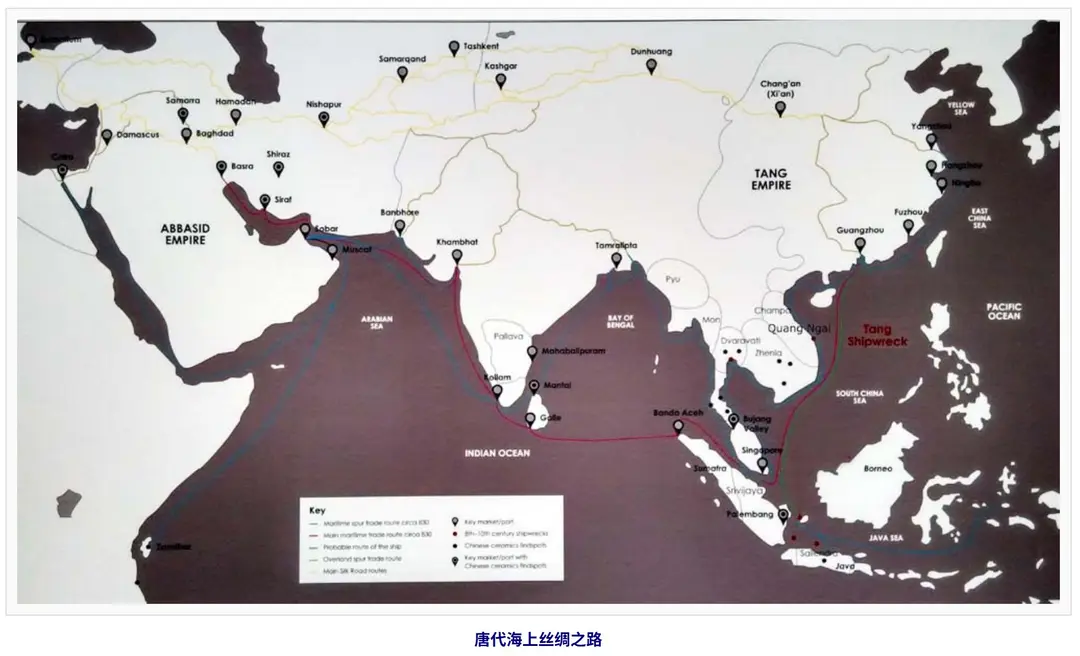
Fourth, the mature maritime shipping system. For Changsha ware to reach the Middle East, maritime shipping was the critical link. Tang Dynasty foreign trade mainly followed the route from Guangzhou along Annam and Champa through Southeast Asia and South Asia to the Middle East. This required advanced navigation and shipbuilding capabilities. Interestingly, the wood and hull structure from the Vietnam shipwreck were identified as Southeast Asian in origin — showing that a Southeast Asian “carrier” played a crucial role in exporting Changsha products. This intermediary role further demonstrates how highly developed the Tang foreign trade system was.
Fifth, the scale of production. The output of Changsha ware was staggering. Dozens of kiln sites have been discovered near Tongguan town, with accumulation layers several meters thick, all Tang Dynasty kiln waste and sherds. This scale of production was born for export — essentially, it was an industrial cluster oriented toward the global market. This is vividly confirmed by the shipwrecks, where Changsha ware dominates the ceramic cargo.
From Peak to Oblivion
Changsha ware went through a rise-and-fall cycle during the late Tang. The Changsha vessels from the Binh Chau wreck already show clear signs of decline: the earlier fine floral patterns, cloud motifs, and Arabic calligraphy were replaced by abstract brown-green splashes, crude execution, and casual composition. In ceramic scholarship, these “abstract splashes” are considered typical of late-stage Changsha production and a signal of technical degeneration.
The decline had multiple causes. On one hand, Huang Chao’s sacking of Guangzhou in 878 disrupted the export system. On the other hand, Changsha ware had hit its technical ceiling — the underglaze color palette was limited, and the body quality could never be improved. By the Song Dynasty, Cizhou ware’s white-ground black decoration and Jingdezhen’s bluish-white ware completely replaced Changsha ware in the market.
What’s most telling is Changsha ware’s position in ceramic historiography.
Post-Tang literature almost never mentions Changsha ware. In Qing Dynasty ceramic monographs like Tao Lu, Changsha was either mentioned in passing or entirely absent. The reason is simple: Changsha ware was not an official kiln. It was excluded from the orthodox canon, from imperial collections, from literati appreciation. It was a folk kiln whose products were export porcelain with limited circulation in China itself. Chinese ceramic history was written by literati who valued Yue’s “secret color”, Xing’s “like snow”, and Ru’s “sky blue” — these had aesthetic authority. Changsha ware’s coarse body, crude glaze, and paintings of palm trees and Arabic script were beneath literati notice.
It was only with the discovery of the Belitung shipwreck in 1998 that Changsha ware’s true story emerged. Shipwrecks don’t lie — every vessel in the cargo is hard evidence of real trade. The Belitung wreck and subsequent finds like Binh Chau together proved one historical fact: In Tang Dynasty export ceramics, Changsha ware was the true market leader.
From Xiang River Mud to Persian Gulf Beaches
Changsha ware’s story is essentially a tale of folk industry keenly responding to global market demand.
It wasn’t an official kiln — no imperial orders or financial support. It was located in inland Hunan, far from the coast. Its raw material was coarse clay from the Xiang River — nothing special. But it got three things right: the right product (colorful = eye-catching), the right market (Middle Eastern customization), and the right cost (water transport + slip technique). These three things today would be called product, market, and supply chain integration — and 9th-century Changsha potters had intuitively figured them out.
The Changsha bowls with abstract brown-green splashes from the Binh Chau wreck may not have been the best examples of Changsha ware, but they traveled across the South China Sea, past the Champa coast, through the Sunda Strait and the Indian Ocean, eventually perhaps bought by a Persian merchant and sold in the markets of Baghdad. This journey says more than any museum label.
Changsha ware’s rise and fall is a legend long ignored by mainstream narratives. Two shipwrecks finally brought it back to light from the hold of history.
Speaking of which, this ability of Hunan people to “do business for global markets” — from Tang Dynasty Changsha ware to today’s construction machinery — spans over a thousand years, with some intriguing continuities. I recently wrote an article about Hunan’s economic development (Hunan’s economic prescription was written long ago — the key is to actually take the medicine ), which mentioned an observation that stayed with me: Hunan people thrive everywhere outside Hunan, but their hometown can never quite replicate that success. Changsha ware was the same — its products reached the Persian Gulf, but the kiln itself was excluded from the orthodox canon, unrecognized by the mainstream narrative. The same people, the same drive, the same external success met with internal silence.
From Tongguan kiln to construction machinery, Hunan people have never lacked the audacity to do global business. The rediscovery of Changsha ware through shipwrecks makes me think: the people of this land have been doing the same thing for over a thousand years — sending products from the banks of the Xiang River to the other end of the world.
The third article in this series returns to the Binh Chau wreck itself, analyzing how Huang Chao’s Rebellion severed Guangzhou trade and how the South China Sea trade network restructured itself in the fracture (see Series III ).
References: Author: NK Koh, The Vietnam Binh Chau (Chau Tan) Late Tang Wreck