At the end of last year, during a training program at a police academy, I wrote an article titled “What It’s Like to Study at a Police Academy”. During that same training period, I happened to reconnect with a former classmate who works at an arbitration commission and arranged for some of the trainees to visit her workplace. This was my first hands-on exposure to an arbitration institution.
Before this, my understanding of arbitration was largely limited to textbooks, legal provisions, and contract templates. I viewed it as a dispute resolution method that was “included at the end of clauses but rarely actually used.” However, that visit transformed arbitration from an abstract concept into a tangible, functioning mechanism for resolving disputes in my mind.
After the visit, I immediately made plans with my classmate to organize an arbitration outreach event for local businesses, aiming to help more companies truly understand and be willing to use this method. Recently, this event was finally realized.
Arbitration Is Better Suited for Corporate Dispute Resolution
For this event, I invited representatives from several arbitration institutions to participate, with the target audience being legal and administrative personnel from local enterprises. Based on the feedback received, what businesses cared about most was not how “theoretically good” arbitration is, but what practical problems it can solve.
The advantages of arbitration are actually not mysterious.
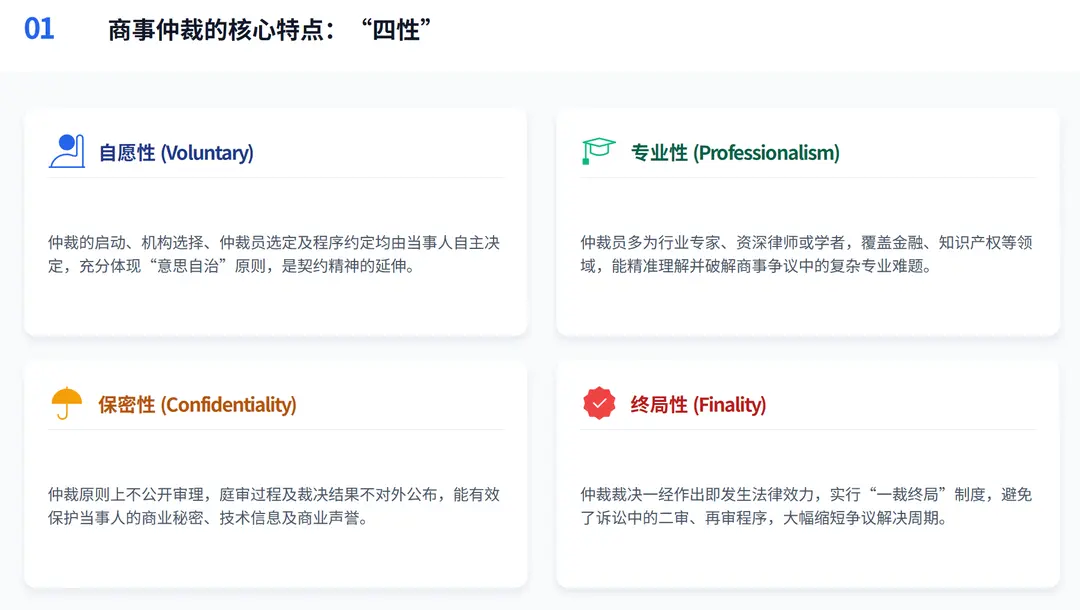
Efficiency, flexibility, confidentiality, professionalism, and international applicability—these are the features repeatedly emphasized in textbooks. However, from a corporate perspective, these are not abstract labels but very tangible benefits:
- Procedural Control: Unlike court litigation, where procedures dictate the process, arbitration allows room for negotiation regarding timelines, pace, and evidence submission arrangements.
- High Professional Relevance: Parties can choose arbitrators who are truly knowledgeable in the relevant field, unlike court cases, which are often randomly assigned.
- Strong Confidentiality: Many corporate disputes are not meant to be publicly disclosed, whereas court proceedings are typically open to the public.
- Better Cross-Regional and Cross-Border Enforceability: Court judgments are often only recognized and enforced domestically or in a limited number of countries with treaties with China, while arbitration awards can be enforced in over 170 countries and regions covered by the New York Convention.
However, during this event, the most frequently asked question by corporate legal personnel was a very practical one: Is arbitration expensive?

In practice, the overall cost of arbitration is not necessarily higher than litigation. Especially when considering the savings in time, management, and internal coordination costs, arbitration can be more “cost-effective” for businesses. Notably, one of the arbitration institutions we invited operates as a public institution, and their fees are even lower.
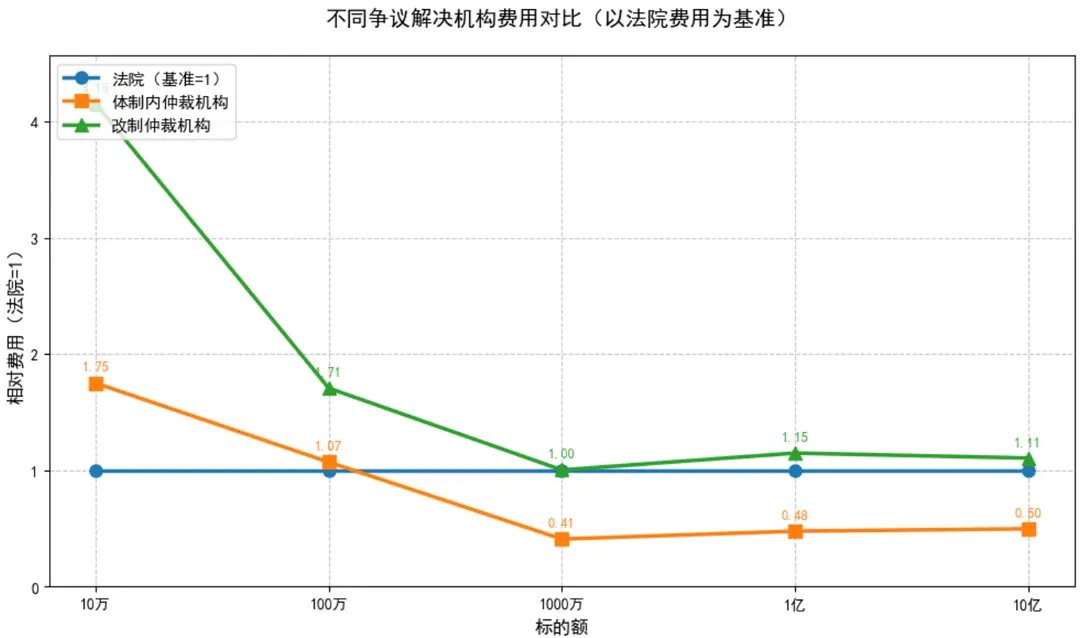
I created a simple chart for comparison. For cases with a claim value below 1 million RMB, court litigation fees are typically lower than arbitration fees. For cases above 1 million RMB, arbitration fees at public institutions are usually lower than court fees, while fees at reformed arbitration institutions are generally comparable to court fees. However, considering that arbitration follows a “one-award, final decision” principle—meaning a case incurs only a one-time fee—while court cases may involve second-instance trials or retrials, potentially doubling the costs, arbitration can still be more economical.
Why Arbitration Institutions Have Not Actively Promoted Arbitration in the Past
During the event, one participant raised an interesting question: If arbitration has so many advantages, why have we never heard about it before?
The main reason is that most arbitration commissions in China operate either as public institutions or under a public institution framework. Under this structure, their operational logic leans more toward “passive acceptance” rather than “active promotion.” In other words, these institutions face little survival pressure.
In contrast, courts inherently possess compulsory jurisdiction. Even if you are unfamiliar with litigation, you may eventually be “pushed” into judicial proceedings. Arbitration, however, is the opposite—it must be chosen in advance by the parties.
This leads to a situation where arbitration, a system that requires explanation, understanding, and guided usage, has long remained in a state of waiting for users. If arbitration institutions do not actively promote it, almost no one will know about this dispute resolution method, or even if they do, they may not know how to use it. As a result, arbitration often becomes a “decorative clause” in contracts.
How to Truly Utilize Arbitration: The Answer Lies Not in Businesses
After the event, I gained a clear understanding of how to promote arbitration: The real entry point for arbitration is not businesses but lawyers.
For the vast majority of enterprises, business owners or responsible personnel do not design dispute resolution mechanisms themselves. The contract clauses they use in their operations, especially dispute resolution clauses, are typically drafted by external lawyers or retained legal advisors. In other words, whether a business has “arbitration awareness” largely depends on whether lawyers are familiar with arbitration and willing to recommend it in contracts.
If lawyers themselves are unfamiliar with arbitration, resistant to it, or believe that “going to court is safer,” then no amount of outreach to businesses will have a significant impact.
Therefore, what arbitration institutions truly need to do is not merely discuss the advantages of the system in general terms but deeply engage with the legal profession ecosystem. This includes conducting targeted training, collaborating with law firms, and reviewing and providing feedback on real cases.
Arbitration Is a Significantly Underestimated Practical Value
One point repeatedly emphasized during the event was the international enforceability of arbitration awards.
The recognition and enforcement of court judgments abroad have always been a high-threshold issue in practice, involving complex procedures, lengthy timelines, and heavy reliance on bilateral judicial assistance agreements. In contrast, arbitration awards, particularly under the New York Convention framework, offer a more practical and stable possibility for cross-border enforcement.
For businesses engaged in cross-regional or cross-border transactions, this is not just an “added benefit” but a fundamental tool for risk control.
This is especially evident in the context of Guangdong. As a major foreign trade province, Guangdong’s cross-border transaction volume has long remained high, with exports alone reaching nearly 6 trillion RMB in 2025—a figure even surpassing Japan’s total. In such a dense transactional environment, relying solely on domestic court litigation is often insufficient to address the risks businesses actually face.
In this sense, arbitration is not meant to “replace courts” but to provide a more feasible path for dispute scenarios that courts are inherently ill-suited or ill-equipped to handle.
The journey from “visiting an arbitration institution” to “organizing an outreach event” has given me a more intuitive understanding of arbitration:
Arbitration is not a failed system; it is simply a system that has been long underestimated and underutilized.
In China’s current legal ecosystem, many systems are not lacking in textual design. What is truly scarce is the motivation and mechanisms to naturally integrate these systems into commercial practices and establish usage habits.
Whether arbitration will be more widely accepted by businesses in the future does not depend on how “advanced” it is but on whether it can be repeatedly proven to be a worthwhile choice in real transactions, disputes, and enforcement processes. And this is precisely what makes promoting arbitration both challenging and truly valuable.