

Recently, Lao T suddenly discovered that some AIs already have shopping capabilities. For example, when wanting to buy a cabinet for a specific gap in the bathroom, the conventional method is to search on shopping apps using keywords like “side cabinet,” “gap cabinet,” or “narrow cabinet,” then browse product detail pages one by one. If dimensions are unclear, you might need to contact customer service; for material or installation concerns, or worries about quality, you’d have to sift through reviews. But now, AI shopping models are likely changing this approach.
How to Use General-Purpose AI Shopping Features
Currently, AI shopping is clearly not a mature feature, but after some searching, Lao T found that many users abroad are indeed using AI for shopping. For instance, a user on HN shared that they spent 20 minutes on Amazon looking for a cabinet of specific dimensions without success. After inputting their requirements into ChatGPT and using its online search function, they immediately found a suitable product.
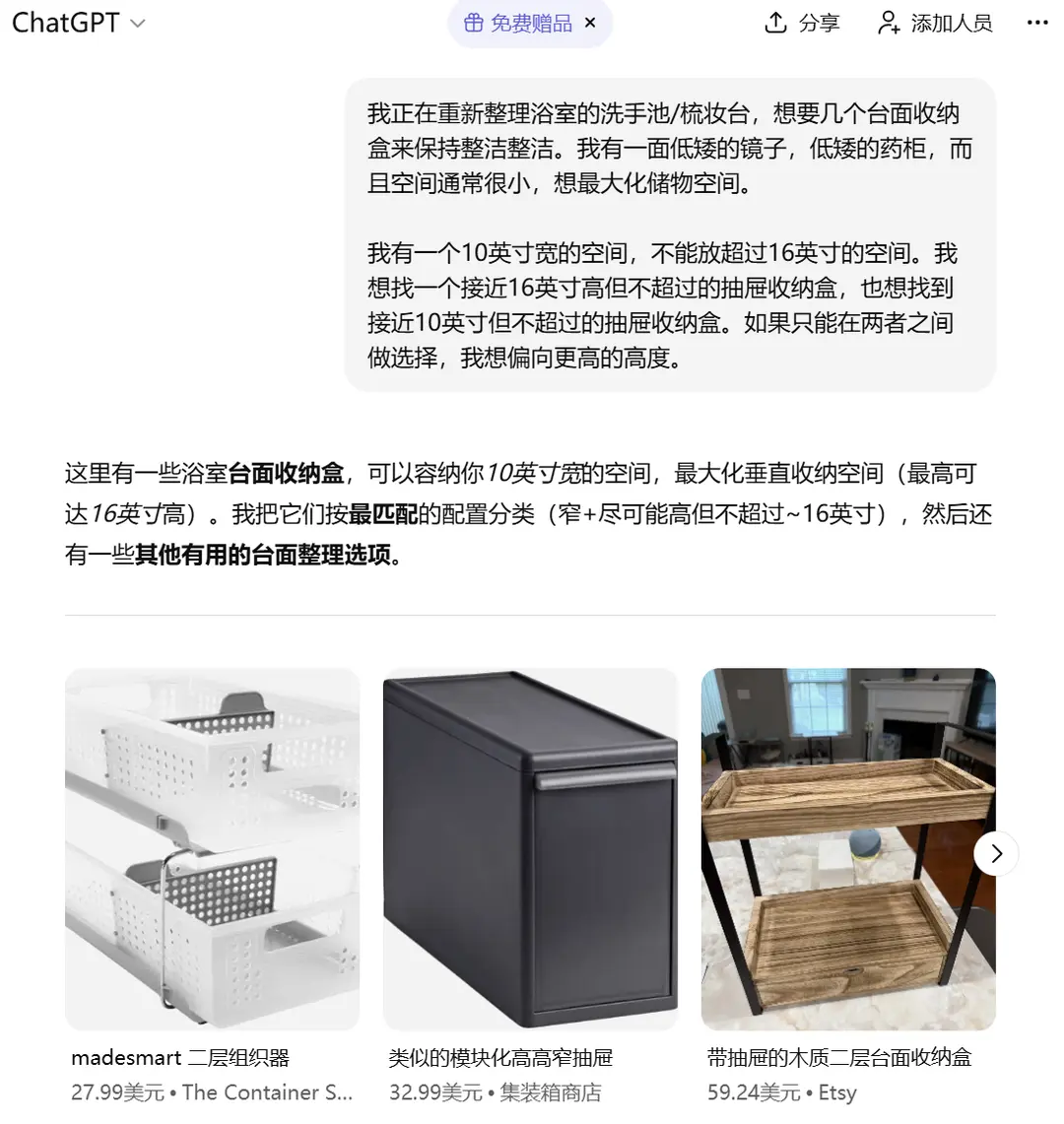
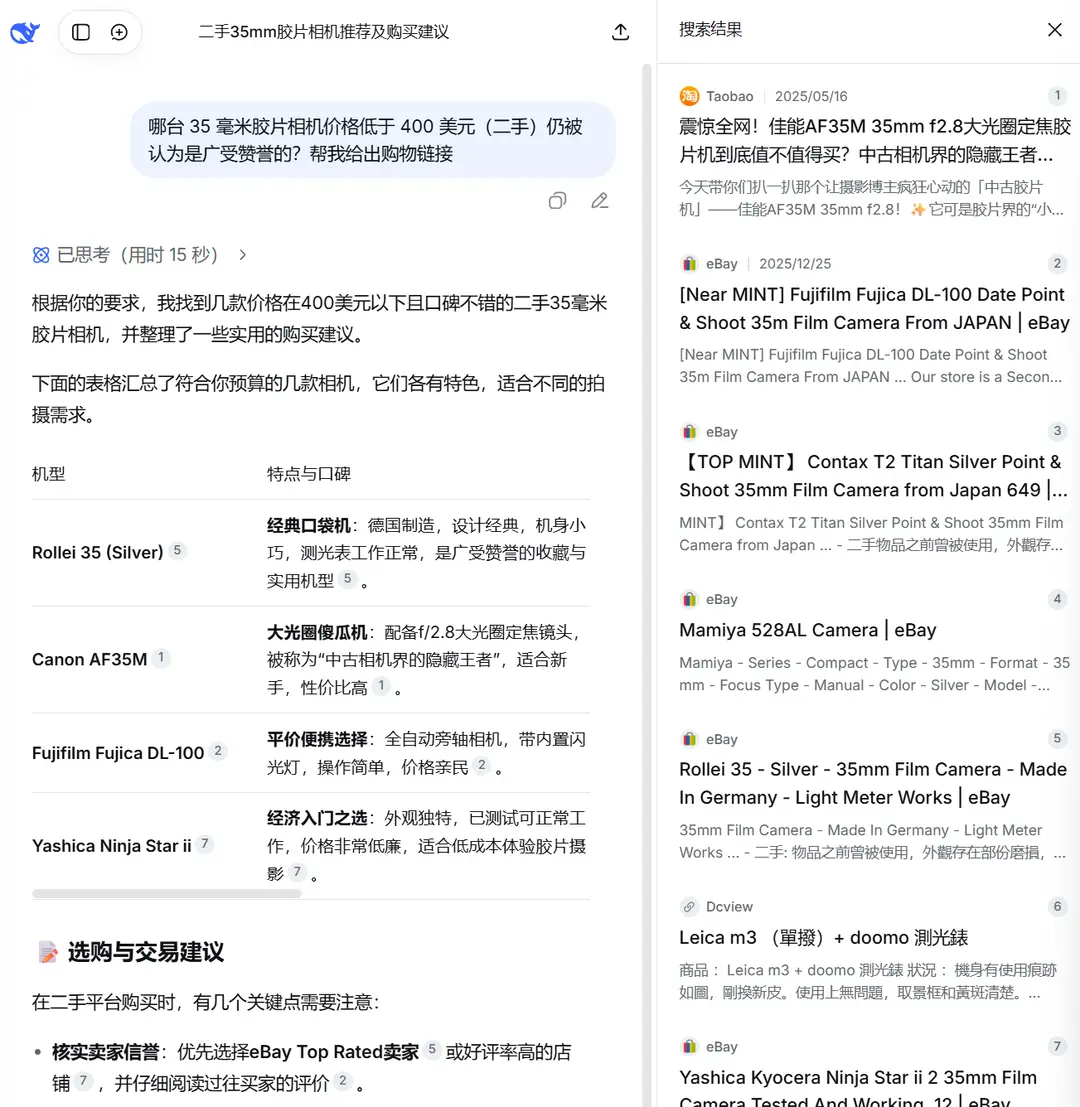
Other users also mentioned examples like asking an AI in a conversation: “Which 35mm film cameras under $400 (used) are still highly regarded? Help me find shopping links.” The AI then automatically provided purchase links from shopping platforms. Besides links, the AI also gave extensive reasoning for the choices, including how to buy, how to use, and important considerations. This shopping experience far surpasses the convenience currently offered by most e-commerce platforms.

Moreover, if further product understanding is needed, AI can help users analyze product reviews, filtering out likely “inflated” comments and selecting the most valuable information for the user.
Undoubtedly, this AI shopping model significantly upgrades the traditional online shopping experience. However, in the current domestic environment, this experience might still take some time to arrive. The main reason is that mainstream domestic shopping platforms generally do not open product pages to the public, requiring user login for access.
I also tried on Deepseek. Currently, Deepseek can only list possible product candidates, and the search process shows it primarily queries open shopping platforms abroad.
How to Use E-commerce Platform AI Shopping Features
From the usage experience mentioned earlier, the shopping features currently experienced on general-purpose (or “all-in-one”) AIs can hardly be called an optimized specific function; they are merely a manifestation of these AIs’ capabilities. Yet, this manifestation already significantly outperforms previous shopping experiences. Clearly, this technological advancement is worth promoting and popularizing.
E-commerce platforms have also sensed this “crisis” and are launching their own AIs to build moats. For example, a certain platform recently launched an AI shopping app, which already has 1,000 downloads in my Vivo phone’s app store. Another major platform has introduced a similar “chatbot” AI shopping feature.

Using these e-commerce platform AIs is quite straightforward. For instance, in the aforementioned app, you simply input what you want in natural language, and it immediately matches your needs. Additionally, such shopping apps have a unique advantage: they recommend products users are most likely to prefer based on past purchase records and habits. This undoubtedly represents another unique track. As I mentioned in a previous article What AI Really Lacks Now Is Not Computing Power, But “Memory” , long-term memory for AI is a major trend in current AI development, shifting from turn-based dialogues to comprehensive historical analysis, thereby providing more scientific bases for shopping decisions.

What Are the Differences Between General-Purpose AI Shopping and E-commerce Platform AI Shopping?
As seen from the usage methods mentioned earlier, general-purpose AIs like DeepSeek, Kimi, and ChatGPT rely heavily on the openness of shopping website information to smoothly use shopping features; otherwise, they cannot search and analyze these shopping pages. In contrast, e-commerce AIs are closed systems, circulating all product information and user purchase records internally. The main difference is that general-purpose AIs can search for products across a wider range of shopping platforms, while e-commerce AI shopping is limited to products on their own platform.
From a personal perspective, I believe both development paths have unique value. For example, shopping with general-purpose AIs allows comparing information across different platforms, avoiding the “information cocoon” and “big data price discrimination.” Meanwhile, e-commerce AIs can cultivate user habits by binding personal purchase records and usage patterns, especially through various dazzling “discount coupons.”
Regardless, driven by the pressure from general-purpose AIs, basic product information on various e-commerce platforms may also become more open. After all, general-purpose AIs are flourishing, with countless user entry points. If these AIs can only find products from Platform A but not from Platforms B and C, then B and C would likely be very anxious.
Coincidentally, while researching Google SEO recently, Lao T noticed many people proposing the argument: “Search engine SEO is a thing of the past; AI SEO is the future.” Think about it: now everyone asks questions and seeks answers from AIs. For specific queries, if an AI can already aggregate sufficient detailed information and provide clear guidance, who would click through to the original webpage? Unless it’s a shopping link that must be clicked for purchase.
For shopping platforms, this could lead to several significant changes: Bid-based ranking might become ineffective; product information will become more parameterized; page information needs to shift from attracting human eyes to attracting AI.
For example, various bid-based rankings on e-commerce platforms often involve manual manipulation of search results. In front of AI, if the AI itself does not implement bid-based ranking, the search results might be fairer.
For instance, product information parameterization means each product needs to provide as precise descriptive information as possible for AI analysis, even converting “unspeakable” information into “speakable text,” such as brand value, design aesthetics, descriptions of specific graphics on products, etc.
Regarding page information, many shoppers have experienced product detail pages with endless images that take forever to load on mobile, where all text is turned into images to catch attention, often playing word games to mislead consumers. But in front of AI, more images could negatively impact AI computation, potentially giving an advantage to products with simple pages and detailed text descriptions.
However, the rise of AI shopping might also bring certain negative impacts, primarily putting pressure on sellers offering “homogeneous products.” After all, current AIs are like “emotionless machines,” providing “standard answers” based solely on user needs. In such cases, if there are homogeneous results, the AI might ruthlessly choose “the most suitable one.” This means that products and platforms that previously relied on packaging, emotional appeal, and information asymmetry for advantage will see their edge rapidly diminish with AI intervention.
Overall, as more shopping decisions are completed within AI, what e-commerce platforms truly compete on is no longer “whose page is flashier,” but “whose data is more authentic, structure clearer, and historical feedback more reliable.” From this perspective, AI shopping is not merely changing how users place orders; it is quietly reshaping the underlying logic of the entire e-commerce system.