
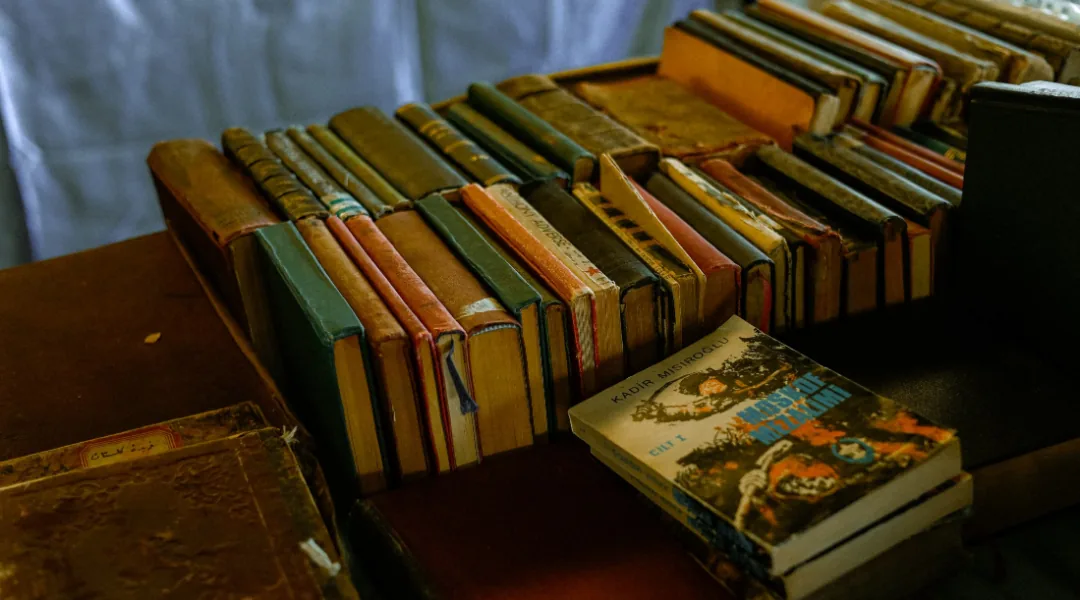
Recently, Anthropic scanned a batch of old books and then destroyed the originals. This controversial move set off a firestorm online, with accusations of book burning being thrown around instantly.
But after thinking about it more carefully, and looking at those anguished comments, I suddenly found it absurd. If these people truly cared about culture, where were they when those old books were selling for a few yuan per kilogram in second-hand markets and no one wanted them? To put it bluntly, this moral outrage only exists on trending topics; it never translates into a purchasing decision. It is a cheap form of self-gratification, using others’ actions to coat oneself with a layer of gilded “cultural defender” status.
In this process, I also seriously pondered a question: among those old books we enshrine on pedestals, how many are truly valuable, and how many are just emotional baggage we cannot bear to discard?
The essence of knowledge is flow
In my cabinet, I have a stash of the 1960s–70s edition of The Hundred Thousand Whys. To be honest, apart from a bit of collectible value, the content is a whole era behind today’s. A casual flip reveals that the “whys” it answers now seem almost laughable to today’s children. This set is still kept not because it is still useful, but because it carries some personal memories. But that value belongs only to me; it has nothing to do with the progress of human knowledge.
Then there are those self-funded books written by retired old comrades after they left office. I have a few at home. After they passed away, these books became, in legal terms, unique copies. What value do they have? Their only use is to prove that the author once lived. But does that proof mean anything to anyone else? I don’t think so. In tens of thousands of years of human history, there is no need for an unread memoir to prove that someone existed. To put it bluntly, these books being swept into the dustbin of history is not a tragedy; it is a law of nature.
The problem is that our entire social system for preserving knowledge happens to keep these things alive as well. Copyright law protects works for fifty or even seventy years after the author’s death. They have neither commercial value nor can they be legally made public; they can only quietly rot in the cage of the protection period. This is called protecting knowledge, but in fact it is a long suspended death sentence for knowledge. By the time the sentence is up, the paper has long since decayed.
I have always believed that truly valuable knowledge does not need to be printed as a book to gain dignity. I have been blogging for nearly twenty years, with over four hundred posts and more than a million words. By the time they were written, they had already been read by tens of thousands, reposted, and discussed. They have lived. If I were to collect them and print them as a book after retirement, it would merely be taking something that has already fulfilled its mission, packaging it again, locking it on a shelf, waiting for people of the next era to come gawk at it. That is not dignity; it is superfluous. Of course, the quality of what I write is not particularly high, but it would not be fair to say that some of it is completely worthless. Still, so what?
History never cares about truth; it only cares about what the present needs
Someone once argued with me, saying that rare books must be preserved, because if discovered by future scholars centuries later, they might rewrite the entire understanding of history. This argument sounds plausible at first, but upon a little reflection, it does not hold up.
History itself is a ruthless compression machine. In the year 0 AD, history was the minutiae of the preceding centuries. By the year 1000 AD, that part had been heavily compressed; people cared more about what happened in the past five hundred years. Even in modern times, once World War II ended, how many of the anti-war novels, memoirs, and strategic analyses from World War I are still taken out and read? It is not that they were banned or destroyed, but that they have been overwhelmed by newer, more recent war traumas. Even texts that were once followed by hundreds of millions will sink. How could a rare book that no one cared about in its own time hope to make a comeback in the next era? The odds are lower than winning the lottery.
And the cruelty goes further. Even if a book that gathered dust for centuries were to be miraculously unearthed by later generations, what meaning would it have?
Even those books that have been passed down through the ages have been altered beyond recognition. For instance, the Analects we read today was compiled during the Han dynasty. The Han Confucians did not want Confucius’s original words; they wanted a thought that served Emperor Wu of Han’s grand unification. Or take the Three Hundred Tang Poems, which some scholars have verified as having been altered in over a hundred places; even the line “Moonlight before my bed” in Quiet Night Thoughts, a line etched into the national memory, was tampered with. Not to mention books that were rediscovered. A typical example is the Collected Poems and Essays of Wang Chuanshan, which I was reading earlier this year. Wang was a Ming loyalist obsessed with the distinction between Hua and Yi and the restoration of the Ming. Yet his manuscripts were unearthed by Zeng Guofan, who edited and altered them, turning them into the orthodox voice of late-Qing Neo-Confucianism. You see, even if a book is tough enough to survive centuries without decaying, by the time it is finally discovered, it cannot escape being dismembered and reshaped. Later generations are not there to understand the author; they are there to borrow a shell. The author meant A, but later generations have their own script and need it to say B, so it becomes B.
I used to believe that preserving rare books was about leaving a fair reader for the future. Now I understand that fair reader does not exist. All that exists are generation after generation using old books as props to perform their own plays. So, preserving a rare book is essentially preserving a shell that can be freely borrowed by the future. Its value does not depend on what it recorded in itself, but on what prop a future era happens to need.
Letting AI devour these books is not a bad thing
Once I worked through this, looking back at the Anthropic incident, my feelings were completely different.
That AI company bought a century-old encyclopedia compiled by an individual—thousands of pages, hand-compiled, locked in a private bookcase, never opened by anyone. But after scanning it and feeding it into the model, hundreds of millions of people can now ask it questions in their own languages. And then they destroyed the originals.
Some called it book burning. I laughed. Book burning is about destroying content and preventing dissemination. Scanning and then destroying—this means the content has been fully extracted and activated, and then the redundant physical container is disposed of. Book burning is snuffing out the flame; this is after the flame has already been passed on, throwing away the spent torch. To conflate these two things is either lazy thinking or deliberate sensationalism.
And frankly, AI is doing something that humans themselves cannot do and would not deign to do. It does not care whether a book is rubbish, whether anyone has read it, or whether it was written by an academic authority or the memoirs of a retired old comrade. It swallows all these texts that humans do not even glance at, digests them, extracts from them, and turns them into a callable data layer. The essence of this process is knowledge recycling. Humans have produced massive amounts of knowledge waste. In the past, it rotted in piles of paper and in libraries, untouched and unprocessable. Now AI has arrived, like a giant knowledge recycling truck, hauling all this waste away, breaking it down, and extracting even the tiniest bit of useful raw material.
That is ten thousand times better than letting them mould on bookshelves or be imprisoned by copyright law until they rot.
Of course, some will say that AI may learn knowledge wrong and produce biases and hallucinations. But I would counter: is the human way of preserving knowledge perfect? Libraries also remove certain books under pressure; archives also redact sensitive documents before making them public; publishers also alter content in reprints. The human knowledge preservation system has always been selective and shaped by the times. Those so-called neutral public institutions erect paywalls, locking public knowledge away in places only the privileged can access. Why should these institutions be trusted more than AI?
At least AI does not pretend. It does not pretend to be passing on orthodoxy, does not pretend to show respect, does not pretend to be an impartial guardian. It just swallows everything and spits it out when you need it. Crude, but not hypocritical.
My modest understanding of knowledge
In fact, when you think about it, our expectations of knowledge are perhaps the same as our expectations of human relationships. We do not need it to be enshrined in a temple, polished until shiny, or always correct. We need it to be alive, to be within reach when we need it, to let it engage with the problems we are thinking about, to allow something new to emerge because of it.
An old book devoured by AI has not died. It has become a fragment, a data point, a mode of thinking that hundreds of millions can call upon at any time. It is no longer a complete book, nor does it belong to any single author. It has merged into the torrent of knowledge and become a part that anyone can reach out and take. Isn’t that a greater form of existence?
I have been blogging for so many years, and I have never cared whether it can be preserved. I only care whether it has been seen in the present moment, whether it has made some reader feel understood at some instant. If so, it has already fulfilled its mission. I do not need that kind of dignity—bound into a book and locked in a library. How long my ideas last is left to drift in time. If one day no one needs them anymore, let them disappear.
True knowledge should flow like air, not sit like a stone in a temple, waiting for people to kowtow.