
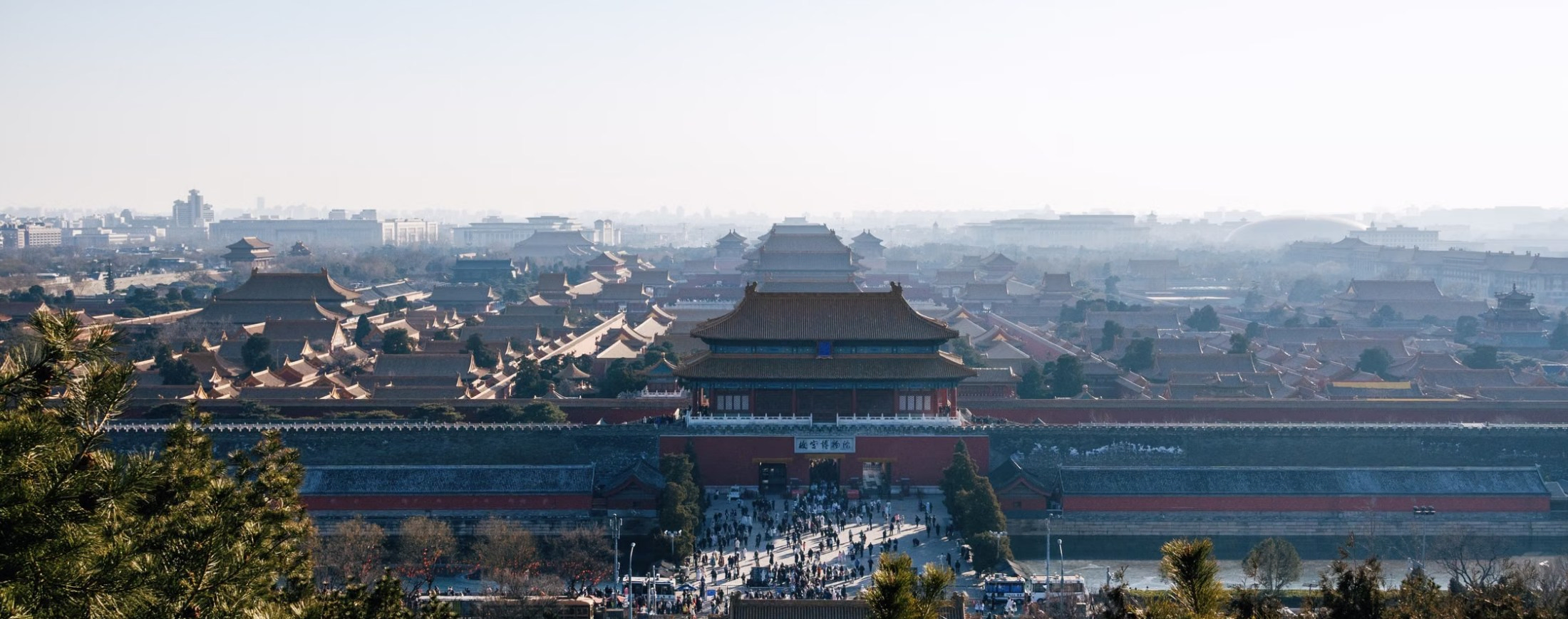
Tang poetry, Song ci, Yuan qu, Ming novels—so what exactly does the Qing dynasty have?
Introduction: The Historical Health Check Ruler—A Cold-Eyed Examination Stripped of Emotion
“Tang poetry, Song ci, Yuan qu, Ming novels—what does the Qing dynasty have?"—folk wisdom usually answers with Dream of the Red Chamber or “the Manchu-Han Imperial Feast.” But if we elevate our perspective to the horizon of a thousand-year civilizational evolution, this question is, at its core, a historical health check problem.
Evaluating a dynasty cannot rely on ethnic sentiment, nor can it use modern moral sensibilities to indict the ancients. We need an objective “civilizational health check ruler” that takes physical measurements across two dimensions:1
- Survival Dimension: Have the three bedrock elements—language and script, cultural customs, and geographical environment—persisted? Has the territorial chassis been consolidated?
- Development Dimension: Has productive capacity broken through? Has technological innovation iterated? Has culture popularized and trickled downward?
Measuring with this ruler, the Qing dynasty presents an extraordinarily striking specimen: it scored a near-perfect high score on “survival,” yet handed in an almost entirely blank sheet on “development.”2
This is neither a “verdict of conviction” nor a “petition for exoneration.” It is merely a dispassionate dissection: what kind of tearing and cost occurred within an agrarian land-power civilization when it confronted the冲击 of an industrial sea-power civilization.
Volume I: The Cultural Incision—From Marketplace Trickle-Down to the Elite Literati’s “Desk-Bound Swan Song”
The cultural evolution of Chinese civilization originally advanced along a clear main thread of “privilege devolution and cultural trickle-down”: Tang poetry belonged to the aristocratic elite, Song ci devolved downward to the scholar-official class, Yuan qu entered the marketplace and entertainment quarters, and Ming fiction was thoroughly embraced by the masses. This was a thousand-year-long, irreversible process of cultural democratization.3
1. Story Genes vs. Desk-Bound Symbols
The novels of the Ming dynasty (The Three Kingdoms, The Water Margin, Journey to the West) were products of “generational accumulation.” They were honed over centuries in teahouses and storytelling arenas, and their story genes are extraordinarily hardcore:
- Havoc in Heaven, Borrowing Arrows with Straw Boats, Wu Song Fights the Tiger—these plot points constitute the bedrock skeleton of Chinese collective memory. Even peddlers and porters who have never flipped through the originals can recite these stories backward and forward from New Year prints, pingshu storytelling, and shadow puppetry.
- They circulated among the folk for centuries before being compiled into books; their plots are “skeletal” in structure—understood at first hearing, spread as soon as told, remembered for a lifetime. They are not “literature”; they are “language itself”—“Borrowing Arrows with Straw Boats” is a chengyu idiom, “the Empty Fort Strategy” is a stratagem, “Wu Song Fights the Tiger” is courage. These stories have melted into the daily expressions of the Chinese people.4
The Ming dynasty even achieved “hardcore popularization,” with an intensity unimaginable in previous dynasties:
- Zhu Yuanzhang’s “Sentence-Reduction Literacy Drive”: This beggar-born founding emperor mandated nationwide study of The Grand Pronouncements (Da Gao), a vernacular legal case collection he personally wrote, stipulating that every household must possess a copy. The most brilliant twist—if a criminal’s household possessed The Grand Pronouncements and could recite it, the sentence was reduced by one degree. This was tantamount to using “a knife” to force commoners to learn characters—the method was crude, but the effect was immediate.5
- The Full Rollout of the Community School (Shexue) System: The Ming dynasty widely established community schools (equivalent to village elementary schools) in the countryside, enrolling commoner children aged 8 to 15, tuition-free or charging only a nominal bundle of dried meat as a token fee. The teaching materials were vernacular primers like the Three Character Classic, The Hundred Family Surnames, and The Thousand Character Classic, with a single goal: literacy—enough to keep accounts and understand contracts.5
- Printing Technology Thoroughly Trickled Down to the Marketplace: Ming dynasty block-printing costs were extremely low, and daily-use encyclopedic handbooks (riyong leishu) exploded onto the scene—titles like Everything You Need Without Asking Others, Household Essentials, Agricultural Manuals, and Medical Formularies flew everywhere. An ordinary peddler, artisan, or peasant could save up a bit of money and buy a “look-at-the-picture-learn-the-character” type of almanac.5
- The Comprehensive Devolution of Folk Writing Rights: Zhu Yuanzhang personally stepped in to promote duilian (antithetical couplets), decreeing that “on the gates of all officials, ministers, scholars, and commoners, a pair of spring couplets must be affixed.” He even personally composed an imperial brush inscription for a butcher—“With both hands cleave open the path of life and death; with one blade sever the root of right and wrong”—the emperor himself taking the lead in play, culture directly trickling down to the bottom stratum. The right to compile genealogies was liberated from the hands of powerful aristocratic clans; villages across the country, every surname, began compiling genealogies on a large scale, creating a situation where “every family has its genealogy, every county has its gazetteer.” The right to record history was handed from the imperial historiographers into the ancestral halls of ordinary people. Gazetteer compilation during the Ming reached a feverish pitch—recording not only taxes and population but also customs, dialects, local products, and even folk legends and strange anecdotes—this was essentially using writing to compose biographies for the daily lives of ordinary people.6
The daily life of a Ming dynasty commoner looked like this: listening to Journey to the West storytelling, pasting the spring couplets promoted by the founding emperor, compiling their own family genealogy, memorizing the sentence-reducing Grand Pronouncements, sending their kids to the village community school to learn a few characters. This was an era of culture permeating on a massive scale from the elite to the folk.5
By the Qing dynasty, however, the trend of cultural trickle-down experienced a “reverse backwash.” Dream of the Red Chamber, while representing the artistic pinnacle of the Chinese classical novel, was a “literati-solo-creation-type” desk-bound swan song. It depicts the domestic affairs of the aristocracy, employs exquisitely refined literary brushwork, and has an extremely high reading threshold. It did not grow out of teahouses; it “admired its own reflection in solitude” from within the literati study. For 95% of the general public, Dream of the Red Chamber is an elite symbol “heard of but with no idea what’s written inside”—“99% of people can’t recall any plot, 95% or more have no clue what’s written in it, at most they know a few names.”4 Even regarding who its author is, the controversy that “it was written by Ming dynasty loyalist elders” still echoes within Redology circles—Mao Pijiang, Fang Yizhi, Wu Meicun, and Hong Sheng have all been nominated as candidates for the “true author.”7
The Qing dynasty did not carve out any new popularizing cultural products on the track of cultural trickle-down. The literary inquisition (wenziyu) drove intellectuals into the “safe lane” of textual criticism (kaozheng) and exegetical studies (xungu); antithetical couplets shrank from a marketplace game back into a word game within literati studies; genealogies dared not record genuine sentiments; gazetteers dared not record sensitive local customs. That door of “folk writing rights” that the Ming had opened was shut again, panel by panel, by the Qing.36
And the so-called “the Qing dynasty’s grand synthesis is treaties” of folk black humor precisely reflects the historical sensation that literary achievement cannot conceal real humiliation—the late Qing signed a pile of unequal treaties, a pain shared by the entire nation. No literary achievement can “offset” or “whitewash” this period of history. No matter how fine the poetry or how exquisite the ci lyrics, they cannot fill the holes blasted open by gunboats.8
Tang: has (poetry); Song: has (ci); Yuan: has (qu); Ming: has the most (novels); Qing: nothing.
Volume II: The Institutional Bottom Card—The Manchu Qing’s Anti-Han Logic and the Industrial Cost of “Active Blindness”
Why could the Ming promote cultural trickle-down and technological exploration, while the Qing headed toward closure? The root cause lies in the institutional ecology difference between the “small government” and the “big government.”
1. Institutional Ecology and “Anti-Han” Anxiety
The mid-to-late Ming displayed “small government” characteristics: after the silver monetization of the Single Whip Reform, the court fiscally washed its hands of many responsibilities; grassroots governance relied on the self-rule of the gentry, clans, community schools, and charitable estates (yizhuang); “imperial power did not descend below the county level.” After state power contracted, folk society obtained the free space to compile novels, repair genealogies, run private schools, and play with couplets. This was a “loosely managed” system—although it led to end-of-dynasty chaos, it gave society room to breathe.9
The Qing, by contrast, as a minority-conquest regime, bore a profound “anti-Han anxiety” branded into the底层 of its rule. Driven by this fundamental “anti-Han” anxiety, the Qing established an exceptionally tight “big government” control system: the Eight Banners garrisons, the baojia mutual surveillance system, and the literary inquisition network were comprehensively rolled out; the intensity of surveillance over grassroots society far exceeded that of the Ming; intellectuals were herded into the “safe lane” of textual criticism, not daring to touch political critique or scientific-technological exploration; folk creativity was systematically compressed. The Ming’s “small government” tossed a great many social functions to the folk, whereas the Qing kneaded society into a dead knot—wanting to control everything, the result was that nothing was allowed to move.9
This institutional difference manifested itself with particular brutality in knowledge management:
Knowledge Blockade: Under the pretext of compiling the Siku Quanshu (Complete Library of the Four Treasuries), the Qianlong Emperor had vast quantities of ancient books burned and tampered with—by some estimates, the number of books wholly destroyed or partially expurgated reached into the thousands. This differs in essence from the Vatican Library’s “offline backup” of Chinese ancient texts: the Vatican’s “lock” was for preservation—missionaries brought books back to Rome, objectively preserving for China a large number of editions that had been destroyed or lost domestically; whereas the Siku Quanshu’s “lock” was for destruction—the court actively deleted system files, severing the flow and renewal of knowledge at the societal level, directly dragging Chinese scholarship from “exploration” into the dead end of “textual criticism.” When we today study Ming history or the history of Sino-Western exchange, we sometimes have no choice but to go to the Vatican and scroll through microfilm—because the Qing empire’s “anti-Han firewall” filtered out far too many things; it was instead that “book-locking cabinet” ten thousand li away that preserved for us the shadow of the truth.10
Technological Discontinuity: The Ming dynasty’s Zheng He voyages to the Western Ocean possessed ten-thousand-ton-class treasure ships with watertight compartment technology (Columbus’s contemporary Santa María was a mere 25 meters long); Xu Guangqi collaborated with Matteo Ricci to translate the first six volumes of Euclid’s Elements (1607); in the late Ming, “red-barbarian cannon” (hongyi dapao) were deployed on a large scale, and Western ballistics was systematically introduced. Yet the Qing, in order to prevent Han people from “going down to the sea,” burned coastal ships and destroyed archives, causing the entire nation’s naval warfare knowledge system to be “formatted.” The final nine volumes of the Elements were not supplemented in translation by Li Shanlan until 1857—a gap of a full 250 years in between. Red-barbarian cannon were locked away in warehouses; firearms technology regressed rather than advanced. The most absurd case: by the 1860s, when Peng Yulin was building the Xiang Army’s naval force to fight the Taiping Heavenly Kingdom, he could only flip through Gongjin’s Methods of Naval Warfare, a text from the Three Kingdoms period 1,600 years earlier, as his teaching material—a nation that had once possessed Zheng He’s treasure ships, in less than two hundred years, saw its naval warfare knowledge degrade to the point of needing to find inspiration in Romance of the Three Kingdoms.11
2. “Selective Blindness” and the Shackles of the Self-Strengthening Movement
The Qing upper class was not ignorant of the Industrial Revolution—a single glance at the Western architecture of the Old Summer Palace (Yuanmingyuan) reveals European court design; the Qing court had in fact continuously maintained very close contacts with Europe within the ruling class. The Kangxi Emperor conducted scientific experiments, studied astronomy and mathematics, directed cartographic surveys, and even set up a “laboratory”; the Qianlong Emperor received the Macartney Embassy, and the achievements of the French Revolution and the Industrial Revolution were all reported to the throne. Yet they made a sober choice of self-preservation:12
Introducing industrialization and new thought would equal the awakening of Han power and the collapse of the ruling system; maintaining an agrarian society could at least preserve the rule of the Aisin Gioro clan.
This was a cold-blooded political arithmetic problem: once the fruits of the Industrial Revolution were systematically introduced into China, the difficulty of the Manchu Qing’s continued rule would grow exponentially. This was not “ignorance,” not “obscurantism,” but an alien ruling clique, in order to preserve its own privileges, actively choosing to make the entire nation stop growing.12
This “private-interest-first” logic directly produced the dead knot of the Self-Strengthening Movement. Why did the Self-Strengthening Movement originate from Han bureaucrats? Because the Taiping Heavenly Kingdom had smashed the Eight Banners and Green Standard armies into dregs; Zeng Guofan, Li Hongzhang, and this cohort of Confucian-bred Han landlords were forced to raise funds themselves, train troops themselves, and run factories themselves. The core interest of the Manchu Qing aristocracy was “mounted archery as the foundation”; they had run the numbers: once Han people controlled machine manufacturing, they would control war potential; once they controlled war potential, they would control discursive power. With money in Han hands, guns in Han hands, railways and telegraphs in Han hands—what “privilege” would remain for the Manchu Qing aristocracy?13
Thus the Self-Strengthening Movement was locked from beginning to end within a contorted framework: the Manchu Qing court could tolerate Han bureaucrats buying a few cannons and opening a few shipyards, because such gadgets did not threaten “the Heavenly Mandate of imperial power.” But the moment anyone proposed reforming the civil service examinations, establishing a parliament, or enacting a constitution, the Manchu Qing’s “political red line” was breached. They permitted Li Hongzhang to buy warships, but not to reform institutions; they permitted Zuo Zongtang to plant cotton, but not to liberate productive forces. The fundamental reason for the failure of the Self-Strengthening Movement was not that too little technology was purchased, but that the Manchu Qing ruling stratum never treated it as a “national strategy” from start to finish—they treated it as “Han people messing around.”13 In the end, with a single Sino-Japanese War, the paper-pasted scaffold collapsed at a poke—China’s productive development was forcibly smothered for several centuries.13
Volume III: Geopolitical Reconstruction—Land-Power Obsession, the Tributary Perspective, and the Fate of the Firefighters
Evaluating the Qing dynasty’s “territorial expansion” must be examined within the coordinate system of 17th–18th century global great-power expansion.
1. The Collision of Global Expansions
The 17th–18th centuries were precisely the critical period of expansion for the globe’s great powers; nearly all great powers benefited from that round of expansion. But different expansion directions brought radically different civilizational consequences:14
[Comparison of 17th–18th Century Global Expansion Models]
┌──────────────┬──────────────────────────────────┬──────────────────────────────────┐
│   Nation     │   Expansion Direction & Means    │   Geopolitical & Economic Outcome │
├──────────────┼──────────────────────────────────┼──────────────────────────────────┤
│ Britain/     │ Maritime routes, trading ports,  │ Acquired industrial capital;     │
│ Netherlands  │ colonies                         │ the more they fought, the more   │
│              │                                  │ open they became                 │
├──────────────┼──────────────────────────────────┼──────────────────────────────────┤
│ Tsarist      │ Siberian furs and minerals       │ Desperately sought ice-free      │
│ Russia       │                                  │ ports; integrated into trade     │
├──────────────┼──────────────────────────────────┼──────────────────────────────────┤
│ Qing Dynasty │ Dzungaria, Xinjiang, Tibet,      │ Military blockade and isolation; │
│              │ Mongolia                         │ annually subsidized military     │
│              │                                  │ expenses out of pocket           │
└──────────────┴──────────────────────────────────┴──────────────────────────────────┘
The Qing fought the Dzungars for seventy years and took control of vast frontier territories—but after taking them, what did it do? Blockade! Han immigration was forbidden, mining and commerce were forbidden; the new territories were treated as imperial hunting grounds and penal exile destinations, generating no capital circulation whatsoever, while instead bleeding enormous annual military expenditures just to garrison them. Western great powers, the more they expanded, the more open they became; the Qing, the more it expanded, the more心虚 it became—because as a minority-conquest regime, it harbored an extreme fear of Han people putting down roots in the new territories. Thus its “expansion” was, in essence, a “military cordon sanitaire”—not for development, but to prevent the “spillover” of interior Han people from threatening its ruling foundations.14
In this “open-book exam” of global great-power expansion, all the other great powers were answering “modern chemistry,” while only the Qing dynasty, with utmost seriousness, scored full marks on “agrarian-topography anatomy”—it gained on the map, but in civilizational evolution, it lost the entire future.14
Concerning territory, there is an even more vexing logical paradox: if one counts the Qing as having “opened up new territory and expanded the realm,” that is tantamount to admitting that places like Xinjiang and the Northeast were not within China’s territory during the Ming—this directly negates the legal principle of “since ancient times.” In fact, the Ming exercised loose-rein (jimi) rule over the Northeast (the Nurgan Regional Military Commission) and the Western Regions (Hami Garrison); although loose, these were legally territories within the tributary system. The Qing’s merit was, at most, turning these “nominal territories” into “directly administered provinces”—in essence, “strengthened administration” rather than “creating new land.” If one counts it as “internal unification,” then its “martial achievement” was merely a tardy administrative consolidation, hardly an “epoch-making feat of territorial expansion.”15
As for the other argument frequently used to “rehabilitate” the Qing—the population explosion—it likewise cannot withstand scrutiny. Corn, sweet potatoes, and potatoes, introduced in the late Ming, were only truly popularized during the Kangxi-Qianlong period, whereupon the population exploded from 100 million to 400 million. What if it had been a different dynasty? Had the Ming persisted, or had another Han dynasty taken over, getting hold of these seeds would have nurtured just as many people. This was purely a species dividend brought by the global Age of Discovery; the Qing merely had the good luck to “catch” it—it was absolutely not a testament to its skillful governance. More ironically, the pressures brought by the population explosion were shifted onto the底层 through even more brutal exploitation (land rents, taxes), ultimately leading to the massive explosion of the Taiping Heavenly Kingdom—which is precisely proof of the Qing’s governance failure.16
2. The Tributary Perspective: Vietnam and Mongolia in Contrast
Re-examining the Qing from the perspective of tributary states reveals key facts obscured by mainstream narratives.
In treaties such as the Treaty of Shimonoseki and the Sino-French New Treaty, the Western powers recognized the Qing’s suzerainty over its tributary states. This meant that the independence or transfer of a tributary state had to obtain the Qing’s consent through treaty form—in legal principle, this is similar to the logic that colonial independence required the approval of the suzerain. Tributary and directly-administered were merely two different modes of governance. Viewed from modern history, tributary tribute and colonial taxation were, in essence, the same thing.17
The case of Vietnam merits even deeper reflection:
Vietnam: Before 1644, it was highly Sinicized—Chinese characters, civil service examinations, and Chinese surnames were all present; its “degree of Sinicization” was even higher than that of the Manchus. The Ming had established the Jiaozhi Provincial Administration Commission and exercised direct jurisdiction over Vietnam. Vietnam’s independence (938) and the cession of the Sixteen Prefectures of Yan and Yun (936) occurred almost simultaneously—the time difference between the two breaking away from central-plains jurisdiction was less than two years. If it had been a Vietnamese regime that entered and took over the Central Plains in 1644, it would most likely not have implemented “queue-and-robe imposition” (tifa yifu), nor would it have carried out “literary inquisitions to guard against the Han”—because it was itself a “top student” within the Han cultural sphere. But history chose the Manchus, not because they were “more Sinicized,” but because they were “closer to Beijing, had cavalry superiority, and happened to catch the window when Li Zicheng breached the pass.”1718
Certain contemporary Vietnamese “pure Vietnamese genes” narratives—claiming that “the Kinh people are completely unrelated to the Han people”—are, in essence, political operations to construct modern national identity. Through selective sampling (selecting only Kinh samples, concentrating sampling in the south to dilute the influence of northern genes), a kind of ethnic severance is manufactured under a veneer of “science.” But a single simple counterexample suffices to puncture this narrative: to this day, the surname Jiang (姜) still exists in Vietnam—Jiang is one of the eight great ancient surnames, originating from the Yan Emperor, a purely authentic ancient Huaxia surname. A single character “姜” proves the indelibility of millennia of bloodline exchange more powerfully than a pile of academic papers.19
The Mongol Lady Sanniangzi: Lady Sanniangzi (daughter of the chief of the Qilagute tribe, wife of Altan Khan, chief of the Tümed Mongols) of the Ming-era Mongols promoted the Longqing Peace Accord, presided over border trade markets for forty years, and constructed the city of Guihua (present-day Hohhot). The Ming-dynasty text Records of Pacification in Two Reigns (Liangchao Pingrang Lu) by Zhuge Yuansheng records that she “venerated China, esteemed the Buddha, and every time before the Buddha repented, prayed for rebirth so that she might dwell in the Central Plains.” “Prayed for rebirth so that she might dwell in the Central Plains”—this is the classical Chinese version of “in the next life, may I enter Huaxia,” and also the historical prototype of the online meme “would rather be a dog of the Ming.” Sanniangzi’s original words prove that the Ming dynasty’s “cultural吸引力” had already penetrated deep into the steppe, causing even a Mongol aristocratic woman to yearn for it in her heart. This kind of attraction relied not on mounted archery, but on the allure of “living a better life.” The Qing’s control over the Mongols, by contrast, relied more on religious division and marital alliances than on cultural attraction—because “Huaxia” under the Qing had already been locked by literary inquisitions and maritime prohibition into a dried-up well, incapable of even激发 the willingness of Mongol aristocrats to “in the next life, may I dwell in the Central Plains.”20
3. The Deceptiveness of the Manchu Qing Entry into the Pass
The reason the Manchu Qing’s entry into the pass possessed “acceptability” in history—a key point often overlooked—is that it was itself a tributary state recognized by the Ming, and moreover, including Liaodong, many places had historically been areas under commandery-county administration. This identity switch from “tributary” to “overlord” was not unfamiliar within the Chinese discursive system—southern barbarians, western Rong, northern Di, eastern Yi; you exit, I enter the stage—it was, in essence, a matter of long separation inevitably leading to union. The Manchu Qing entry into the pass was cloaked in the guise of “internal affairs of a tributary state,” rather than the visage of “alien civilizational invasion,” which made evaluations at the time and in later generations extremely complex.21
But one must distinguish between two types of “entry into the pass” that are completely different in nature: from the perspective of land-power theory, the Mongols and Manchus were themselves populations from the peripheral zones of the Chinese world; although for a long time not regarded as “Tang people,” they were in essence no different from the Five Barbarians (Wu Hu) or the Shatuo Turks—all had considerable space for assimilation. Cross-ocean European powers, however, were entirely different—different languages and scripts, different religious beliefs, different civilizational genes, with virtually no space for assimilation. Historically, cases like the Khitans changing their dynastic name to Liao, or Yelü Deguang proclaiming himself emperor at Kaifeng—although not recognized by the orthodox line—it is undeniable that the vast region north of Hebei was precisely under the governance of the Liao and later the Jin that it achieved Sinicization. What essential difference is there, after all, between Yelü Deguang and the Shatuo people?22
Some raise the counterargument: even if the Manchu Qing had not entered the pass, what if the Dutch, the Spanish, or, a century or two later, the British and French had come—would the Ming’s outcome have been even worse? Lao T considers this a classic confusion of the deceptive aspect of the Manchu Qing. In reality, if the Great Ming had truly persisted without collapsing into the 18th century, at the very least, in East Asia, only the Great Ming would have been doing the steamrolling. The development of science could not possibly have been a European monopoly either—the Ming’s maritime technology was not bad from the very start. The Ming dynasty was a systematic era of reconstructing Chinese historical culture.22
4. Zeng Guofan and the True Role of the “Firefighters”
After the Taiping Heavenly Kingdom smashed the Eight Banners and Green Standard armies to pieces, Han bureaucrats such as Zeng Guofan, Zuo Zongtang, Hu Linyi, and Peng Yulin were forcibly pushed onto the stage of history. They were originally people of no consequence whatsoever—before the Taiping outbreak, Zeng Guofan was merely a capital official of modest rank; Zuo Zongtang, in his forties, was still teaching school in the Hunan countryside; Hu Linyi and Peng Yulin were either frustrated local officials or scholars who had resigned and returned home. Had the Taiping not riddled the Eight Banners and Green Standard armies into sieves, these men would never have touched military command in their lifetimes. They were “temporary workers” forcibly promoted by “crisis” after the Qing ruling system had completely failed.23
Nowadays, some online label Zeng Guofan a “Han traitor,” but this in fact does not help construct that set of discourse. Because the real situation Zeng Guofan faced was this: had he raised the banner of “expel the barbarians” in the 1860s, not only would there have been no chance of victory, but it would also have caused China to prematurely fall, fifty years early, into the contraction dilemma of the “Eighteen Han Provinces.” Sun Yat-sen, on his way back from abroad after the Wuchang Uprising, still clung to the view of the “Two Capitals and Thirteen Provinces”—it was only after returning and discovering that the Beiyang forces actually had the capacity for “Five Races Under One Union” that he changed his stance. But this kind of opportunity显然 did not exist in Zeng Guofan’s era.23
Stripping away the “Han traitor thesis” or the “class thesis,” and viewing Zeng Guofan from the perspective of civilizational theory:24
- In eliminating the Taiping Heavenly Kingdom, what he preserved was the middle and lower Yangtze region, the core granary and cultural carrier of Chinese civilization. The Taiping’s “class solution” was to smash Confucian temples, abolish Chinese characters, and establish a theocracy—at the time, this was tantamount to performing a “frontal lobotomy” on Chinese civilization. Zeng Guofan’s choice, though conservative, at least preserved the traditional chain of “clan—gentry—imperial power.” “Not losing order” is itself the highest form of productivity protection.
- That Zuo Zongtang could subsequently “carry his coffin” to recover Xinjiang depended precisely on this Xiang Army legacy. What they prolonged was not the Manchu Qing imperial power, but the physical vessel of the Great Unity of Chinese civilization. That Zeng, Zuo, Hu, and Peng prolonged the Qing’s life was, from a later perspective, not necessarily a bad thing—they allowed China to survive the most dangerous “total colonization” window period.
The absurd detail of him flipping through Gongjin’s Methods of Naval Warfare precisely proves that he was a realist who prioritized “survival,” not a pioneer who prioritized “development.” He had no concept of “system upgrade” in his mind. He was neither a hero nor a Han traitor—he was the man who, amidst a great fire, desperately clutched the family land deeds and ancestral spirit tablets to his chest. Although he could not prevent the house from becoming obsolete, he at least did not let the house collapse directly into ruins amidst wind and rain.24
Volume IV: The Land-Sea Paradox—The Three Elements of Civilization and the Dual Tear Between “Survival” and “Development”
Many people often fall into the emotional narratives of “After Yashan, there was no more Huaxia” or “the civilizational rupture of 1644.” But these cannot stand in the face of civilizational facts.
1. The Hardcore Measurement of the Three Elements of Civilization
To measure whether a civilization has ruptured, one cannot only look at “who sits on the imperial throne”; one must examine the three core bedrock elements:25
- Language and Script: Chinese characters and the Chinese language were always the official and folk mainstream (unbroken). The Manchu language, by contrast, became endangered. Although the Yuan dynasty revered Tibetan Buddhism, it never abolished the Han civil service examinations; the Qing pushed the official status of the Chinese language to the extreme.
- Cultural Customs: Confucian ethical principles, clan networks (compiling genealogies, building ancestral halls, establishing clan fields, setting clan regulations), and annual seasonal observances were completely continuous (unbroken). The Zhang Heavenly Masters were enfeoffed as usual; the worship of Lord Guan, Mazu belief, the local Earth God (Tudiye), and the City God (Chenghuang) were never suppressed by Qing authorities—on the contrary, they were frequently granted inscribed plaques and honorific titles. A late-Qing Jiangnan peasant, from birth to burial—naming, schooling, marriage, household division, funeral—completed the entire process within the clan network, with virtually no essential difference from the Tang, Song, and Ming.26
- Geographical Environment: People still farmed in the Yellow River and Yangtze River basins under a monsoon climate, and still needed to manage floods—the survival imperatives of this land determined that the “civilizational kernel” could not be replaced (unchanged).
The “queue-and-robe imposition” (tifa yifu) is often treated as ironclad proof of “civilizational rupture,” but re-examined through the three-element framework, it was merely a “skin reinstallation” at the level of cultural customs, not a “replacement of the underlying system.” The queue-and-robe imposition forced Han people to change their external attire and appearance, but it did not alter the kernel of “ritual” (li)—the procedures for weddings and funerals, the rules for ancestral worship, the grades of mourning attire, and the hierarchical order between ruler and minister, father and son all remained exactly as before. Contrast this with genuine civilizational rupture—the Spanish in the Americas forcibly converting indigenous peoples to Catholicism, burning Maya codices, abolishing native calendars—that was a thorough replacement of “the底层 code of the worldview.” The Qing merely changed the Han people’s hairstyle and official dress style, but still permitted Han people to worship ancestors in their ancestral halls, read the Four Books in their academies, and observe the twenty-four solar terms in their fields.26
“After Yashan, there was no more Huaxia” looks only at “who sits on the imperial throne,” not at “who is writing, farming, trading, and marrying.” It is, in essence, the projection of ethnic sentiment onto the dimension of history, not an objective description of civilizational realities.27
If “After Yashan, there was no more Huaxia” were true, then during the ninety-eight years of Yuan rule, Chinese civilization should have already thoroughly “vanished.” But the fact is: the moment the Yuan fell, Zhu Yuanzhang immediately picked up the banner of “Restore Huaxia,” and the social structure and cultural traditions seamlessly connected. This shows that the core of Chinese civilization is the “operating system,” while the person sitting on the dragon throne is merely the “user”—the user changed, but the system kept running as before. Contrast with cases where civilizational rupture genuinely occurred—after the collapse of the Western Roman Empire, Latin disappeared, cities atrophied, and centralized authority disintegrated; after the Aztec civilization was destroyed by the Spanish, its script was lost, its religion was banned, and over 90% of its population died—China during the Qing period not only did not rupture, but reached its greatest historical extent in physical territory.27
2. Chinese Civilization’s Own “Development Resistance”—Not Entirely the Qing’s Fault to Bear
But the three-element framework also reveals a deeper problem: the Qing’s low score on “development” cannot be entirely blamed on the Qing. Chinese civilization’s own cultural inertia constituted, over a longer time span, a “chronic drag” on technological progress and social change:28
- The Rigidity of Language and Script: “For example, the development of language and script—the promotion of vernacular Chinese and the massive use of new terms—this was, in fact, mainly a problem of the Han people themselves.” Classical Chinese (wenyanwen), as a highly instrumentalized written language, served in agrarian society as a “technical barrier for the ruling stratum,” maintaining knowledge monopoly. It was neither a problem of Chinese characters per se, nor something forcibly caused by the Manchu Qing, but rather a stylistic old habit long maintained by the Chinese scholar-official class to protect its own “right of interpretation.”
- Cultural Conservatism: “For example, cultural development—in reality, this was also millennia of Han culture tying its own hands and feet. The New Culture Movement was very difficult to pull off within the original system; after all, practices like ‘Down with the Confucian Shop’ would, if placed before the late Qing years, have been even more synonymous with ‘destroying Huaxia.’” The Confucian system achieved the ultimate in maintaining “survival,” but it treated “stability” as the highest value and “change” as the source of “chaos.” This “self-binding” was a genetic defect of Han culture itself: it was too excellent in the agrarian age, so much so that it did not believe any civilization could surpass it.
- Resistance to Technological Popularization: “When Hunan and Jiangxi were building the Canton-Hankou Railway, there were still great Confucian scholars opposing it, saying it would ‘crush the dragon veins’—this shows that the阻碍 to industrial civilization was the continuation of a civilization’s deep ‘geographical cognition model.’ Even if you swapped in a Han emperor, when building railways there would still be Jiangnan great Confucians submitting memorials like A Memorial on Railways Crushing Dragon Veins.”
Thus, the more precise stratified judgment is: The Qing dynasty exploited and reinforced the “stability-maintenance capacity” within the existing conservatism of Chinese civilization, but at a specific historical juncture, it suppressed the civilization’s endogenous “innovative试探”; meanwhile, Chinese civilization’s own cultural inertia constituted, over a longer time span, a “chronic drag” on technological progress and social change. The combined force of the two led to modern China’s “passive transformation.”28
3. The Structural Contradiction Between Land-Power Centralization and Industrial Civilization
Chinese civilization is a quintessential land-power civilization, whose survival code is centralized authority and stability; the core of industrial civilization, by contrast, is decentralized trial-and-error, risk investment, and global exchange. Several millennia of Chinese civilization, viewed from its roots, is precisely the representative of the land-power civilization that Mahan spoke of—a very large characteristic being centralized authority—and this has a structural contradiction with the development of industrial civilization.29
Under the fiscal and communications conditions of the 18th–19th centuries, the Qing had to prioritize ensuring the security of the northwestern land-power axis (guarding against the loss of control over the Mongolian Plateau and the Western Regions), which consumed the overwhelming majority of agrarian fiscal revenue. Land-power expenditures—northwestern garrisons, the post-station system, annual banquets and stipends for Mongol princes—were “fixed expenditures” that had to be spent every year; sea-power expenditures—building large sailing warships, training naval personnel—were an “astronomical incremental investment.” Under the limited tax revenues of an agrarian fiscal system, if the Qing threw its full weight behind building a navy, it would inevitably have to cut northwestern military expenditures, leading to the loss of control over the Mongolian Plateau—once the “land-power hub” snapped, the empire’s physical chassis would fall apart. Even more critical was the technological bottleneck: before the mid-19th century, an order from Beijing took two months to reach Ili and one month to reach Guangzhou. If it tried to simultaneously manage the ocean and the interior, the court simply could not rapidly allocate resources in a crisis. An empire with an excessively large management radius and lacking modern communication means could only choose “one heavy end.”29
At the same time, Chinese civilization had, at the psychological level, a deep-rooted “coldness toward the sea.” The底层 peasants, bankrupt aristocrats, and religious dissenters of Europe’s colonial era faced the single-choice question of “go to sea and possibly die, or don’t go to sea and definitely starve,” and what they encountered in the Americas and Africa was a “technological gap”—firearms against bows and arrows, steel against stone tools—able to acquire enormous land and wealth. But China’s periphery (Southeast Asia, Japan) consisted of mature civilizations; there was no expected payoff of “one man, one gun, seizing a piece of land.” Several millennia of agrarian experience proved that “land is life, mobility means risk.” “Being attached to one’s native land and reluctant to relocate” was not moral preaching but the internalization of physical rationality. Even today, the Chinese people’s obsession with “buying a home” and their attachment to “returning to one’s roots in old age” are, in essence, still psychological residues of a land-power civilization. In folk narratives, the sea was never “opportunity” but the归宿 of “lonely wandering ghosts”—the core of Mazu culture is “rescue from disaster,” not “conquest.”30
The课题 of land-sea coordination—human history has yet to produce a single successful precedent. At present, it is merely a slogan, with little resonance among the populace. The most直观 case is the Korean Peninsula: North Korea has taken the land-power direction, and South Korea the sea-power route—the two have thoroughly parted ways and to this day cannot be reconciled. Letting go of sea power was not only suicide for the Manchu Qing; under the格局 of the 17th–19th centuries, it very likely meant thorough fragmentation. Because the contradiction between the two had virtually no room for reconciliation at the time. The outcome would very likely have been the model of Europe versus Russia, or the kind of Southern Song versus Jin.31
4. The “Territorial-Expansion Apathy” of Southern Regimes and the Exception of Zhu Yuanzhang
An observation that runs through Chinese history is: whether it was Zhuge Liang’s Northern Expeditions, Huang Chao’s Northern Expedition, the Taiping Heavenly Kingdom’s Northern Expedition, or the Guangzhou Government’s Northern Expedition—none had particularly great ambition; their goals all stopped at “regime change” or “defensive counterattack.” Chiang Kai-shek’s Northern Expedition is very typical—its main objective was simply to unify the interior within the passes. Although “Five Races Under One Union” had been in place for decades and the Northeast had been established as provinces for decades, in reality, southerners all felt those places mattered little; the Northeast was dispensable and not treated as a major affair. The exceptions to the Northern Expedition pattern are mainly the two special cases of Liu Che (Emperor Wu of Han) and Zhu Di (the Yongle Emperor).32
Behind this lies a logic of geographical determinism: the South was commercially and agriculturally oriented and had no addiction to “land area.” Northern regimes, arising from bitter-cold lands, had a natural hunger for “pastureland, warhorses, population, and strategic depth” and had to keep卷 outward ceaselessly to maintain survival. A southern regime, so long as it held onto the tax revenues of Jiangnan, the canal grain transport, and the channels of maritime trade, could live quite well—to them, “conquering the Gobi Desert” was a money-losing business. In Chinese history, “Great Unity” was mostly accomplished from the north or northwest—because only a regime coming from that direction possessed the impulse to treat the entire eastern end of the Eurasian continent as a “strategic chessboard.”32
Zhu Yuanzhang is a critical exception. Although he raised his troops in the Yangtze basin and proclaimed himself emperor in Nanjing, he himself and his core inner circle were, in their bones, “northerners”—his ancestral home was Pei County in Jiangsu (hometown of the Han founder Liu Bang), and later the family migrated to Fengyang in Anhui. Fengyang lies on the south bank of the Huai River, but geographically sits right on the midpoint of China’s north-south dividing line, historically belonging to the southern fringe of the “Central Plains cultural sphere.” His core team (Xu Da, Chang Yuchun, Tang He, Li Shanchang) were all men from around Fengyang; they did not fear the great plains of the north, did not dread steppe cavalry, and had no psychological障碍 toward “Northern Expeditions.” Contrast his true “southern rivals”: Chen Youliang (a native of Mianyang, Hubei) was invincible in naval warfare but strategically narrow-visioned in land combat against Mongol cavalry; Zhang Shicheng (a native of Taizhou, Jiangsu) was content merely guarding the prosperity of Jiangnan. Zhu Yuanzhang ultimately defeated these two “purely southern” rivals by relying on having both mastery of southern naval superiority and retention of northern land-combat ferocity.33
A more precise formulation is: a regime’s “territorial-expansion ambition” does not depend on where it raises its troops, but on whether its core decision-making stratum possesses “northern survival experience.” Zhu Yuanzhang’s group had it (Fengyang is close to the north); Chiang Kai-shek’s group did not (Fenghua, Zhejiang, is purely Jiangnan); the Taiping Heavenly Kingdom did not (Liangguang is purely southern)—only those regimes that are “physically in the south but mentally in the north” possess the capacity to truly integrate the whole of China.33
And if, in 1644, a highly Sinicized Vietnamese regime had entered and taken over—Vietnam at that time was also entirely using Chinese characters and Chinese surnames, even more Sinicized than Nurhaci—China might have turned toward the sea earlier, but it is also extremely likely that, due to a southern regime’s “natural apathy” toward the northern frontiers, it would have lost control over Mongolia, the Western Regions, and the Northeast, ultimately falling into a fragmented格局 similar to the Southern Song–Jin standoff. This cruel “either-or” equation is the rigid constraint of geographical determinism.18
Volume V: The Contemporary Mirror—The Psychological Structure Behind the “1644 View of History” and the Ultimate Examination
1. The “Want-It-All” Perfect Fantasy
In contemporary online public opinion, the demographics of “anti-Qing” and “anti-capital” heavily overlap. This mentality折射 the instinctive entanglement of a land-power civilization confronting the冲击 of industrialization:34
“Want both Silicon Valley’s high income, and Northern Europe’s high welfare, and also Japan-Korea’s mono-ethnic environment and Russia’s landmass and nuclear arsenal.”
This “perfect fantasy” craves the wealth-and-power fruits of industrial civilization, but deeply fears the social撕裂 and capital costs that industrialization brings. Hidden behind it is a logical裂缝: being anti-Qing is because of “missing out on the benefits of industrialization”; being anti-capital is because of “loathing the costs of industrialization.” The two combined form a fantasy of “wanting only the dividends of industrialization while rejecting its costs.”34
But every civilizational model is a “local optimum” evolved over the long term under specific geographical, historical, and security constraints—Northern Europe’s high welfare comes at the cost of high taxes, high trust, and high cultural homogeneity; Silicon Valley’s high income comes at the cost of extreme inequality and social撕裂; Japan-Korea’s mono-ethnicity comes at the cost of low fertility and insufficient吸引力 for external talent; Russia’s landmass and nuclear arsenal come at the cost of a severely weak economic volume and backward infrastructure. To envy its “fruit,” one must accept its “cause.” But history has no sterile, aseptic version of industrialization.34
2. The Deep Psychological Structure of the “1644 View of History”
The online “1644 View of History”—the emotional historical narrative that treats the Manchu Qing entry into the pass in 1644 as the “rupture of Huaxia civilization”—is, in essence, a compound of “rage at what was missed” and “fear of the cost.”35
The core narrative of anti-Qing is that “the Qing dynasty’s maritime prohibition and闭关锁国 caused China to miss the Industrial Revolution,” whose implicit premise is “if we had seized the opportunity of the Industrial Revolution then, we wouldn’t be so passive today”—this narrative tacitly accepts that “industrialization” itself is progressive and worth pursuing. The core narrative of anti-capital is “capitalism’s掠夺性, exploitativeness, and oppression of the底层 people,” whose implicit premise is that “the fruits of industrial civilization have been monopolized by a minority, and ordinary people have not enjoyed a fair distribution”—this narrative tacitly accepts that “the inequality brought by industrialization” is unacceptable.35
The reason these two demographics overlap is that both stand on the observational perspective of a land-power civilization: both crave the fruits of industrial civilization (strong national power, modern technology, wealth accumulation), and loathe the costs of industrial civilization (social撕裂, cultural conflict, the alienation of human nature by capital). Subconsciously, they believe that “if China had originally been led by ‘our own people’ (a Han regime) to主导 the Industrial Revolution, it could have walked a path both advanced and fair”—but history has no such precedent.35
The “1644 View of History” is not a rigorous academic school, but rather reflects the intense expression of public sentiment. It forms an interesting echo with the “framework disputes” within Qing historiography—the “New Qing History” school emphasizes the “Manchu characteristics” of the Qing, provoking strong opposition from domestic scholars; the official compilation of the History of the Qing (Qing Shi), launched at the beginning of the 21st century and still undrafted more than twenty years later, is precisely because a balance must be found between “consolidating territory” and “maritime prohibition and闭关锁国,” between the “High Qing Prosperity” and the “literary inquisitions.” A historical period on which even professional scholars cannot reach consensus precisely proves that history is not a “standard answer” but a battlefield of “interpretive authority.”35
3. The Ultimate Reading of the Civilizational Health Check Ruler
┌─────────────────────────────────────────────────────────┐
│                Civilizational Health Check Ruler         │
│                  (Civilization Scale)                    │
└────────────────────┬────────────────────────────────────┘
                     │
     ┌───────────────┴───────────────┐
     ▼                               ▼
【Survival Dimension】          【Development Dimension】
(Survival)                      (Development)
• Core Elements:                • Core Elements:
  Language/Customs/Geography      Productivity/Technology/
                                  Cultural Trickle-Down
• Qing Score:                   • Qing Score:
  High Score (80+)                Blank Sheet (Low Score)
• Achievements:                 • Costs:
  Preserved civilizational        Locked down the ocean
  main body                       Suppressed thought
  Consolidated an unprecedentedly Missed the Industrial
  vast territorial chassis        Revolution
This ruler has measured a Qing dynasty torn along the dual tracks of “survival” and “development”:36
- Civilizational Continuity: During the Qing dynasty’s 268 years of rule, none of the three core elements of Chinese civilization—language and script, cultural customs, and geographical environment—experienced rupture. This is a “high shock resistance” rarely seen in human history.
- Developmental Rupture: During the same period, Chinese civilization virtually stagnated on the “development” dimensions of productivity enhancement, social vitality release, and external exchange expansion—not because of “ignorance,” but because of the structural contradiction between the land-power civilization’s “survival-first” algorithm and the industrial civilization’s “risk-investment” algorithm.
These two definitions can explain why China in the 19th century, confronting the Western冲击, presented the paradox of being “large but not strong”: “large” because the Qing left behind an unprecedentedly vast territorial chassis—this is the high score on “survival”; “not strong” because the entire civilizational system was locked into the operational mode of the agrarian era—this is the low score on “development.”36
4. Conclusion: A Ruler That Requires No Taking of Sides
The true tragedy of the Qing dynasty lies not only in its being the self-preserving governance of an “alien ruling clique,” but even more in its being the systemic incompatibility exposed when an entire agrarian land-power civilization confronted the冲击 of an industrial sea-power civilization.37
It bequeathed to modern China an unprecedentedly supersized “survival container”—the Qing’s “historical contribution” was leaving Chinese civilization a supersized physical chassis; its “historical crime” was plugging up every ventilation opening of this container, giving this civilization enormous strategic depth as it faced the industrial age, but simultaneously saddling it with a heavy transformation burden. The ultimate value of this container was verified in the 20th century: after the Qing dynasty fell, China was not thoroughly dismembered like the Austro-Hungarian or Ottoman Empires—that “supersized chassis” gave the later Chinese regimes the standing to重新 negotiate their own place in the world.37
But the cost was this: China took the冲击 of the “industrial age” hard on the底板 of the “agrarian age”; this process lasted nearly a century and is still being digested today.37
Using this ruler to measure the Ming dynasty yields a symmetrical mirror image: it was not perfect on “survival” (late-period fiscal collapse, the Little Ice Age catastrophe), but it was extremely vibrant on “development”—cultural trickle-down, bustling marketplace prosperity, maritime起步, firearms exploration, preserving for Chinese civilization a “window for breathing outward.” Using this ruler to measure Zeng Guofan: he was an extreme realist who prioritized “survival,” preventing the physical collapse of the civilizational main body, but on “development” he was extremely conservative, with no concept of “system upgrade” in his mind.37
Setting aside the sets of ethnic narrative, class narrative, and Western human-rights-and-freedom narrative, in China’s several thousand years of history, the evaluation of a dynasty fundamentally comes down to the two questions of a civilization’s survival and development. The highest historical evaluations—such as those of Liu Che (Emperor Wu of Han) and Li Shimin (Emperor Taizong of Tang)—also affirm their contributions to civilizational survival through opening up territory and expanding the realm.37
When we learn to use this “health check ruler” to strip away立场, ideology, and emotion, history is no longer a battlefield for taking sides, but a bright mirror reflecting a civilization’s path here and its choices for the future.
The ultimate value of history has never been remembering conclusions, but learning how to analyze.
Footnotes:
See the dialogue Section 27, “The Three Elements of Civilization—Language and Script, Cultural Customs, Geographical Environment” and Section 37, “Final Chapter—A Ruler That Requires No Taking of Sides.” In the debate, Lao T proposed that the core elements distinguishing different civilizations are language and script, cultural customs, and geographical environment—rather than the traditional three elements of civilization (writing, cities, metallurgy). The inspiration for this framework came from: when English people moved to America, they were no longer England; when Chinese people went to Southeast Asia, they were no longer China—from this phenomenon, the importance of geographical environment for distinguishing civilizations was逆推. Based on this framework, Lao T further归结 the evaluation of a dynasty into the two fundamental dimensions of “survival” and “development.” ↩︎
See the dialogue Section 36, “The Chinese Nation’s ‘Civilizational Continuity’ and ‘Developmental Rupture.’” In the debate, Lao T arrived at this set of precise definitions: civilizational continuity—during the Qing’s 268 years, none of the three core elements ruptured, a “high shock resistance” rarely seen in human history; developmental rupture—during the same period, productivity enhancement, social vitality release, and external exchange expansion virtually stagnated. ↩︎
See the dialogue Section 1, “The Cultural Incision—The ‘Upward-Floating’ Anomaly Within the ‘Trickle-Down’ Trend” and Section 3, “The Qing ‘Has Nothing At All’—The Truth of the Reverse Backwash.” At the very start of the debate, Lao T raised the core observational perspective of the “cultural trickle-down” trend: Tang poetry (aristocratic) → Song ci (scholar-official) → Yuan qu (marketplace) → Ming fiction (the masses)—a clear path of cultural privilege devolution. The Qing not only failed to continue this trend but出现了 “reverse backwash”—the literary inquisition drove literati back into their studies; couplets, genealogies, and gazetteers, cultural forms already devolved to the folk during the Ming, were重新 reclaimed into the elite sphere. ↩︎ ↩︎
See the dialogue Section 2, “The ‘Fault Line’ in Literary Influence—Why Ming Novels Steamrolled Qing Novels.” Lao T gave hardcore comparison criteria: the three Ming novels are “generational-accumulation type”—before compilation, they had been heard by commoners in folk storytelling arenas for centuries, their plots “skeletal,” understood at first hearing, spread as soon as told; Dream of the Red Chamber is “literati-solo-creation type”—without a folk sung-storytelling底本, its plot is “capillary-style,” without dramatic “burst points.” In the debate, Lao T stated bluntly: “99% of people can’t recall any plot, 95% or more have no clue what’s written in it, at most they know a few names. For example, two people in my own family with graduate degrees in law and engineering, when talking about it, also only know a few names.” ↩︎ ↩︎
See the dialogue Section 7, “Literacy and Cultural Popularization—The Ming’s ‘Hardcore Trickle-Down.’” Lao T enumerated in detail Zhu Yuanzhang’s “hardcore law-promotion-style literacy drive” (The Grand Pronouncements sentence-reduction system), the full rollout of the community school system, and the trickle-down of printing technology to the marketplace, among other Ming literacy practices, and summarized the Ming-Qing gap in one sentence: “A Ming commoner—listening to Journey to the West storytelling, pasting the spring couplets promoted by the founding emperor, compiling their own family genealogy, memorizing the sentence-reducing Grand Pronouncements, sending their kids to the village community school to learn a few characters. Come the Qing—Dream of the Red Chamber couldn’t be understood, couplets became the sour pedantic parallelism of literati, genealogies dared not be乱 written, community schools only taught the eight-legged essay.” ↩︎ ↩︎ ↩︎ ↩︎
See the dialogue Section 6, “Couplets, Genealogies, Gazetteers—The Ming’s ‘Folk Writing Rights.’” Lao T pointed out that these three constituted the complete拼图 of the Ming’s “folk writing rights”: Zhu Yuanzhang personally stepped in to promote couplets (“With both hands cleave open the path of life and death; with one blade sever the root of right and wrong” bestowed upon a butcher), the right to compile genealogies was devolved from powerful clans to all lineages, and gazetteer compilation exploded, recording customs, dialects, local products, and even folk legends. The Qing blocked all three of these channels. ↩︎ ↩︎
See the dialogue Section 4, “The Authorship Mystery of Dream of the Red Chamber—The Theory That ‘It Was Written by a Ming Person.’” In the debate, Lao T raised the point that “in fact, Dream of the Red Chamber could possibly have been written by a Ming person,” touching on a controversy widely circulating in Redology circles. The nominated “true author” candidates include Mao Pijiang, Fang Yizhi, Wu Meicun, Hong Sheng, and others, with arguments mainly drawn from the book’s “anti-Qing and mourning-the-Ming” allegories. However, mainstream academia (the “New Redology”) still认定 the author as Cao Xueqin, with primary evidence including explicit mentions in the poetry of contemporaries, Zhiyanzhai’s marginalia repeatedly identifying “Xueqin” as the author, and internal textual evidence such as the reference to A Sequel to the Pipa (a play by Cao Xueqin’s grandfather Cao Yin). ↩︎
See the dialogue Section 5, “The ‘Treaty Thesis’—Black Humor from the Commoner’s Perspective.” In the debate, Lao T stated bluntly: “If you want to put it that way, what commoners unanimously认可 as the Qing’s grand synthesis, comparable to Tang poetry and Song ci, is treaties.” This statement, though black humor,确实 holds at the level of folk perception—the late Qing signed a pile of unequal treaties, a pain shared by the entire nation. But the dialogue also clearly pointed out: literature归 literature, politics归 politics. The Song dynasty was also lousy at warfare and signed the Treaty of Chanyuan, but no one says “the representative of Song ci is annual tribute payments.” ↩︎
See the dialogue Section 8, “The Institutional Bottom Card—The Ming ‘Small Government’ vs. the Qing ‘Big Government.’” Lao T pointed out that the mid-to-late Ming displayed “small government” characteristics—after the Single Whip Reform, the court fiscally washed its hands; grassroots governance relied on gentry self-rule; “imperial power did not descend below the county level”; folk society gained free space. The Qing, driven by “anti-Han” anxiety, established a “big government” control system—the Eight Banners garrisons, the baojia system, and the literary inquisition network were comprehensively rolled out, and folk creativity was systematically compressed. Lao T further pointed out: the Ming’s “small government” was a kind of “fiscal hands-off boss” state, while the Qing kneaded society into a dead knot—wanting to control everything, the result was that nothing was allowed to move. ↩︎ ↩︎
See the dialogue Section 17, “The Vatican and the Siku Quanshu—The Essential Difference Between the Two ‘Locks.’” In the debate, Lao T mentioned that the Vatican Library holds a large collection of pre-Ming Chinese ancient texts (approximately 7,000 volumes), and noted that “the Vatican’s approach is actually no different from the Siku Quanshu. Both are locked away in small circles, basically not lent out, and outsiders basically can’t see them even if they enter.” But the essential difference is: the Siku Quanshu’s “lock” was for destruction—actively deleting system files; the Vatican’s “lock” was for preservation—making an offline backup of system files. Lao T lamented: “When we today study Ming history or the history of Sino-Western exchange, we sometimes have no choice but to go to the Vatican and scroll through microfilm.” ↩︎
See the dialogue Section 16, “The Technological Discontinuity—The Absurdity from Zheng He to Peng Yulin.” In the debate, Lao T recounted a shocking detail from reading a biography of Zeng Guofan: in the 1860s, when Peng Yulin was building the Xiang Army’s naval force, he actually flipped out Gongjin’s Methods of Naval Warfare from 1,600 years earlier as teaching material. Lao T said: “When I read this detail in Zeng Guofan’s biography, I felt it was utterly absurd.” The dialogue further contrasted the Ming’s technological legacy (Zheng He’s treasure ships, Xu Guangqi’s translation of the Elements, the deployment of red-barbarian cannon) with the Qing’s technological regression (the final nine volumes of the Elements left blank for 250 years, firearms technology regressing rather than advancing, maritime archives destroyed). Lao T’s summary was: “The Ming’s technology was ‘having a foundation but not using it well’; the Qing’s technology was ‘directly deleting the database and running away, not even leaving the code behind.’” ↩︎
See the dialogue Section 18, “The Truth That the Manchu Qing Upper Class ‘Knew But Ignored’ the Industrial Revolution.” In the debate, Lao T pointed out: “Photos of the Old Summer Palace taken by Westerners, including restoration renderings—one look and you can see it was European court design. Moreover, the Qing dynasty in fact continuously maintained very close contacts with Europe within the ruling class. That is to say, the Manchu Qing upper class actually knew about the European Industrial Revolution, including the development of modern science.” Lao T further judged: “This was a political choice. Because once the fruits of the Industrial Revolution were systematically introduced into China, the difficulty of the Manchu Qing’s continued rule would grow exponentially.” ↩︎ ↩︎
See the dialogue Section 19, “The ‘Han Bureaucrat Predicament’ of the Self-Strengthening Movement.” Lao T clearly pointed out: “It’s very obvious why the Self-Strengthening Movement was initiated by Han bureaucrats and only advanced under enormous pressure—it’s the same logic. To put it bluntly, this was China’s productive development being forcibly smothered for several centuries.” The dialogue analyzed the Self-Strengthening Movement’s三重困境: why it had to be Han bureaucrats (the Manchu Qing aristocracy’s “mounted archery as the foundation”), why “Chinese essence, Western utility” was so contorted (could not touch the political red line), and why resistance was so great (Manchu conservative factions would rather forgo “wealth and power” than lose “control”). Lao T’s conclusion was: the Self-Strengthening Movement failed not because too little technology was purchased, but because the Manchu Qing ruling stratum never treated it as a “national strategy” from start to finish. ↩︎ ↩︎ ↩︎
See the dialogue Section 11, “The Global Coordinate System—The 17th–18th Century ‘Open-Book Exam.’” In the debate, Lao T pointed out: “You have to know that the 17th and 18th centuries were precisely the period of expansion for the globe’s great powers; nearly all great powers benefited from that round of expansion.” The dialogue contrasted the expansion model differences between Britain/the Netherlands (maritime routes, colonies, acquiring industrial capital), Tsarist Russia (Siberian furs and minerals, seeking ice-free ports), and the Qing (after fighting the Dzungars for seventy years and seizing Xinjiang, Tibet, and Mongolia, imposing blockades, forbidding Han immigration and mining and commerce, annually subsidizing military expenses). Lao T’s summary was: “In that round of ‘open-book exam’ of global great-power expansion, all the other great powers were answering ‘modern chemistry,’ while only the Qing dynasty, with utmost seriousness, scored full marks on ‘agrarian-topography anatomy.’” ↩︎ ↩︎ ↩︎
See the dialogue Section 10, “The Territorial Paradox—Unification or Lockdown?” Lao T提出了 a rigorous logical dissection: if counted as “opening up territory and expanding the realm,” it is tantamount to承认 that these places were not within China’s territory during the Ming—negating the legal principle of “since ancient times”; if counted as “internal unification,” then its “martial achievement” is merely a tardy administrative consolidation. More ironically, the Qing treated the new territories as “private hunting grounds” and “military cordons sanitaires.” Lao T stated bluntly: “Territory cannot really be counted as a contribution; on the contrary, it was he who locked down the scope of the realm.” ↩︎
See the dialogue Section 9, “Population and Species—The Qing’s ‘Luck Card.’” In the debate, Lao T stated bluntly: “The Qing’s population can’t really be counted as a contribution; it was mainly the influence of high-yield crops brought by East-West exchange.” The dialogue pointed out that corn, sweet potatoes, and potatoes were a global Age of Discovery species dividend introduced in the late Ming; the Qing merely had the good luck to “catch” it. More ironically, the pressures brought by the population explosion were shifted onto the底层 through brutal exploitation by the Qing, ultimately leading to the massive explosion of the Taiping Heavenly Kingdom—precisely proof of the Qing’s governance failure. Lao T’s summary was: the Qing’s contribution to Chinese history was not “doing something right” but “happening to catch something.” ↩︎
See the dialogue Section 12, “The ‘Spectacles’ of Tributary States—The Qing’s Position in the Global Coordinate System.” In the debate, Lao T pointed out: “Tributary and directly-administered were merely two different modes. Viewed from modern history, tributary tribute and colonial taxation were, in essence, the same thing.” The dialogue analyzed the Vietnam case: highly Sinicized before 1644 (Chinese characters, civil service examinations, Chinese surnames); the Ming had established the Jiaozhi Provincial Administration Commission exercising direct jurisdiction; Vietnam’s independence (938) and the cession of the Sixteen Prefectures of Yan and Yun (936) occurred almost simultaneously. Lao T also pointed out that the Ming’s tributary system even extended to the Timurid Empire—when Timur defeated the Ottomans at Ankara and saved Byzantium, he had declared himself a vassal to the Ming. Even the Kalmyks on the banks of the Volga still retain a great deal of Ming culture to this day. ↩︎ ↩︎
See the dialogue Section 24, “The Hypothesis of a Vietnamese Entry Into the Central Plains—A Thought Experiment.” In the debate, Lao T提出了 a highly imaginative thought experiment: “Setting aside later history, suppose in 1644 it had been Vietnamese who entered and took over the Central Plains; I believe it would have been acceptable at the time. After all, Vietnam at that time was also entirely using Chinese characters and Chinese surnames, even more Sinicized than Nurhaci. After all, the Ming had genuinely directly administered Vietnam. And over a thousand years of history cannot be severed. In reality, if Vietnam were truly to enter and take over the Central Plains, it would be no different from the Sixteen Prefectures of Yan and Yun hypothetically having a state enter and take over the Central Plains.” Lao T further made a precise historical定位: Vietnam’s independence should actually be dated to after the Jinghai Military Governor period, breaking away in the mid-to-late Song. The timing is about the same as the occupation of Yan and Yun—the two broke away from Song jurisdiction only two years apart. ↩︎ ↩︎
See the dialogue Section 23, “Genetic Politics—The Scientific Narrative of Vietnam’s ‘De-Sinicization.’” Lao T expressed strong skepticism toward Vietnam’s 2019 genetic study claiming “the Kinh people are completely unrelated to the Han people”: “I feel that study was just something Vietnam cooked up for its own nation-building,” “I fundamentally do not believe that after ruling Vietnam for over a thousand years, there is actually no Han DNA留存—it completely不符合 the laws of human development.” Lao T falsified it with personal experience: “Because I previously knew a Vietnamese person whose Chinese surname was Jiang (姜)."—Jiang is one of the eight great ancient surnames, originating from the Yan Emperor, a purely authentic ancient Huaxia surname. A single character “姜” punctures that set of “pure Vietnamese” narrative泡沫 more powerfully than a pile of academic papers. ↩︎
See the dialogue Section 13, “Lady Sanniangzi and ‘Would Rather Be a Dog of the Ming’—The Depth of Cultural Attraction.” In the debate, Lao T mentioned “Princess Wala” and the saying “would rather be a dog of the Ming,” then subsequently自查 corrected it to Lady Sanniangzi. The Ming-dynasty text Records of Pacification in Two Reigns records Lady Sanniangzi “every time before the Buddha repented, prayed for rebirth so that she might dwell in the Central Plains.” Lao T astutely connected this to the online meme, pointing out that “prayed for rebirth so that she might dwell in the Central Plains” is the classical Chinese version of “in the next life, may I enter Huaxia.” Lao T’s summary was: Lady Sanniangzi’s original words prove that the Ming dynasty’s “cultural attraction” had already penetrated deep into the steppe; this kind of attraction relied not on mounted archery, but on the allure of “living a better life.” ↩︎
See the dialogue Section 14, “The Deceptiveness of the Manchu Qing Entry Into the Pass—The Cover of Tributary State Status.” In the debate, Lao T pointed out that the Manchu Qing entry into the pass possessed extreme deceptiveness, mainly in that it was itself a tributary state recognized by the Ming, and moreover, including Liaodong, many places had historically been areas under commandery-county administration. This identity switch from “tributary” to “overlord” was not unfamiliar within the Chinese discursive system—southern barbarians, western Rong, northern Di, eastern Yi; you exit, I enter the stage—it was, in essence, a matter of long separation inevitably leading to union. ↩︎
See the dialogue Section 15, “The Land-Power Theory Perspective—The Essential Difference Between Mongols/Manchus and European Powers.” Starting from land-power theory, Lao T distinguished between two types of “entry into the pass” that are completely different in nature: the Mongols and Manchus were themselves populations from the peripheral zones of the Chinese world, no different from the Five Barbarians or the Shatuo Turks, all having considerable space for assimilation; cross-ocean European powers, however, were entirely different—different languages and scripts, different religious beliefs, different civilizational genes, with virtually no space for assimilation. Lao T further pointed out: “In reality, if the Great Ming had truly persisted without collapsing into the 18th century, at the very least, in East Asia, only the Great Ming would have been doing the steamrolling.” “The Ming dynasty was a systematic era of reconstructing Chinese historical culture.” ↩︎ ↩︎
See the dialogue Section 21, “Zeng, Zuo, Hu, Peng—The ‘Firefighters’ Pushed to the Foreground.” In the debate, Lao T pointed out: “Zeng, Zuo, Hu, and Peng were pushed onto the stage by the force of history; they were originally people of no consequence whatsoever under the Qing government.” Lao T analyzed the real situation Zeng Guofan faced: had he raised the banner of “expel the barbarians” in the 1860s, not only would there have been no chance of victory, but it would also have caused China to prematurely fall, fifty years early, into the contraction dilemma of the “Eighteen Han Provinces.” Lao T also pointed out that Sun Yat-sen initially also clung to the view of the “Two Capitals and Thirteen Provinces,” and only changed after discovering that the Beiyang forces actually had the capacity for “Five Races Under One Union”—but this kind of opportunity显然 did not exist in Zeng Guofan’s era. Lao T’s conclusion was: “That Zeng, Zuo, Hu, and Peng prolonged the Qing’s life was, from a later perspective, not necessarily a bad thing.” ↩︎ ↩︎
See the dialogue Section 22, “The ‘Civilizational-Theory’ Stripping Away in the Evaluation of Zeng Guofan.” In the debate, Lao T clearly stated: “Nowadays, many people are习惯于 branding Zeng Guofan as a Han traitor, but I feel this actually does not help them construct that set of discourse.” The dialogue used the “civilizational theory” framework to重新定位 Zeng Guofan, refuting one by one the “Han traitor thesis” (what he preserved was not the Aisin Gioro family genealogy, but Huaxia’s social order), the “class thesis” (the Taiping’s方案 was to smash Confucian temples and abolish Chinese characters—tantamount to performing a “frontal lobotomy” on civilization), and the “human rights thesis” (using 21st-century social contract theory to measure a 19th-century agrarian empire on the verge of dissolution). Lao T’s summary was: Zeng Guofan was an extreme realist who prioritized “survival”—“he was the man who, amidst a great fire, desperately clutched the family land deeds and ancestral spirit tablets to his chest. Although he could not prevent the house from becoming obsolete, he at least did not let the house collapse directly into ruins amidst wind and rain.” ↩︎ ↩︎
See the dialogue Section 27, “The Three Elements of Civilization—Language and Script, Cultural Customs, Geographical Environment.” In the debate, Lao T proposed: “The characteristics of a civilization, I feel, are mainly three aspects: language and script, cultural customs, and geographical environment. Unlike the three elements of civilization—those criteria for judging whether a civilization exists—these are criteria for distinguishing different civilizations.” Lao T specially explained the origin of the geographical environment element: “I suddenly thought of the phenomenon that when English people moved to America, they were no longer England; when Chinese people went to Southeast Asia, they were no longer China—from this, I逆推 the importance of geographical environment for distinguishing civilizations.” Lao T also pointed out that among the mainstream three elements of civilization, “virtually only writing can distinguish different civilizations. That’s far too narrow. Because there are so many countries that speak English—how could you possibly distinguish different types? I’m not trying to compare Britain and America; it’s passable to treat both as one type of civilization. The main point is that many countries in Africa, South Asia, and the Philippines also speak English.” ↩︎
See the dialogue Section 28, “The ‘True Weight’ of the Queue-and-Robe Imposition—Viewed from the Three Elements of Civilization.” In the debate, Lao T clearly pointed out: “Viewed from these three elements, the queue-and-robe imposition is also just a small point at the cultural level. On the whole, whether Confucianism, Daoism, or even traditional religious culture—none of it was actually broken during the Qing. The ethical principles and ritual proprieties were all that same set.” The dialogue further analyzed that the queue-and-robe imposition was merely a “skin reinstallation” and not a “replacement of the underlying system”—the procedures for weddings and funerals, the rules for ancestral worship, the grades of mourning attire, and the hierarchical order between ruler and minister, father and son all remained exactly as before. The most hardcore evidence is that the clan system was not broken: compiling genealogies, building ancestral halls, establishing clan fields, setting clan regulations—the Qing not only did not prohibit these, but反而 encouraged clan self-rule. ↩︎ ↩︎
See the dialogue Section 29, “The Thorough Falsification of ‘After Yashan, There Was No More Huaxia.’” In the debate, Lao T clearly表态: “The so-called view that after Yashan there was no more Huaxia simply cannot stand at all. The core elements of Chinese civilization were not lost. A comparison with the civilizational rupture problems of several other ancient civilizations should make this very obvious.” The dialogue used the three-element framework to measure both the Yuan and Qing dynasties one by one, and contrasted cases where civilizational rupture genuinely occurred (after the Western Roman Empire’s collapse, Latin disappeared; after the Aztec civilization was destroyed, its script was lost and over 90% of its population died). Lao T’s summary was: “‘After Yashan, there was no more Huaxia’ cannot stand because it looks only at ‘who sits on the imperial throne,’ not at ‘who is writing, farming, trading, and marrying.’” ↩︎ ↩︎
See the dialogue Section 30, “Chinese Civilization’s Own ‘Development Resistance’—Not Entirely the Qing’s Fault to Bear.” In the debate, Lao T made an important self-correction: “For example, the development of language and script—the promotion of vernacular Chinese and the massive use of new terms—this was, in fact, mainly a problem of the Han people themselves.” “For example, cultural development—in reality, this was also millennia of Han culture tying its own hands and feet. The New Culture Movement was very difficult to pull off within the original system; after all, practices like ‘Down with the Confucian Shop’ would, if placed before the late Qing years, have been even more synonymous with ‘destroying Huaxia.’” “As for the matter of industrial civilization and agrarian civilization, it was根本 not something a single Qing dynasty could完全 suppress. At the very least, when Hunan and Jiangxi were building the Canton-Hankou Railway, there were still great Confucian scholars opposing it, saying it would ‘crush the dragon veins.’ The negative influence of traditional Chinese culture on technological progress cannot be underestimated either.” ↩︎ ↩︎
See the dialogue Section 31, “The Fate of Land Power—The Structural Contradiction Between Centralized Authority and Industrial Civilization.” In the debate, Lao T pointed out: “Several millennia of Chinese civilization, viewed from its roots, is precisely the representative of the land-power civilization that Mahan spoke of—a very large characteristic being centralized authority. This has a structural contradiction with the development of industrial civilization. When you talk about stability maintenance, that’s also a manifestation within this.” The dialogue analyzed the Qing’s dilemma under limited agrarian fiscal revenues: throwing full weight behind building a navy would inevitably require cutting northwestern military expenditures, leading to the loss of control over the Mongolian Plateau—“once the ’land-power hub’ snapped, the empire’s physical chassis would fall apart.” Lao T’s conclusion was: under the technological conditions of the 17th–19th centuries, a巨型 empire with continental security as its survival chassis, once shifting its strategic重心 toward sea power, would end not in successful transformation but in撕裂. ↩︎ ↩︎
See the dialogue Section 32, “The European Colonial Era and Chinese Civilization’s ‘Coldness Toward Going to Sea.’” The dialogue contrasted the fundamental difference between European colonizers’ single-choice question of “go to sea and possibly die, or don’t go to sea and definitely starve” and the “no expected payoff of one man, one gun, seizing a piece of land” in the mature civilizational environment of China’s periphery. Lao T pointed out that “being attached to one’s native land and reluctant to relocate” was not moral preaching but the internalization of physical rationality—the Chinese people’s obsession with “buying a home” and their attachment to “returning to one’s roots in old age” are, in essence, still psychological residues of a land-power civilization. The core of Mazu culture is “rescue from disaster,” not “conquest”—in folk narratives, the sea was never “opportunity” but the归宿 of “lonely wandering ghosts.” ↩︎
See the dialogue Section 33, “The Predicament of Land-Sea Coordination—An Unsolved Problem in Human History.” In the debate, Lao T pointed out: “The课题 of land-sea coordination—human history has yet to produce a single successful precedent. At present, it is actually just a slogan, with little resonance among the populace. At the very least, getting ordinary people to roam the world like the European colonial era is simply unrealistic; not many people are willing to go out.” Lao T used the Korean Peninsula case to illustrate the parting of ways between land power and sea power—“North Korea has taken the land-power direction, and South Korea the sea-power route”—the two have thoroughly parted ways and to this day cannot be reconciled. Lao T further pointed out: “Letting go of sea power was not only suicide for the Manchu Qing; under the格局 of the 17th–19th centuries, it very likely meant thorough fragmentation.” ↩︎
See the dialogue Section 25, “Geographical Determinism—The Observation That ‘Southern Regimes Have No Territorial-Expansion Ambition.’” In the debate, Lao T提出了 an observation that runs through Chinese history: “A southerner fundamentally cannot possibly have any thoughts about territorial expansion. This point can be seen from the Southern Song’s contentment with a corner of the realm. And under these circumstances, it was actually very difficult for China to obtain a relatively secure environment. It could even evolve into a sea-power civilization with little dependence on land, thereby creating a dispersed格局 similar to the European continent.” The dialogue analyzed one by one Zhuge Liang’s Northern Expeditions (using offense as defense), Huang Chao’s Northern Expedition (roving bandits foraging for food), the Taiping Heavenly Kingdom’s Northern Expedition (a religious decapitation strike), the Guangzhou Government’s Northern Expedition (unifying the Eighteen Han Provinces), and Chiang Kai-shek’s Northern Expedition (unifying the interior within the passes; the Northeast was dispensable). Lao T pointed out that the exceptions to the Northern Expedition pattern are mainly the two special cases of Liu Che and Zhu Di. ↩︎ ↩︎
See the dialogue Section 26, “Zhu Yuanzhang’s ‘Northern Attributes’—A Critical Exception.” In the debate, Lao T pointed out: “Zhu Yuanzhang was himself also a northerner; he just initially fought Chen Youliang in the Yangtze basin.” The dialogue conducted a精细辨析 of Zhu Yuanzhang’s identity: ancestral home in Pei County, Jiangsu, later migrated to Fengyang, Anhui—Fengyang sits geographically right on the midpoint of China’s north-south dividing line, historically belonging to the southern fringe of the “Central Plains cultural sphere.” His core team (Xu Da, Chang Yuchun, Tang He, Li Shanchang) were all men from around Fengyang; they did not fear the great plains of the north, did not dread steppe cavalry. Contrasting Chen Youliang (Mianyang, Hubei—invincible in naval warfare but strategically narrow-visioned in land combat) and Zhang Shicheng (Taizhou, Jiangsu—content merely guarding Jiangnan’s prosperity), Zhu Yuanzhang relied on having both mastery of southern naval superiority and retention of northern land-combat ferocity. Lao T’s precise formulation was: a regime’s “territorial-expansion ambition” does not depend on where it raises its troops, but on whether its core decision-making stratum possesses “northern survival experience.” ↩︎ ↩︎
See the dialogue Section 34, “Contemporary Echoes—The ‘Want-It-All’ Perfect Fantasy.” In the debate, Lao T astutely observed: “In reality, people online who are anti-Qing and people who are anti-capital大概率 overlap. On one hand, they抨击 the Qing dynasty’s maritime prohibition and闭关锁国 for missing the stage of capitalist industrial revolution; on the other hand, they hate the capitalist掠夺 distribution model to the bone.” Lao T used a近乎段子-like sentence to push this perfect fantasy to the extreme: “Want both Northern Europe’s high welfare, and Silicon Valley’s high income, and also Japan-Korea’s mono-ethnic environment and Russia’s landmass and nuclear arsenal.” The dialogue拆解 the costs of each model one by one: Northern Europe’s high welfare = high taxes, high trust, high cultural homogeneity; Silicon Valley’s high income = extreme inequality, social撕裂; Japan-Korea’s mono-ethnicity = low fertility; Russia’s landmass and nuclear arsenal = severely weak economic volume. Lao T’s summary was: “People are more seeing the successful examples of Europe, America, Japan, and Korea and envying them, wanting to learn this kind of economic advantage, but not wanting to bear the cost. Land power is fundamentally about seeking stability; going to sea brings great rewards but also great risks.” ↩︎ ↩︎ ↩︎
See the dialogue Section 20, “The 1644 View of History and the Predicament of Qing Historiography” and Section 35, “The Deep Psychological Structure of the Contemporary ‘1644 View of History.’” In the debate, Lao T pointed out: “Nowadays, the so-called 1644 View of History online actually also represents a cry from the broad masses of common people. After all, with the History of the Qing, several thousand scholars over several decades still can’t even settle on a basic framework. It’s precisely because they wear so many shackles that they feel this won’t do and that won’t do either, unable to respect history, unable to achieve logical self-consistency.” The dialogue further dissected the psychological structure of the “1644 View of History”: it is a compound of “rage at what was missed” and “fear of the cost”—being anti-Qing is because of “missing out on the benefits of industrialization”; being anti-capital is because of “loathing the costs of industrialization”; the two combined form a fantasy of “wanting only the dividends of industrialization while rejecting its costs.” Lao T also坦承: “History fundamentally has no standard answers; even in mathematics, some propositions不一定 have standard answers. Physics and chemistry are even more随时 subject to being overturned by new theories.” ↩︎ ↩︎ ↩︎ ↩︎
See the dialogue Section 36, “The Chinese Nation’s ‘Civilizational Continuity’ and ‘Developmental Rupture.’” In the final part of the debate, Lao T arrived at this set of precise definitions: civilizational continuity—none of the three core elements ruptured, a “high shock resistance” rarely seen in human history; developmental rupture—productivity enhancement, social vitality release, and external exchange expansion virtually stagnated. These two definitions explain the paradox of 19th-century China being “large but not strong”: “large” because the Qing left behind an unprecedentedly vast territorial chassis (high score on survival); “not strong” because the entire civilizational system was locked into the operational mode of the agrarian era (low score on development). ↩︎ ↩︎
See the dialogue Section 37, “Final Chapter—A Ruler That Requires No Taking of Sides.” At the end of the debate, Lao T归结 the evaluation standard to the fundamental question of civilization: “Setting aside the sets of ethnic narrative, class narrative, and Western human-rights-and-freedom narrative, in China’s several thousand years of history, the evaluation of a dynasty fundamentally comes down to the two questions of a civilization’s survival and development. The highest historical evaluations—such as those of Liu Che and Li Shimin—also affirm their contributions to civilizational survival through opening up territory and expanding the realm.” The dialogue used this ruler to measure the Qing, the Ming, and Zeng Guofan respectively, arriving at the conclusion: this ruler requires no taking of sides, no ethnic-nationalist passion, and no class narrative—it merely places a dynasty back into its geographical, technological, and security constraint conditions and asks the two most朴素 questions: Did you take this civilization forward? Or did you hold it in place or even drag it backward? ↩︎ ↩︎ ↩︎ ↩︎ ↩︎