

Ever since I added a “status” feature to this theme, I’ve been occasionally ranting or recording life reflections or events on my phone. Some blog posts may originate from these simple everyday thoughts.
Guangdong Romance Show
2026-06-24 20:44
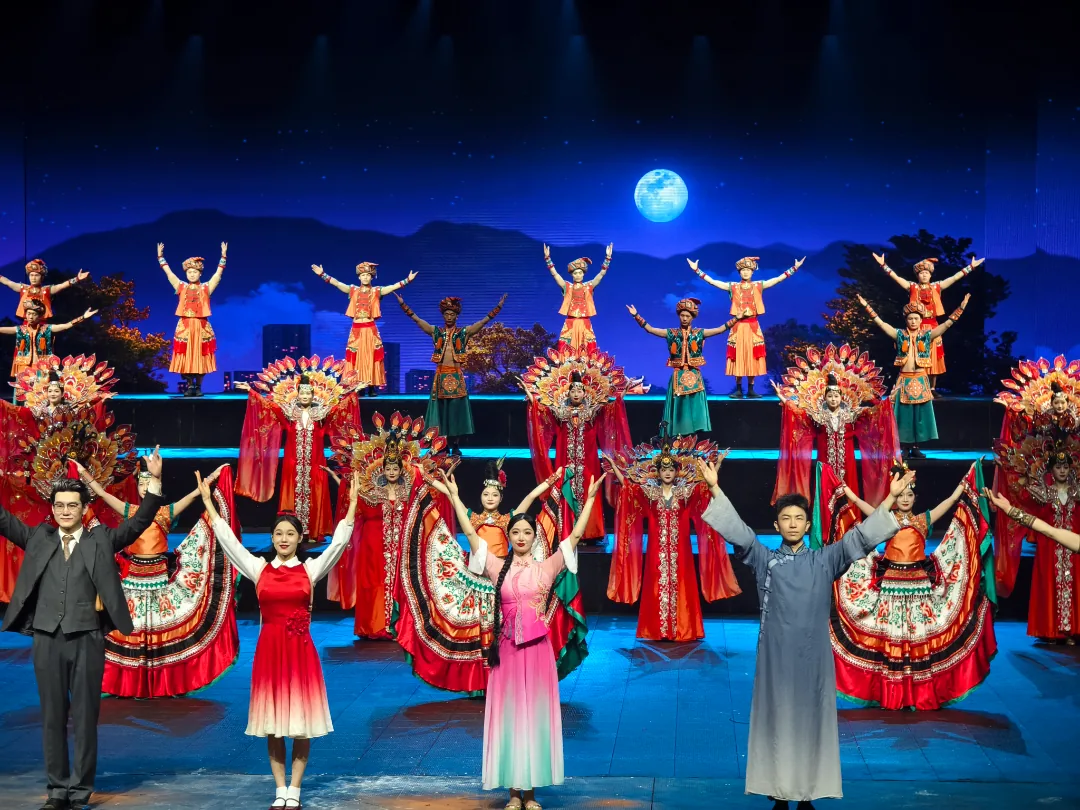
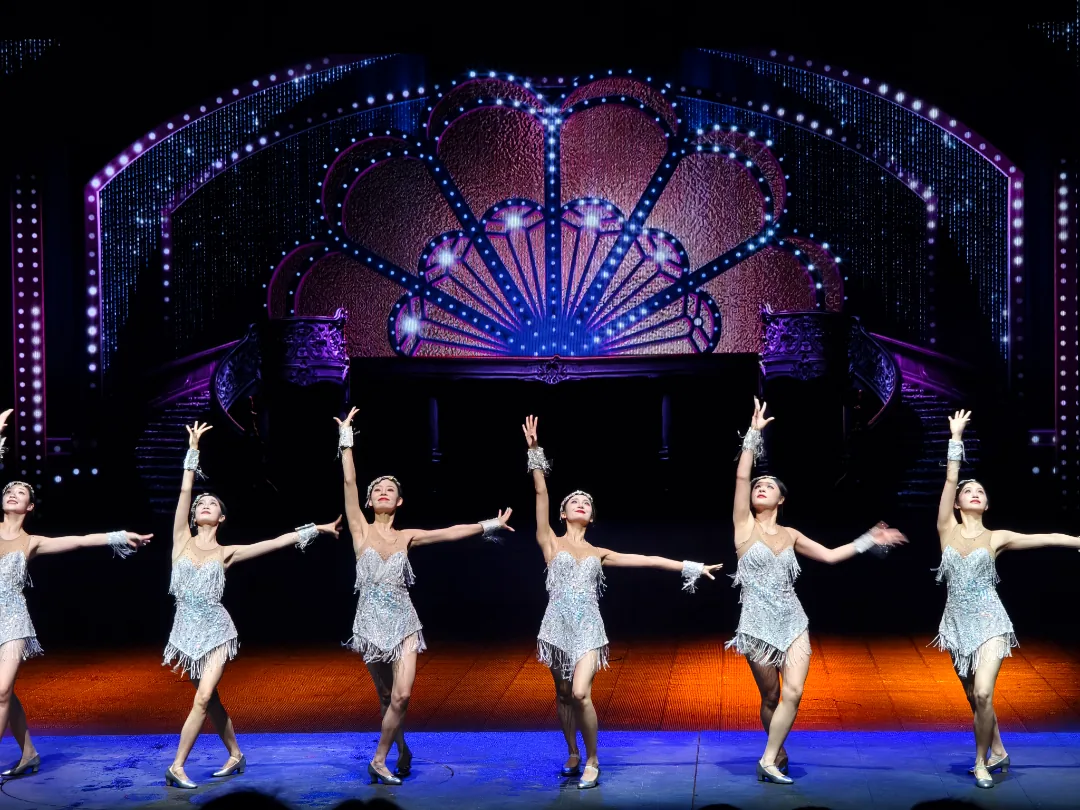
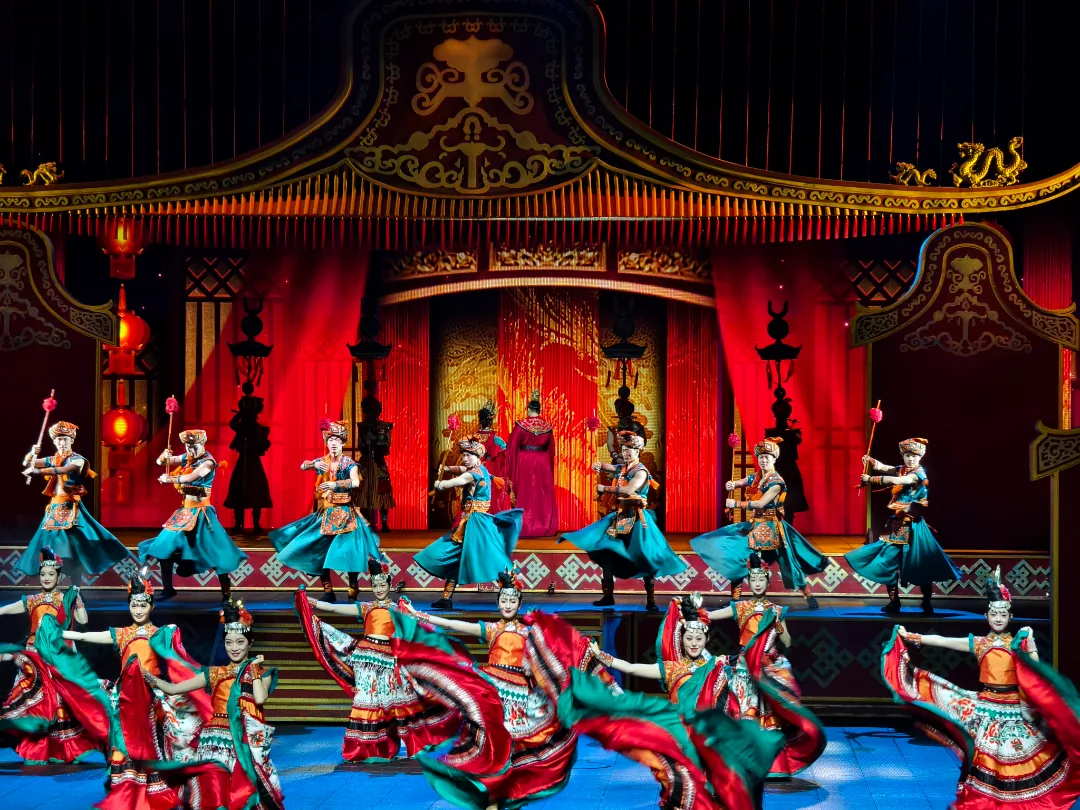
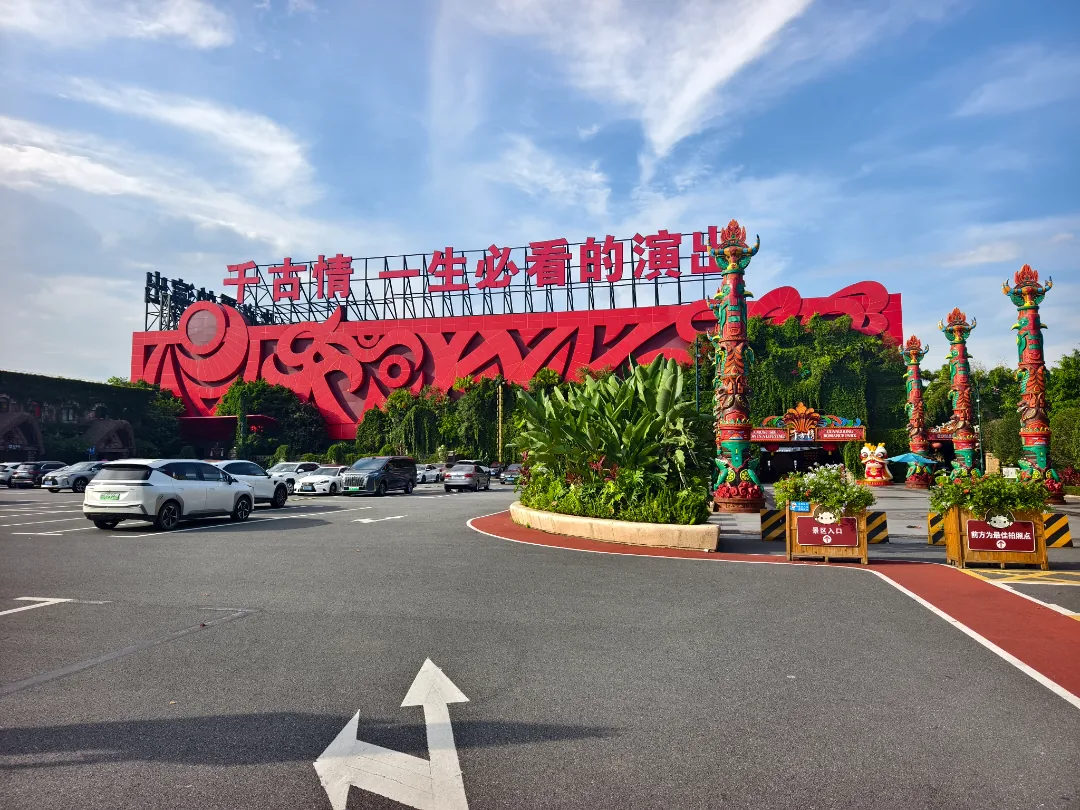
I participated in a “recuperation” activity organized by the local trade union, a two-day event. We went to the foot of Xiqiao Mountain and watched a performance called Guangdong Romance Show. I had never heard of such a show before. Seeing that the ticket price was 200 yuan, I thought it would be a “tax on stupidity,” but the actual experience exceeded my expectations. Besides the performance, there were plenty of “check-in” spots nearby.




When a Calligrapher Recites “Invitation to Wine” Wrong, Can We Still Talk About Art?
2026-06-22 18:07
Today, in a WeChat group for fellow townsfolk, someone shared a video that made me quite emotional. A well-known calligrapher was creating a giant piece of wild cursive script, writing Li Bai’s “Invitation to Wine.” The video recorded the entire process of his brushwork, which was indeed imposing, and there were quite a few onlookers. But I noticed two details: first, when reciting the verses, he got several lines wrong in a row; second, during the writing, he clearly wrote the wrong line, and the whole composition fell into disarray.
Then, a few people in the group praised this mistake as an “advanced expression of art.” They basically said that ordinary people like us couldn’t understand it, that this was the essence of calligraphic art—a state of “selflessness” and a “stroke of genius.”
I thought to myself: What does this have to do with art?
Some Things Are Just Wrong
I’m not trained in calligraphy, but I think some judgments don’t require a professional background. Reciting a poem wrong is reciting a poem wrong; writing a line wrong is writing a line wrong. This has nothing to do with aesthetics, schools, or innovation—it’s a matter of basic skills and attitude.
In artistic creation, there is indeed the saying “turn decay into magic.” A painter’s accidental drip of paint may form a wonderful texture, which can be considered a pleasant surprise. But the premise is that the creator has precise control skills, and the accident happens within their mastery.
What category does reciting “Invitation to Wine” wrong fall into? It falls into not even having a solid grasp of the text. What about writing the wrong line? It falls into starting to write without a clear layout. These are completely different from “conscious breakthroughs.”
Some might say that wild cursive is inherently passionate creation, and occasional mistakes are unavoidable. I don’t deny that creation has fluctuations, and even masters have mediocre works. Li Bai’s more than 900 poems are not all classics. But the difference is that when Li Bai wrote something mediocre, it was because his emotions weren’t quite there, not because of basic word errors. Li Bai’s “floor” was still supported by solid basic skills.
But here, the “floor” has fallen below common sense.
Why Do People Always Spin Mistakes as Innovation?
I’ve noticed an interesting phenomenon: every time such an obviously flawed work is questioned, a group of “guardians” always jumps out, defending it with a set of jargon that’s hard to understand. Common phrases include:
“You don’t understand art.”
“This is a higher level of expression.”
“You can’t judge innovation by traditional standards.”
I used to think that maybe I really wasn’t skilled enough to see the mystery. But later, I slowly understood one thing—if their theories are valid, why don’t they dare to face the most basic questions?
Recited the poem wrong? Explain why. Wrote the wrong line? Explain why that layout was chosen. Faced with specific, verifiable mistakes, they avoid them and instead use “you don’t understand” to shut people up. This isn’t defending art; it’s defending authority itself.
The reason is simple: if this work is deemed a “master’s mistake,” the academic evaluation and market value built around it would instantly shrink. So they must interpret the “mistake” as a “higher level of correctness” to preserve the amulet of “only I can understand it.”
Sincerity Is Rarer Than Talent
I later looked up how true calligraphy masters deal with mistakes.
Mr. Qi Gong, in his later years, had poor eyesight and often made errors in writing. His practice was to frankly note at the signature: “Eyes dim, hands trembling, strokes distorted.” Mr. Lin Sanzhi, revered as the “Contemporary Sage of Cursive,” would directly blot out and rewrite wrong characters, telling his students: “Wrong is wrong, don’t make excuses.”
See, those with real confidence dare to admit mistakes. Because they know that one mistake doesn’t damage their overall achievements. But those who desperately explain all mistakes as “artistic innovation” expose their inner weakness—they are afraid of being questioned, so afraid that they use lies to cover up a mistake that could have been easily let go.
This reminds me of a more common phenomenon: when “innovation” can be a shield for any mistake, art criticism falls into a state where it cannot be questioned. You say he wrote it wrong, he says it’s a “conscious breakthrough”; you say the layout is messy, he says it’s “deconstructing tradition”; you say his basic skills are lacking, he says it’s “returning to simplicity.”
This game essentially turns art into religion, artists into gurus, and the audience into believers. When believers question the guru, they naturally get only one answer: “Your level is not enough.”
Back to Common Sense
Ultimately, art is not that mystical.
It is exploration built on basic skills. First, you must be able to write well, recite poems correctly, and think through the layout—only then can you talk about “breakthroughs” and “innovation.” Just like Picasso, who could draw top-tier academic realistic sketches in his teens before exploring Cubism. This order cannot be reversed.
If a creator hasn’t even passed the basic skills test and starts talking big about “concepts,” “spirit,” and “breakthroughs,” they are not doing art—they are fooling people.
That video gave me a simple reminder: next time I see something I don’t understand, I don’t need to rush to doubt myself. First, ask myself the most basic questions—did he write it correctly? Did he think it through? Is he sincere?
If even these fundamentals don’t hold, then I suggest directly interpreting the phrase “you don’t understand” as “you’ve been fooled.”
Why Was Hunan Obscure for Three Thousand Years, and What Made It Rise All of a Sudden?
2026-06-15 15:11
I briefly answered this question on Zhihu, writing whatever came to mind without much structure. But without a doubt, these are my immediate thoughts, and I felt it was worth reposting them.
The late Qing scholar from Hunan, Wang Kaiyun, once wrote: “Since Hunan was established as a commandery, it has never led the empire.” His contemporary Pi Xirui put it more bluntly: “Hunanese figures are rarely seen in historical biographies. In the three hundred years of Tang imperial examinations, Liu Tui from Changsha was the first to pass the进士 exam, which was then called ‘breaking the wilderness.’”
For three thousand years of recorded history, Hunan was on the periphery for 95% of the time. During the Three Kingdoms period, the talents from Hunan that could be named could be counted on one hand—just one or two like Jiang Wan. In the three hundred years of Tang examinations, Changsha produced only its first进士, and all of Hunan followed with the cry of “breaking the wilderness.”
But it was this very land that “never led the empire” that, from the Taiping Rebellion to the founding of New China, in just over a hundred years, produced a galaxy of great figures and dominated the scene, even surpassing traditional talent centers like Beijing and Jiangsu-Zhejiang, becoming a key force shaping China’s destiny.
What happened in between? Why Hunan, and not somewhere else?
I was born and grew up in a place called Shuangfeng in central Hunan. Until I first opened Google Earth in 2008, I never truly understood my hometown.
Our village group had about 20 households, around 70 people, with 8 surnames: Zeng, Peng, Qin, Zhou, He, Xie, Yu, Wang. The most common surname had only a few households. Zooming out to the whole village, with about 600 people, there were over 30 surnames.
When I was a child, I thought this was normal. Later, after watching more films and reading more articles, I found that most places in China are “one village, one surname”—hundreds of people in a village all share one surname, complete with ancestral halls, genealogies, and communal land. My hometown’s pattern of “15 households, 9 surnames” was actually the exception.
Why was that? The answer only truly emerged when I opened Google Earth in 2008. At that moment, I looked down and saw my hometown—what I had always thought were “mountains” turned out to be just a bunch of undulating green little buns. In my own classification, my hometown belongs to “mature hills,” with relative heights ranging from tens to hundreds of meters, and ravines cutting the surface into fragments.
What does this terrain mean? Every decent paddy field is tucked into the crevice between two ridges, locally called “chong” or “ao.” To hold onto this small piece of land, farmers had to build their houses at the foot of the slope at the mouth of the gully. Households were scattered, making large-scale settlement impossible.
Without settlement, there were no large surname clans. Without large clans, there were no gentry families. Without gentry families, Hunanese could never rank high on the political track of traditional China. “Since Hunan was established as a commandery, it has never led the empire”—it wasn’t that Hunanese were incapable, but that this terrain simply didn’t give you room to form local power.
I previously wrote a blog post about “one village, one surname” and concluded that this patchwork of surnames was caused by the Xiang Army wars. But later, after reading through many genealogies of other Hunan surnames, I realized that judgment was too simplistic.
A particularly interesting phenomenon: the year “Tongguang Second Year” (AD 924) is repeatedly mentioned in many Hunan genealogies. I searched and found that the Fang family of Yueyang, the Yuan family of Xinhua, the He family of Xiangxiang, the Chen family of Xiangxiang, the Zou family of Xinhua, the Song family of Yiyang, the Peng family of Changsha—dozens of surname genealogies marked that year as the time when their founding ancestors moved from Jiangxi to Hunan.
Of course, this may not be the actual year, but it at least shows one thing: during the Five Dynasties and Ten Kingdoms period, Hunan under the Ma Chu kingdom was seen as a “land of peace” worth fleeing to. And my hometown in central Hunan, since the Yuan and Ming dynasties, had been a major immigrant dispersal area for the “Jiangxi filling Huguang” migration. Immigrants didn’t move in as whole clans, but scattered around to “stake claims.” Each wave of immigration added a new color block to the existing surname patchwork.
By the time of the Taiping Rebellion, central Hunan looked like this: no large surname clans, no powerful gentry families, no one could dominate. The Zeng Guofan family itself was also immigrant—his great-grandfather moved from Hengyang to Xiangxiang and, after several generations of management in this mixed society, slowly took root.
The Taiping Rebellion changed everything in Hunan. When the Taiping army entered Hunan from Quanzhou, it had only 20,000 troops; by the time it left Hunan, it had swelled to 150,000, and Hunanese became one of the most important sources of Taiping soldiers. The miners from Chenzhou formed the “Earth Camp” that dug tunnels for the Taiping army, breaking through anything; Tang Zhengcai from Daozhou built a navy for the Taiping, building pontoon bridges to cross the Yangtze and helping capture Wuchang.
But what the Taiping did in Hunan also directly created its own gravediggers. From looting to indiscriminate massacres, the Taiping pushed Hunanese to the other side. It was against this backdrop that Zeng Guofan returned to Xiangxiang and formed the Xiang Army under the banner of “defending the hometown.”
The Xiang Army and the Taiping had one thing in common: their main force was Hunanese. But one group was mobilized by Taiping ideology, the other by Zeng Guofan’s organization. The human resources of the same province played decisive roles on both sides of the same war.
Why could the Xiang Army be raised in central Hunan? Precisely because central Hunan had no strong clans. In a clan society, mobilizing troops required the clan chief’s approval; but in central Hunan’s dispersed society, interpersonal relationships relied not on “clan law” but on “village ties”—people lived scattered but knew each other well. Zeng Guofan used the military structure of “camp → sentry → squad” to reorganize this loose sand, integrating peasants scattered in different gullies into a combat-ready army.
After the Xiang Army pacified the Taiping, Hunanese suddenly realized: what the court couldn’t manage, we could; what the court couldn’t pay, we could; what the court couldn’t win, we could. Once this experience was established, “the sky is high and the emperor is far away” was no longer a geographical fate but a psychological confidence.
At this point, I must clarify a term that has been misunderstood by the media for twenty years: “baman” (stubbornly tough).
I checked the usage of the character “man” in Zeng Guofan’s family letters. When criticizing his children’s study methods, he said: “Man reading, man memorizing, man reviewing—surely cannot lead to lasting mastery, merely wasting days.” It meant rote memorization without thinking, a waste of time. He also criticized his younger brother Zeng Guohua for “having a man-like expression on his face, most prone to bullying others”—that “man” was clearly negative.
When Cai Hesen first arrived in Paris to study, he knew no French. In his letters, he said he relied on a dictionary to “man-read” newspapers and magazines, and forcibly translated works like the Communist Manifesto. Here, “man-read” is just a hair’s breadth away from Zeng’s criticized “man-reading”—one scolds for not thinking, the other describes a personal struggle. The direction differs, but the core is the same: “no shortcuts, no detours, just hard grit.”
The term we locals use is “ban man.” Ban means being tripped up, stuck, blocked. Hunan—this place was tripped up by geography for three thousand years, by transportation, by being far from the center of power—holding its breath, unable to get out. It wasn’t until the late Qing, when the country’s doors were forced open and the old order collapsed, that Hunanese discovered that being tripped up for a lifetime had actually trained them in the tough spirit of “opening roads across mountains and building bridges over water.”
If you replace “ban” with “ba” (overbearing), the meaning twists completely. Overbearing tyranny is outward; ban man is inward. This is Hunanese resilience, not Hunanese posture.
Back to the original question: Why was Hunan obscure for three thousand years, and what made it rise suddenly?
My answer is: Hunan’s peculiarity lies not in that it changed, but that the era finally became suited to its original nature.
Traditional China was a clan society. Power structures extended downward through bloodlines. Whoever had a large ancestral hall, a long genealogy, and could monopolize local opinion and military sources could claim a place on the political map. Hunan had none of these—hills cut it up, rain washed it flat, immigrants stirred it up. It was naturally unsuited for competing on the traditional track.
But after the late Qing, the old system began to crumble. When clan ties were no longer the only effective form of organization, and when war and revolution demanded a more flexible capacity for social mobilization, Hunan’s “dispersed society,” marginalized for three thousand years, became the place with the fewest constraints. It had fewer vested interests to protect and fewer old rules to obey.
The Xiang Army was not the starting point of Hunan’s rise; it was merely the moment when Hunanese first realized, “we can organize ourselves.” From then on, from the Self-Strengthening Movement to the Xinhai Revolution, from the New Democratic Revolution to the founding of New China, Hunanese have been repeating the same thing: where there is no ready-made organization, build a new framework yourself.
Hunan is a place that was marginalized for three thousand years and finally waited for an era when even the marginalized could stand at the center of the stage.
That’s my understanding of Hunan. It is not some “overbearing province”; it is just a place that was tripped up by geography and history for too long, and thus developed a knack for stubborn perseverance.
Legal Affairs Training
2026-05-28 18:05
A few days ago, I attended a legal affairs training session, mainly watching videos for several consecutive days. I really gained a lot—almost everyone in the venue stayed focused throughout. On one hand, the topic is indeed very important with almost no margin for error; on the other hand, these policy backgrounds, if not studied well during the training, could lead to serious deviations if such cases arise later. During the session, I saw some notifications from relevant ministries, which felt vastly different from everyday perceptions. The country is so large, and there are indeed many problems inside and out—many things are hard to handle and not convenient to discuss publicly. What can be seen in public is only the tip of the iceberg.
What Really Supports a Consumer Power?
2026-05-13 15:14
Today, in a group chat, I argued with someone about whether China can transform into a consumer country. Looking at the news, it’s always about promoting consumption—“encourage people to spend more,” distributing coupons, subsidies, stimulating night-time economy—as if consumption is just a matter of promotion.
I went through a full round of reasoning and found that we might have the direction backwards.
First, I confirmed a judgment: everything that can be mass-produced will inevitably see prices fall. Cars, home appliances, pre-made dishes, houses—none escape this rule. Relying on selling goods to support consumption is unsustainable in the long run. What truly supports developed consumer countries are six basic needs: education, healthcare, elderly care, housing, transportation, and food. More than half of these are “selling services” rather than “selling goods.”
China’s problem is that the prices of education, healthcare, elderly care, transportation, etc., are locked down by public services—private prices can’t rise, and the reputation and price ceilings of private hospitals and private universities are very low. On the surface, this seems like a deadlock: if basic needs prices can’t go up, how can high consumption form?
But think from another angle: the path has just been swapped, not blocked.
Instead of relying on people to pay more out of pocket for medical treatment and schooling, we can raise the baseline of public services overall. I made a rough estimate: if we bring all primary schools nationwide to the level of top Beijing public schools, and all county hospitals to the level of top-tier hospitals in Beijing and Shanghai, the additional annual government consumption would be on the order of 2 trillion US dollars. This itself is consumption—real, measurable, and sustainable. At the same time, the wages of millions of teachers and doctors would rise, boosting their personal consumption as well.
This path is different from the US model of “household debt-driven consumption.” It’s closer to “public welfare-driven consumption”—raising the baseline through government spending, rather than making individuals pay for it themselves.
Of course, there is an unavoidable question: who ultimately pays for this? If property taxes and consumption taxes are passed on to residents, it’s just another way of making people pay. The real test is whether the tax system reform can keep up. Whether this path ends up as a “sense of gain” or a “sense of pain” is the difference.
In the end, a consumer power is not built by “stimulus”; it’s built by “raising the baseline.” This baseline is not about making everyone afford the latest phone, but about ensuring everyone can access education and healthcare of a very high standard. It sounds idealistic, but upon reflection, this may be the only viable path for China to become a consumer country.
What I Realized After Reading about the Southern Ming
2026-05-10 15:50
Recently, while browsing Zhihu, I got caught up by a question: since the Qing had already entered the pass, why were the bigwigs of the Southern Ming still fighting among themselves?
The answers varied widely. Some said it was because Zhu Yuanzhang killed too many meritorious officials, and everyone was afraid of becoming another Lan Yu. Others said it was because losing an internal struggle still left the option to surrender to the Qing and keep wealth, whereas successfully resisting the Qing might lead to a purge later. Others analyzed technically, saying the Southern Ming’s problem wasn’t infighting, but that it failed to produce a strong leader at the critical moment.
These answers were sharp and gave a feeling of sudden enlightenment. I read dozens of them, from Southern Ming to the late Yuan, from late Yuan to early Ming, and then to the Southern Song and the War of Resistance. But the more I read, the stronger my sense of unease became.
Why can the same history be told as completely different stories, each sounding so reasonable?
Later, I saw a discussion about the Nurgan Regional Military Commission, and the comment section was in uproar. Some said it represented the Ming’s actual control over the Northeast, while others said the Ming never really governed there. Then someone asked: if you admit the Ming controlled the Northeast, then Nurhaci was a Ming border general rebelling, and the Qing entry was a civil war; if not, then the Qing was a foreign invader. Choose one.
At that moment, I suddenly understood.
Historical facts themselves are certain, but how you interpret them depends on your position and concerns. Those discussions about the Southern Ming, on the surface, argued why the Ming fell, but underneath, they were responding to some anxiety of today. Collapse of trust, prisoner’s dilemma, failure of collective action—these terms are too familiar; they’re not just about things three hundred years ago.
What truly made me realize this was a joking comment in the replies: “Descendants of Jews also have Han ethnicity on their Chinese ID cards.” That sentence was light, but the question behind it was heavy. Identity, ethnicity, nation—these concepts can be told as completely different stories on different timescales. No version is naturally correct; the key is how you choose the starting point and define who belongs.
After all this fuss, my final takeaway was not whether the Southern Ming should bear the blame. Instead, I’ve developed a habit: whenever I see a particularly self-consistent, sharp historical interpretation, I stop and think—what framework is this person using to tell the story? What are they omitting? Why did they choose this angle?
This shift in perspective might be more useful than remembering any historical conclusion.
It’s Hard to See Pine Trees in My Hometown Anymore
2026-05-04 17:30
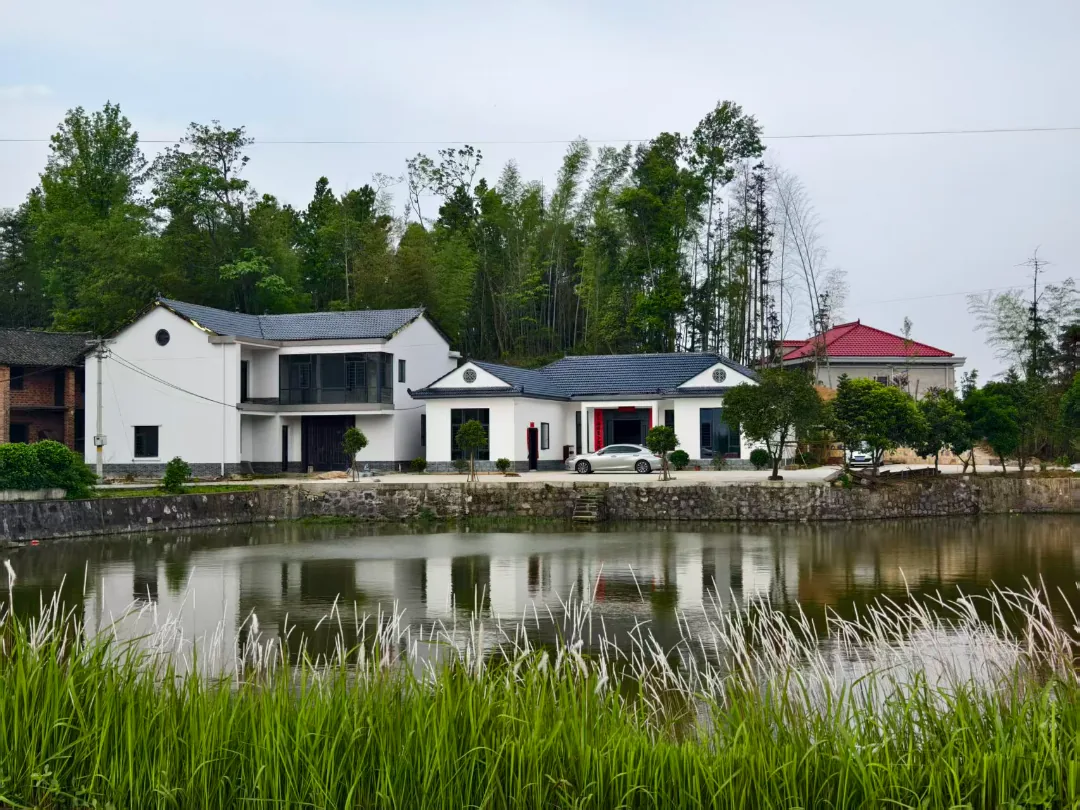
A few years ago, a pine wilt disease epidemic swept through my hometown, killing almost all the Masson pines, leaving the hills a vast gray for years.
Now, several years later, the color of the hills has completely changed—from the brownish-green of the pines to large patches of light green and yellow, transforming from “coniferous forest” to broadleaf forest. It’s hard to say if that’s good or bad.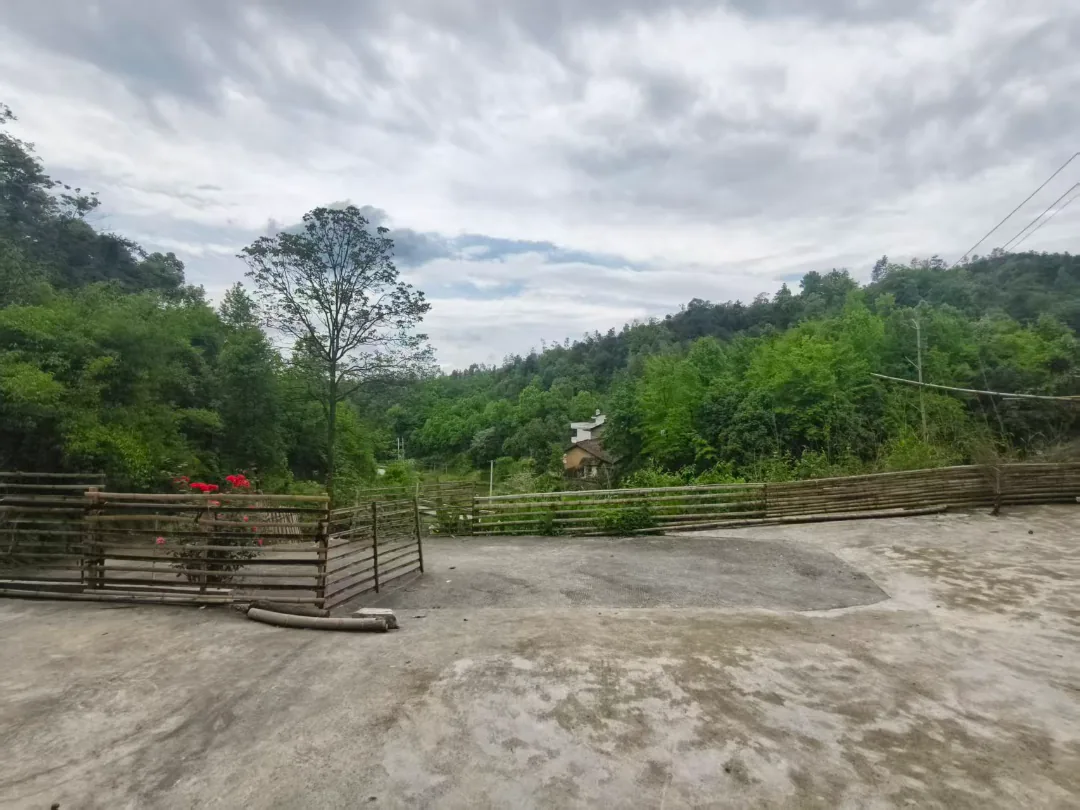
Stories of Jiaozhou
2026-05-02 15:59
I’ve long known that Lingnan was sinicized earlier than Hunan and entered the power center earlier, but I had no concrete idea. Today, while answering a question from a Vietnamese person, I looked into this a bit deeper.
First, over nearly three hundred years of the Tang dynasty, Hunan produced about 25进士, Guangxi about 10, and Guizhou was almost negligible in the Tang. But Jiaozhou, within the scope of a single protectorate, had nearly ten historically verifiable进士. Considering its much smaller population base than Hunan and Guangdong, this density is already quite high. More importantly, among these less than ten people, there was a chancellor like Jiang Gongfu.
Then, I looked up who was the first universally recognized chancellor from Hunan. The answer is quite late: Liu Quanzhi from Changsha in the Qing Jiaqing period, who became a Grand Secretary of the Tirenge. Before that, all claims about Hunanese chancellors were controversial—either their ancestry was unclear, or they were registered elsewhere, or their official position was just a minister rather than chancellor. In other words, after Jiang Wan of the Three Kingdoms, Hunan had a gap of fifteen hundred years at the chancellor level.
This comparison made me rethink Jiaozhou’s status. The Tang set up the Annan Protectorate there, one of the six great protectorates of the empire, with its seat in today’s Hanoi. The Red River Delta had early agricultural development, not only self-sufficient in grain but also able to transship via sea routes. More importantly, the gentry class there deeply participated in Tang political operations through the examination system, completely different from my imagined “remote wilderness.”
I also noticed Vietnam’s surnames today. The Nguyen surname accounts for nearly 40% of the population; the Tran, Le, Pham, Hoang—these major surnames are all medieval Chinese surnames. Nguyen became so large due to the Tran dynasty forcing the Li to change their surname and the Nguyen dynasty’s long rule. This is not just cultural influence, but the continued operation of political institutions in Vietnam itself.
After crunching these numbers, my biggest takeaway is that we easily use later impressions to retroject history. Today, Hunan is a province of talent, but in the Tang it was still culturally developing. Today, Vietnam is an independent country, but in the Tang it was a core administrative region of the empire’s southern frontier. Their political and cultural status at the time was completely different from today’s map impressions.
Sometimes it’s not that history has changed; it’s that the map we use to view history was drawn too late.
Why Was Ancient Land Surveying So Difficult?
2026-04-24 11:16
Today I read an old story that said ancient local officials feared two things most: war and fire. In war, they could flee; but if a fire burned the archives, there was nowhere to run. Especially the household and land registers—if burned, tax collection would be in complete chaos. At first, I didn’t understand: just make a new copy of the registers, why make it sound like the end of the dynasty?
After some research, I found it was far more complicated than I thought.
First, look at manpower. In the Song dynasty, a county with ten thousand households had only about twenty or so clerks and record keepers handling accounts. In my modern way of thinking, one person checking five hundred households, visiting a few per day, could finish in a few months. But in reality, whenever a locality underwent a major household and land survey, it took at least two years, sometimes ten or eight, and dragging on indefinitely was not uncommon.
Where did the problem lie? I later realized it wasn’t in the “checking” step, but in the huge pile of work before that.
First step: measuring land. In ancient times, there were no satellites, no GPS. Measuring tools were the measuring bow and rope. Plains were okay, but in hilly areas, a small terraced field of irregular shape had to be measured inch by inch with a rope. Encountering oddly shaped plots, calculating area could drive people crazy.
Second step: finding people. A household lived remotely; the clerk had to cross a mountain to verify, a round trip taking a whole day. If the head of household was away working, they had to make a second or third trip. With nearly ten thousand households scattered across the county, the time spent just on travel was astronomical.
Third step: cross-examination. You think measuring and recording is enough? No. Data had to be reported level by level—village to township, township to county—with verification at each level. If discrepancies were found with old records, someone had to be sent back to re-measure. More troublesome: the powerful and wealthy wouldn’t cooperate—they either concealed land or bribed clerks to “fly” their taxes onto poor peasants. The survey essentially took money out of their pockets, so resistance was fierce.
So a county survey dragging on for years, in my view, is already quick. The real cost was never in the paperwork, but in the human wrangling and technical limitations in the fields.
After all this, my biggest feeling is that we’re too used to measuring ancient efficiency by today’s standards. We think they were slow, clumsy, rigid—but we ignore those invisible costs. The ancients faced a world of highly asymmetric information; every step was groping in the dark. Building such a tax system was already remarkable.
As the saying goes: don’t mock the clumsy methods of predecessors—they learned to climb without a ladder.
What Script Was Qu Yuan’s “Li Sao” Written In?
2026-04-22 15:56
Today, while watching a video of a Taiwanese person visiting the Three Gorges Dam and then going to Zigui to talk with an old man who has long played the role of Qu Yuan, a specific question suddenly popped into my head. What script did Qu Yuan use to write Li Sao? Was it the Qin script or the Chu script? And is the version we read today a transliteration?
I checked and confirmed: Qu Yuan naturally used Chu script. During the Warring States period, each state’s script originated from Shang-Zhou oracle bones and bronze inscriptions, but later developed differently. Qin in the west kept the Zhou homeland script, relatively regular. Chu in the east had elongated, elegant forms with a romantic flair. After Qin unification, the six states’ scripts were abolished; the Chu Ci we read today is a version transcribed in Han dynasty clerical script.
This discovery interested me: the same origin diverged, then was pulled back onto the same track by unifying forces.
But the question I really wanted to ask had already changed. I wanted to understand what the ancient Chinese state was really like.
Textbooks always talk about the Seven Warring States, giving the impression that only these seven states were active. But in the early Spring and Autumn period, there were over a hundred vassal states; by the early Warring States, there were still more than twenty. The Seven were just the ones that survived. The states of Song, Lu, Zhongshan, Yue—all existed at some point, and all were eventually swallowed.
But one detail I hadn’t paid attention to before: regardless of the Seven or smaller states, they all had a common Zhou king above them. Although the Zhou king had no real authority by the Warring States period, the concept of “All under Zhou” persisted. This is completely different from our modern understanding of a state.
Modern people think of states as sovereign territories with borders and equal diplomacy. Ancient Chinese states were a concentric differential pattern. Areas near the core were directly ruled; distant areas were allowed autonomy, as long as they acknowledged the overlord and paid tribute on time.
After Qin unification, vassal states were replaced by commanderies and counties, with directly appointed officials. But interestingly, for thousands of years afterward, the commandery-county system and the tributary system ran in parallel. The emperor directly ruled near the capital, while in frontier regions, local leaders were enfeoffed to maintain autonomy and tribute.
Vietnam is the classic example. From Qin to early Song, northern and central Vietnam were directly ruled commanderies and counties. After the Song, Vietnam established its own state but long remained a tributary. It wasn’t until the 1885 Sino-French Treaty that it left this system.
I used to have a vague impression of this history, only remembering that it was once part of China, without realizing the complex transitions in between.
Looking back now, I realize several of my previous understandings were off. Unification did not mean eliminating all differences, but establishing a flexible order. Enfeoffment and tributary systems are not the same thing—the former is internal, the latter external.
Starting from Qu Yuan’s Chu poetry, I ended up on a bigger question: how are civilizations constructed, maintained, and evolved? The path goes far, but every step is worthwhile.
Old Historical Scores Can’t Be Settled Because No One Is Clean
2026-04-17 09:04
Today, I saw a lot of discussions about the Battle of Penghu, and the comment sections were all arguing about “Ming-Qing distinction.” Some used it to bring up old scores about the Xiang Army massacres, speaking with indignation as if Hunanese have always been a bunch of butchers. Looking at these comments, I felt something was off.
To be fair, the Xiang Army did kill brutally when they captured Tianjing—I don’t deny that. But those cursing the Xiang Army, have they thought about how the Taiping army fought its way from Guangxi to Hunan? Have they thought about who left records like “villages reduced to ashes, nine of ten homes empty”? You dig up old accounts of the Xiang Army? Fine, then I’ll dig too.
Does Sun Quan’s attack upriver from Nanjing to slaughter Huang Zu at Jiangxia count? Hou Jing’s capture of Jiankang, where people ate people—count? The Southern Tang destroying Chu, where Bian Hao stripped Changsha of its gold, silk, grain, pavilions, and flowers—even leaving no nice plants for Hunanese—count? Zhu Yuanzhang and Chen Youliang’s bloody battle under Nanjing, and the fire on Poyang Lake that killed hundreds of thousands—count? Then later, the Taiping devastated southern Hunan, and the Xiang Army counter-killed at Tianjing—count? And what about Emperor Yuan of Liang, Xiao Yi—this great figure watched his father and brothers trapped during Hou Jing’s rebellion, sent troops to recover Jiankang, then went to Jiangling to become emperor, but when the city fell, he burned 140,000 volumes of ancient books, and the entire population, old and young, was taken to Guanzhong, while he himself was suffocated with a bag of earth by his nephew.
See, dig and dig—where can you stop?
What I truly realized is: under fragmentation, such things have no end. You slaughter me once, I slaughter you once—generation after generation, it cycles. No one is an angel, no one is the sole devil. The real turning point is not which side wins, but the establishment of a unified order. After Qin Shi Huang, unity became the highest value of this land—not because unity is perfect, but because fragmentation is simply terrible.
1840 is a subtle turning point. The Westerners arrived; the entire nation faced a survival crisis, and internal old scores were forcibly shelved. Although this stitching was rough—the later Taiping, Xiang Army, Muslim revolts, and Hakka-Punti clashes still proved how strong the old order’s inertia was—the direction changed. By around 1919, national awakening and class narratives provided a completely new framework, and those blood debts divided by province were redefined as a historical burden “we” share together.
I’m not saying old scores shouldn’t be studied. Academically, they can and should be. But using one page of history to attack a certain group of people today is not about justice—it’s using the dead as a club. The Yangtze has flowed with too much blood for thousands of years; there’s no need to argue over which stretch is the reddest.
Visiting the Shenzhen Toy Fair
2026-04-12 14:58
Yesterday, I took my child to the Shenzhen International Convention and Exhibition Center to visit a toy fair. This was my first time at this center. Before going, I asked Doubao about parking—it said parking was convenient with 13,000 spaces at 18 yuan per hour. But unexpectedly, after several hours, the total parking fee was only 12 yuan. The toy fair was relatively small, with about five or six halls. We walked through four halls and were exhausted. The main thing was shopping while browsing; I carried dozens of toys of various sizes in both hands—quite a ordeal. But kids can’t resist toys, especially considering that most toys at the fair were much cheaper than in regular stores or online. For example, a boxed building block toy that sells for 18 yuan in a physical store and 12 yuan on Pinduoduo was only 2 yuan at the fair. The child was thrilled and just wanted to “buy, buy, buy.” Some manufacturers from other places, because they had to pack up by 4 PM that day, even gave away toys for free. In the end, the four of us bought eight large bags of toys, spending less than 300 yuan total—enough to keep the child entertained for a long time.
Hosting a Junior High School Classmate
2026-04-10 22:36
This week, a junior high school classmate I hadn’t seen for years suddenly contacted me on WeChat, saying he was in our area for training. Seeing the address was only about 20 kilometers away, I went to have dinner with him after work. During the meal, we talked about our class of about 50 people back then, now scattered far and wide. Among those who did well academically: some are general managers of third-tier subsidiaries of state-owned enterprises, heads of overseas offices of such subsidiaries, deputy division chiefs in provincial party organization departments, and discipline inspection group leaders in municipal commissions. Those with above-average grades mostly work in party and government organs and public institutions at municipal and county levels—for example, this classmate is in charge of law enforcement at a county ecological environment bureau. Those who earned master’s degrees: some do historical document research in libraries, some teach in colleges, and some are engineers in leading IT companies. Those with relatively average grades: many chose entrepreneurship—some do entrepot trade in Southeast Asia, some export IT products in Guangdong, some run driving schools in Tibet, and some run supermarkets, restaurants, or shops back home. Others are in auxiliary roles within the system, like auxiliary police, government employees, or village cadres. Since our class was designated as a “key class” among the six classes in our grade, most went on to high school and university, so relatively few directly engaged in manual or agricultural labor—almost all work in the tertiary sector. From a general social evaluation, this almost perfectly confirms the judgment that “better academic performance leads to better career prospects.” But regardless, coming from a poor rural middle school, finding good development opportunities is generally very difficult. We are also fortunate to have encountered a period of stable peaceful development; otherwise, everyone’s life could have been quite different.
Endless Doubao
2026-04-05 11:25
Doubao just announced that its average daily API Token calls have exceeded 120 trillion. As of July last year, the total global daily inference Token consumption for large language models (LLMs) was only 8 trillion. Doubao has long become a national-level AI application. My daughter now uses my phone every day to generate hundreds of conversations. A typical example: Doubao may have been trained on all primary and secondary school textbooks in China, so when my daughter does “dictation” homework, she can directly ask Doubao to dictate the content of a certain lesson, just like a teacher, with almost no difference.
The most crucial point is that while using other AI services, we often face usage caps and conversation limits—for instance, my ChatGPT Plus subscription easily hits the 5-hour limit when using Codex. But Doubao is completely different. My daughter can send it a large number of photos and videos continuously for an entire evening. Once, she took dozens of photos of a homework notebook and asked Doubao to check her work—there was no usage limit at all, and Doubao is still completely free.
Ecological Environment Code
2026-04-03 18:32
This afternoon, I attended a training event organized by the Lawyers Association. The main speaker was a division chief from the Legal Affairs Commission of the National People’s Congress, who had participated in the entire legislative process of the world’s first Ecological Environment Code. During the talk, she mentioned that she herself was puzzled by the term “ecological environment” during the legislative work. Traditionally, ecological environment was considered just one type of environment, alongside living environment, production environment, natural environment, human environment, etc. The Constitution also lists living environment and ecological environment in parallel. But in recent years, “ecological environment” has gained prominence and now essentially means ecology + environment. Previously, the English name of the Ministry of Ecological Environment was translated as “Ministry of Ecological Environment,” but it was later changed to “Ministry of Ecology and Environment.” The earlier translation meant “ecological environment” (as an adjective), while the latter became “ecology and environment” (as two concepts).
Accident Insurance
2026-04-02 23:20
Last month, my child was bitten by a stray cat outside and was taken to the hospital immediately. Over the following weeks, we had four shots of rabies vaccine (2-1-1 schedule) and immunoglobulin, totaling 1,094 yuan. Yesterday, a friend told me this is also covered by accident insurance. I found the family group accident insurance I bought on Alipay for 20 yuan per month, submitted the medical information as required, and received the payment tonight. The reimbursement rate was about 77%.

Openlist
2026-03-24 07:42
I’ve rarely used Alist in the past year or two, mainly because the open-source project turned private, raising concerns about data security—for example, when adding cloud drives, tokens were obtained in plaintext on their servers. Yesterday, I tried OpenList on 1Panel and found it quite good—it only requires logging in and authorizing your cloud drive account, much more reassuring. But oddly, it kept showing “installing” even though it actually finished in a few dozen seconds.
Ad Blocking on iPhone Is a Pain
2026-03-22 22:57
Browsers on iPhone are restricted to WebKit, preventing various browser extensions from reaching their full potential. For example, I like using Edge, but several ad-blocking plugins are helpless against a certain ad network—not even preventing page redirects. Also, uBlock’s element picker is useless, and Stay’s ad selection mode can’t select those full-screen ads; it can only select a small 10px box in a flashing ad, which becomes invalid after a few seconds when the ad switches automatically.
Claude’s Weird Moves
2026-03-19 10:50
My Claude account was banned for some unknown reason, but it still sends me ads. Shameless.
Pocket Hugo Theme Ready for Launch
2026-03-17 12:49
Recently, while developing the Pocket Hugo project, I’ve also been simultaneously developing a Hugo theme suitable for Pocket Hugo—the one this site is currently using. Since it’s my first time developing a theme, I’ve been looking for cases to study and imitate, and I’ve basically built it according to my own ideas. But there are bound to be omissions. I kept remembering to handle the RSS template, but I forgot it in the Hugo.toml settings, which led to all 400+ articles’ RSS feeds being output last night. Apologies to those who subscribe to this site. The theme is currently in its final polishing phase and is expected to go live in a couple of days.
Pocket Hugo Officially Released
2026-03-16 11:56
After some time of preparation, the main features and key details of Pocket Hugo have been addressed, and it is now officially released on Github. I encountered many issues along the way and racked my brain for solutions. Actually, two days ago, I had already released version 1.0.0, which worked very well on desktop browsers and showed no major problems on Vivo phones. But when I switched to iPhone, I discovered a host of issues, including iPhone’s default LocalStorage being too small—uploading a few images crashed the entire page—plus the iPhone’s built-in input method being problematic, Canvas being inefficient, and default font settings affecting UI display. After two more days of polishing, version 1.0.3 is now finally settled.
My original intention in building this project was purely for personal use. If you have similar needs, feel free to give it a try.
Liu Zongyuan’s “On Feudalism”
2026-02-26 13:40
Today, I read Liu Zongyuan’s “On Feudalism.” He said that the era of Yao, Shun, and Yu was already feudal. According to the historical periodization I learned before, this claim is absurd—weren’t Yao, Shun, and Yu in primitive society? How could they be feudal?
On second thought, Liu Zongyuan wrote, “Feudalism was not the will of the sages, but the result of circumstances.” He wasn’t discussing institutional details; his “feudalism” was more like a trend: power moving from decentralization to centralization, and society moving from equality to stratification. If viewed this way, the Yao-Shun-Yu period did already have the rudiments of a “core controlling the periphery.”
Archaeology at the Taosi site confirms this. The ancient city, large tombs, and ritual objects from over 4,000 years ago show that social stratification was already clear. A capital ruling over surrounding small settlements—this pattern of “large states encircling small states” does resemble later feudalism. But it’s not the same thing. Western Zhou feudalism had lineage laws, ritual music, and clear investiture ceremonies—a complete institutional design. The Xia and Shang were more of a “regional lords” or “co-chiefs” model, where the strongest became the leader, while subordinate states had their own armies, territories, and governance systems, and the central authority couldn’t control much.
What I found truly interesting was not the answer to “whether Yao, Shun, and Yu were feudal,” but how the question itself should be asked.
I recalled materials from Feng Shi’s On Civilization that I had read earlier: artifacts from the Kuahuqiao site over 8,000 years ago have characters identical to oracle bone script, and burial patterns from the Hongshan culture are exactly the same as those on the lacquerware of the Zeng Hou Yi tomb from over 2,000 years later. These examples show that before the Shang and Zhou, this cultural symbol system had already been stably transmitted for thousands of years. Writing, trigrams, ritual concepts were not suddenly invented by the Shang and Zhou—they took shape slowly over a long accumulation.
So now I think Chinese history should be seen in two layers.
The upper layer is institutions: tribes, co-chiefs, feudalism, commandery-county—forms change, governance techniques upgrade. The lower layer is civilizational concepts: the understanding of cosmic order, the legitimacy of power, the use of symbols and writing—these things have continued from 8,000 years ago to the present without a break.
Feudalism could succeed not just because the Duke of Zhou designed it well, but because the “cultural sphere” beneath it had existed for a long time. The vassal lords were willing to recognize a common Son of Heaven and a common set of rituals because they already shared the same conceptual system. Qin could implement the commandery-county system because this underlying identity was strong enough that it didn’t need feudalism to maintain it.
Looking back at Liu Zongyuan’s “circumstances,” I think he was right, but didn’t go far enough. “Circumstances” is not just the trend toward centralization of power, but the power accumulated bit by bit by civilizational concepts over a long time. Institutions are just the temporary outlets this power finds.
The Character “Beng” Kept Me Busy for Half a Month
2026-02-15 21:34
Recently, a character has been echoing in my mind. In Shuangfeng dialect, “hide” is “do beng,” and “hide away” is “beng zhe.” This “beng” is pronounced like the Mandarin “ben” (stupid), but the meaning is completely unrelated. As a child, I didn’t think anything of it—I just said what the adults said. Later, when I occasionally wondered how to write this character, I found I couldn’t.
At first, I suspected it wasn’t “hide.” Although Shuangfeng pronunciation is quite different from Mandarin, there are traceable conversion patterns—“cang” can’t become “beng.” So I thought, maybe it’s another character.
I guessed a few. The character “屏” (screen) has a meaning of concealment, and its pronunciation is somewhat related, but it felt forced. The character “弆” has the right meaning but the wrong pronunciation. I looked through a Loudi dialect dictionary and found a character whose definition was “place, arrange”—I thought that might be it, but on closer inspection it was “摆” (bǎi), whose pronunciation is completely different.
Later, I saw an entry in the dictionary with the definition “hide (something)” and the pronunciation marked as “pɔ,” but the entry was preceded by a square box. This is common in dialect dictionaries, indicating that the original character hasn’t been verified. That is, the dictionary compilers themselves didn’t know how to write it.
What truly made me let go of this obsession was a screenshot from another page. In that page, all entries with the pronunciation “p’ǎi” were marked with square boxes. “Hide” was p’ǎi, “drive” was p’ǎi, “bump” was p’ǎi, “close the door” was p’ǎi, and “pig eating” and “dog biting” were also p’ǎi. The same pronunciation corresponded to seven or eight different meanings, each without a corresponding Chinese character.
Then I understood: from the start, I was looking in the wrong direction. This isn’t about a rare character being forgotten; rather, there exist in spoken dialects a batch of “sound-only” words—sounds without characters. The Chinese character system was designed for Mandarin and written language; many everyday local expressions never entered the writing system—they were only passed from mouth to mouth for centuries.
My hometown’s “beng” is probably the same. It might come from a long-dead ancient character, or it might never have had a character at all—just that the people of this region are used to saying it. Either way, I can’t write it down.
After half a month, I finally decided to accept it. Some things simply have no corresponding Chinese characters; language is much larger than writing.
Some Archaeology Looks Like a Mystical Art Too
2026-02-10 16:02
Today, I came across an archaeological video claiming that the “Taosi South Gnomon” was discovered on the coast of Shapa, Yangjiang, Guangdong—a marker for the southernmost point of “All under Heaven” measured in the era of Yao and Shun. At first glance, it’s quite striking: over 4,000 years ago, Chinese ancestors could measure from Shanxi all the way to the South China Sea—what wisdom and organizational power that would require.
But on closer reflection, doubts arise. How could people of that era cross the Qinling and Nanling mountains to accurately measure such a distance? If such a large-scale surveying project truly existed, wouldn’t there be some remains at the site?
I began to look up the original sources of this claim. It turns out that the proponent was He Nu, the archaeological team leader at Taosi. In 2006, with a GPS device and based on the “26,000 li from north to south” recorded in the Book of Documents·Canon of Yao, he used the gnomon ruler unearthed at Taosi to back-calculate a conversion of “250 meters per li,” then drew a straight line south along Taosi’s longitude on an electronic map, eventually locking onto a point in Shapa Town, Yangxi County.
The whole process surprised me. It felt more like a “digital survey” than traditional archaeological excavation. No Taosi-period artifacts were found at the site; the only thing that could be linked to the “South Gnomon” was a mountain ridge extending from north to south into the sea.
A more critical issue came later. I measured the straight-line distance from Taosi to Yangjiang at about 1,580 kilometers. But according to the “26,000 li” conversion, it should be 6,500 kilometers—a discrepancy of over four times. This contradiction is so obvious that I began to suspect that the so-called “26,000 li from north to south” might refer to the total length from the North Gnomon to the South Gnomon, not from the Central Gnomon to the South Gnomon. But even then, no one knows where the North Gnomon is, so the entire system is still built on sand.
After all this, I finally understood one thing: the “Taosi South Gnomon” is not an excavated artifact, but a hypothesis drawn on a map. It’s interesting and imaginative, but far from “historical fact.” Media reports placing it alongside the “Nanhai I” shipwreck is a real overstatement.
Looking back, I almost believed it at first. Not because I wasn’t alert, but because this kind of narrative is too appealing—it pushes the boundaries of Chinese civilization to the South China Sea early on, satisfying a certain emotional need. But precisely this “just right” feeling is why we most need to ask: is it true?
Chatting with Auntie
2026-01-07 15:22
These past two days, while visiting relatives back home, I chatted with many of them, mostly about everyday matters. But when talking with my aunt (my mother’s elder sister), she mentioned some things that were new to me.
Grandfather’s Grandfather
My aunt said she was puzzled why my grandfather’s parents, grandparents, and great-grandparents were all buried in a place called “Datangchong,” which is not near the traditional residential areas of my grandfather’s family and is even several villages away. I briefly recalled some passages from Zeng Guofan’s Family Letters mentioning that after Zeng Guofan’s mother, Lady Jiang, died, she was originally buried in Qidou Chong but later moved to Liangping Mountain, mainly because of the good feng shui there. Then my aunt recalled that my grandfather’s grandfather had been a steward in Zeng Guofan’s household, named “Zeng Jihong.” I immediately looked it up on my phone and found that Zeng Jihong was Zeng Guofan’s second son—so the names couldn’t be the same, right? My aunt said it wasn’t “Ji” but “Zhi,” because in our local dialect, “Ji” and “Zhi” sound the same. After some verification, we found that my grandfather’s grandfather was actually named “Zeng Zhihong,” and his generational name was “Zeng Jikun,” born in the second year of Tongzhi (1863). He was indeed a clan brother of the same generation as Zeng Guofan’s sons Zeng Jihong and Zeng Jize, and during the Guangxu period, he helped manage the Zeng family’s old estate.
Village Committee Elections
My aunt mentioned that her granddaughter wanted to go back to her hometown to run for a village cadre position. Since my aunt is nearly 20 years older than my mother, her granddaughter is actually my classmate from childhood—the eldest daughter of my second cousin (my aunt’s daughter). She was indignant about it, saying that the township government’s election process isn’t “democratic” enough. She listed four or five neighboring villages where the newly appointed village party secretaries were all daughters of so-and-so, all in their early 30s. This indeed felt novel to me, because our village also had a “female village party secretary” before, and my cousin had recently considered running for it. But the final outcome was that the daughter of the previous female party secretary was elected as the new secretary. The main reason is that village party secretaries now receive decent pay—over 4,000 yuan per month in rural areas, much better than working outside, and more than double the wages of those working in local supermarkets or gas stations.
Traffic Accident Settlement
My aunt recalled the compensation after my uncle (her husband) died in a traffic accident. After the at-fault party paid compensation, the village party secretary at the time asked her to give 3,000 yuan to the police station as a “thank you fee.” But my aunt consulted a relative who works in the procuratorate, and that relative advised that there was no need to pay a “thank you” fee—these compensations were due, and the police station was just doing its job without “exceeding authority.” She said she thought about it for a long time before realizing that the village party secretary might have come up with this idea to curry favor with the police station. She sighed repeatedly, saying, “It’s good to have connections”—if she hadn’t had a relative in the procuratorate who understood these things, she might have been taken advantage of.
Grandson Doesn’t Want to Marry
The biggest headache for my aunt’s family now is her only grandson, now over 30, who has no interest in getting married. This nephew of mine I’ve watched grow up; he was quite sensible as a child, unlike some other kids in the neighborhood who went astray. But he wasn’t good at studying—after junior high, he soon went to Yunnan alone to make a living, and later opened an auto repair shop there by himself. He doesn’t like his mother (my cousin) to come over, always feeling that having his mother around would limit his freedom. For the past ten years or so, he’s been living and working on his own. Every year when he comes back for the New Year, the family arranges many blind dates for him, but he still seems “childish” and simply has no interest in marriage. Since my aunt only had three daughters, this grandson was born through “matrilocal marriage” (inviting a son-in-law to live with the wife’s family). But after my uncle passed away a few years ago, the “son” who was invited in also died of illness the year before last. Now the whole family has only this one male heir. My aunt is nearly 80 and doesn’t know how many more years she can wait for her grandson. Whenever she talks about it, she tears up, and I don’t know how to comfort her.
Strange Dreams
2026-01-03 06:12
Last night, I slept with my two children. Perhaps we played too wildly on the bed before sleeping, and the blanket ended up heavy on one side and light on the other, almost giving me a cold. During that time, I seemed to have continuous dreams—at least four different ones, as far as I can remember. When I woke up in the middle of the night, I recalled most of them, but after breakfast, only two outlines remained.
Dreaming of Lei Jun
I’m not a Mi fan, but I do admire Lei Jun. Somehow, I dreamed of him. The dream went like this: I was walking with a friend (I can’t remember who) and we met Lei Jun. After a few kind words, he gave us two phones. Upon checking, they turned out to be the yet-to-be-released Xiaomi 80. Then, somehow, the scene shifted to a Xiaomi phone launch event. We were sitting in the backstage lounge playing with phones, watching Lei Jun speak through the glass. On a long table, each seat had a new phone, supposedly rewards for grassroots employees of Xiaomi, and Lei Jun was going to have dinner with them. I opened the phone and saw that the UI design was Samsung-style, not MIUI at all—but I figured it was a prototype before the launch, so I didn’t find it unusual. That phone had several features that impressed me:
- The screen could light up locally—when the feature was on, only the area your eyes were looking at would light up. If reading an ebook, only the lines you were focusing on would be illuminated.
- There were gamepad buttons on the back.
- The screen brightness could go infinitely low—so low that in a dark environment you could barely see the text, a blessing for night owls.
- The phone was slightly thicker, said to be indestructible no matter how you dropped it.
Dreaming of Tang Monk
After meeting Lei Jun, we left the launch venue, walking across rooftops from one to another. Somehow, we ended up in a desert. Suddenly, we saw an underground palace ahead, like a nine-story pagoda inverted on the ground.
Then, a Tang Monk appeared beside me, saying there was a demon in the pagoda and he needed to go in to subdue it. On the right, a strongman appeared, saying there were people singing underneath, maybe a KTV. After watching them jump down one after another, I thought it didn’t seem too hard. So I jumped too, but halfway down, I was bounced back by the pagoda and landed in a tea garden. In the tea garden, Tang Monk was picking tea leaves, and the strongman was digging soil. I took out my phone to livestream them, but as I broadcasted, the scene shifted to me playing games in an internet cafe.
Then, my son kicked me in the stomach, and I woke up.